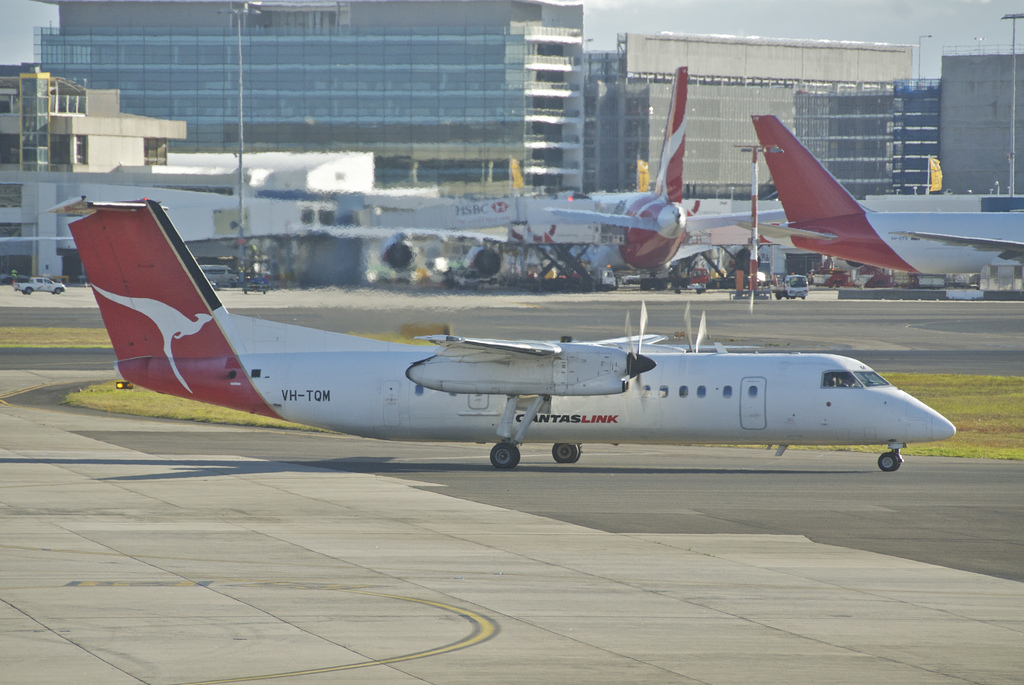
Qantaslink DH8C at Mildura on Feb 25th 2025, lined up with edge lights for takeoff
Last Update: May 12, 2026 / 12:20:28 GMT/Zulu time
Incident Facts
Date of incident
Feb 25, 2025
Classification
Report
Airline
Qantaslink
Flight number
QF-2077
Departure
Mildura, Australia
Destination
Melbourne, Australia
Aircraft Registration
VH-TQM
Aircraft Type
De Havilland Dash 8 (300)
ICAO Type Designator
DH8C
The ATSB released their final report concluding the probable causes of the serious incident were:
Contributing factors
- During line-up, the aircraft was taxied off the starter extension guidance line and the flight crew’s attention was diverted to completing the ready checks. This likely reduced their monitoring of the aircraft's position within the starter extension and resulted in it being positioned close to the right edge of runway 09.
- The flight crew commenced the take-off from a misaligned position resulting in damage to the aircraft and runway edge lights.
Other factors that increased risk
- The flight crew conducted a low pass to facilitate a visual inspection of the landing gear by air traffic control. There were no supporting procedures for the low pass or visual inspection, nor did the flight crew contact the operator to seek assistance.
- The presence of a prescription medication was detected in the captain's post-incident drug and alcohol test that was not prescribed for them. While they were unlikely to have been impaired by the medication, there was no assurance that the captain would not experience any adverse effects or impairment that may have impacted their ability to safely operate the aircraft.
The ATSB analysed:
Diverted attention
The starter extension included a taxi guideline that curved around towards the extended centreline. The guideline was likely visible to the crew as the flight data showed that the aircraft was taxied along the line from the time it entered the starter extension bypass pad until the time it commenced the right turn to line up on runway 09. The captain reported that, although their intention was to use the full length of the extension, it was not required and due to the dark, ambient conditions, they did not want to continue that plan and risk exiting the pavement. As such, they turned the aircraft early.
The flight crew reported that the ready checks were conducted while turning the aircraft to line up for departure. The Flight Crew Operating Manual stated that ready checks could be conducted at a time appropriate for the anticipated take-off. However, the manual did not provide any guidance as to when an appropriate time was during this process. Therefore, the decision was at crew discretion and dependent on the
circumstances at the time.
The FO and captain had predominantly focused their attention inside the flight deck while conducting the ready checks. The captain also reported becoming momentarily distracted looking out the side window. This was at a time when they would also be required to monitor the aircraft’s taxi path. The data showed that the aircraft was turned tightly to the right of the extended centreline and was no longer following the line markings for guidance.
Barshi and others (2009) discuss that it was easy for attention to become absorbed in one or more tasks, allowing another task to drop from awareness. Therefore, it can be concluded that, during the turn to line up, the flight crew's attention was diverted to completing the ready checks, likely reducing their monitoring of the aircraft position within the starter extension, and resulted in it being close to the edge of runway 09. This was consistent with the ATSB research report (2010), which discussed flight crews becoming focused on other tasks upon entering the runway or just prior to entering the runway, and that this was a frequently cited factor in misaligned take-off occurrences.
Misaligned take-off
Although not required for performance, using the starter extension allowed for additional take-off distance and a wider turn than was normally available at airports where the aircraft was mostly operated. However, as identified through ATSB research (2010) and related investigations, additional pavement on one or both sides of the runway has been known to provide erroneous visual cues for pilots. This potentially gives the impression that the additional pavement is part of the runway and that the runway is wider than it is.
Then, following completion of the ready checks and when the aircraft neared completion of the turn to line up, the captain reported being drawn to a row of white lights, believing them to be centreline lights, even though such lights were not fitted to runway 09. With reduced visual cues available due to the dark conditions, a distinct visual indicator such as the white runway edge lights was likely to have been an influence in their belief that it was the runway centreline. Such dark ambient conditions have been consistently cited in the research and similar occurrences. The FO reported looking up but also believed the aircraft was correctly lined up, having associated their observation of the runway threshold markings as being in the correct position to line up.
However, imagery of runway 09 in similar conditions to the incident flight did show that the runway threshold lights, edge lights and right side precision approach path indicator lights would have been visible to the crew from their line-up position. Confirmation bias is the tendency for people to seek information and cues that confirm their tentatively held hypothesis or belief (Wickens et al, 2022). As the flight crew believed they were correctly aligned with the runway centreline, they commenced the take-off roll.
Low pass
The flight crew noted no indications of a landing gear malfunction or failure, and the gear was retracted without issue following the misaligned take-off. They also received advice from the Mildura Airport aerodrome reporting officer that no aircraft parts or debris were identified along the runway. As the aircraft documentation did not provide guidance for such an incident, and to further assess the condition of the landing gear, the flight crew decided that a visual inspection via a low pass of the Melbourne Airport ATC tower was necessary.
The flight crew did not contact QantasLink operations for assistance regarding the landing gear or the conduct of the low pass. This prevented QantasLink from providing input into the decision-making process. Further, while a visual inspection (using binoculars) by ATC from the tower may give a general assessment of the landing gear, it was not likely to have identified specific damage that would have otherwise been visible at close proximity during a ground inspection.
A flight at low altitude, and at a low speed with the landing gear and flaps extended may introduce a number of risks. Notably, the low pass was conducted lower than the briefed low pass height. As this was not a procedure within the operations manuals, there was no assurance that all potential risks had been identified and mitigated.
Unauthorised/unsupervised use of prescription medication
Post-incident drug and alcohol screening of the flight crew detected the presence of a medication, which the captain reported was not prescribed to them. The medication had been taken in the days prior to the incident flight, and although the substance was above the permitted threshold for detection, the results could not be used to assess any level of impairment. Independent analysis by a forensic pharmacologist indicated any effects from the medication could not be completely ruled out, however, impairment was not expected given the reported dosage and time elapsed.
The medication taken could only be dispensed with a prescription, and its consumer medicine information sheet highlighted this requirement and several cautions and potential side effects. Although it was a strictly controlled, commercially produced medication, the absence of medical supervision meant there was no assurance that the captain would not experience any adverse effects or impairment that may have impacted their ability to safely operate the aircraft.
Incident Facts
Date of incident
Feb 25, 2025
Classification
Report
Airline
Qantaslink
Flight number
QF-2077
Departure
Mildura, Australia
Destination
Melbourne, Australia
Aircraft Registration
VH-TQM
Aircraft Type
De Havilland Dash 8 (300)
ICAO Type Designator
DH8C
This article is published under license from Avherald.com. © of text by Avherald.com.
Article source
You can read 2 more free articles without a subscription.
Subscribe now and continue reading without any limits!
Read unlimited articles and receive our daily update briefing. Gain better insights into what is happening in commercial aviation safety.
Send tip
Support AeroInside by sending a small tip amount.
Related articles
 Fleet type match
Jetstar NZ DH8C near Auckland on Oct 13th 2019, engine shut down in flight
A Jetstar New Zealand de Havilland Dash 8-300, registration VH-TQM performing flight JQ-384 from Palmerston North to Auckland (New Zealand) with 47…
Fleet type match
Eastern Australia DH8C at Adelaide on Apr 24th 2015, obstacle proximity warning on approach to Adelaide
An Eastern Australia de Havilland Dash 8-300 on behalf of Qantas, registration VH-TQM performing flight QF-2274 from Port Lincoln,SA to Adelaide,SA…
 Fleet type match
Eastern Australia DH8C at Sydney and Tamworth on Jun 17th 2014, blew a tyre on takeoff
An Eastern Australia de Havilland Dash 8-300 on behalf of Qantas, registration VH-TQM performing flight QF-2034 from Sydney,NS to Armidale,NS…
 Fleet type match
Qantaslink DH8D near Townsville on Apr 20th 2026, rudder problems
A Qantaslink de Havilland Dash 8-400 on behalf of Qantas, registration VH-QOW performing flight QF-2472 from Townsville,QL to Mount Isa,QL…
Newest articles
Transair B735 at Nouakchott on Sep 10th 2026, runway excursion
A Transair Boeing 737-500, registration 6V-AJD performing charter flight R2-4401 from Dakar (Senegal) to Nouakchott (Mauritania) carrying the soccer…
Sepehran B733 at Mashhad on Sep 14th 2026, rejected takeoff due to severe vibrations
A Sepehran Boeing 737-300, registration EP-FSU performing flight SHI-4358 from Mashhad to Kermanshah (Iran), was accelerating on Mashhad's runway 31L…
Subscribe today
Are you researching aviation incidents? Get access to AeroInside Insights, unlimited read access and receive the daily newsletter.
Pick your plan and subscribePartner

ELITE Simulation Solutions is a leading global provider of Flight Simulation Training Devices, IFR training software as well as flight controls and related services. Find out more.
SafetyScan Pro provides streamlined access to thousands of aviation accident reports. Tailored for your safety management efforts. Book your demo today
AeroInside Blog
Popular aircraft
Airbus A320Boeing 737-800
Boeing 737-800 MAX
Popular airlines
American AirlinesUnited
Delta
Air Canada
Lufthansa
British Airways