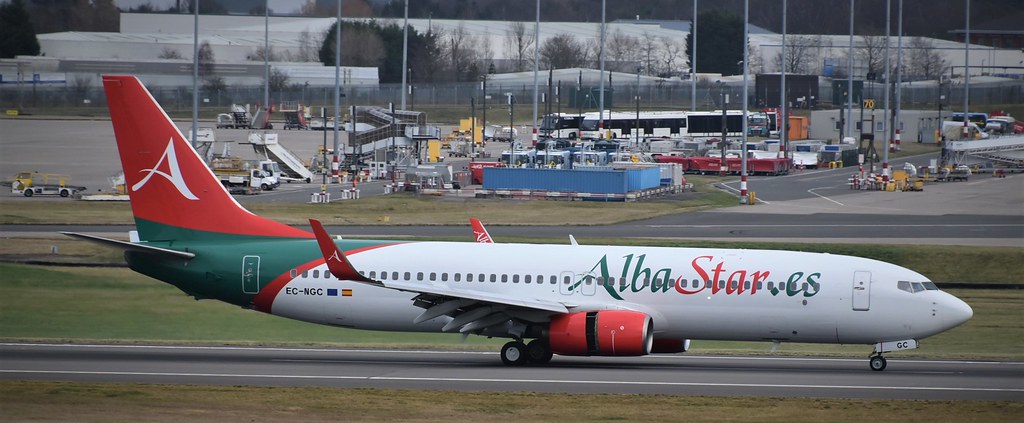
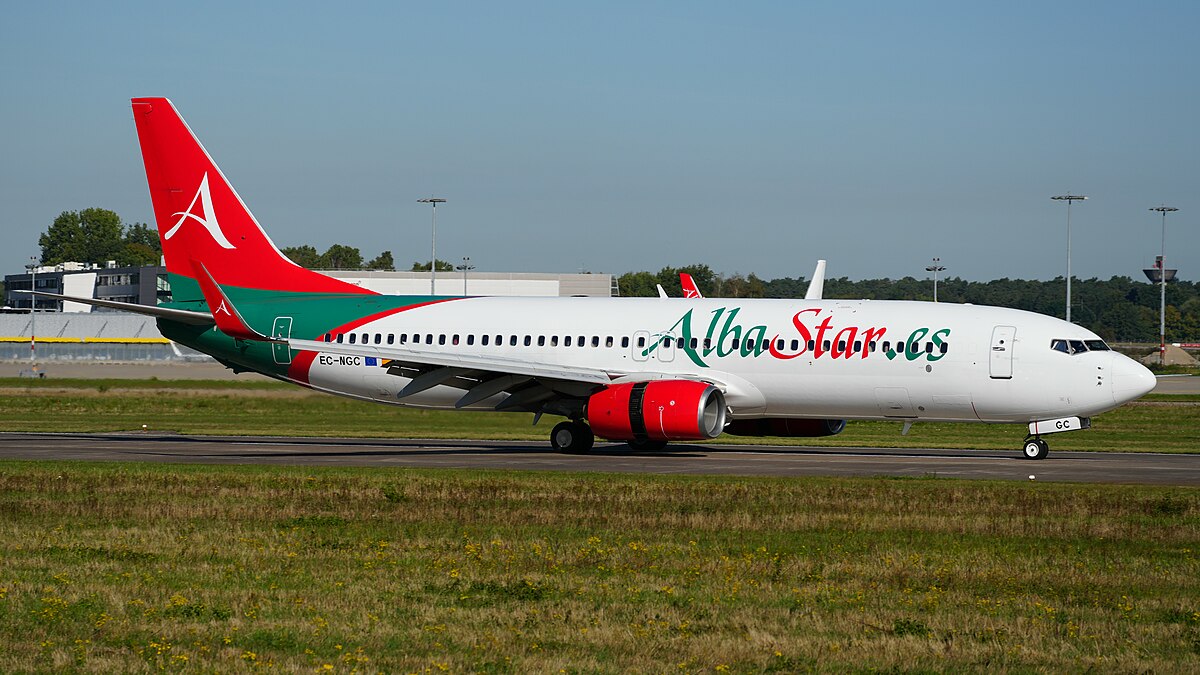
Albastar B738 near Paris on Jul 21st 2023, radar contact lost for 20 minutes, loss of separation as result
Last Update: December 10, 2025 / 16:38:02 GMT/Zulu time

Incident Facts
Date of incident
Jul 21, 2023
Classification
Incident
Airline
Albastar
Flight number
AP-4651
Departure
London Stansted, United Kingdom
Destination
Lourdes, France
Aircraft Registration
EC-NGC
Aircraft Type
Boeing 737-800
ICAO Type Designator
B738
An Air France Embraer ERJ-190, registration F-HBLD performing flight AF-1476 from Paris Charles de Gaulle (France) to Bilbao,SP (Spain), was enroute at FL350 in close proximity while the B738 was invisible on the radar due to their transponder not transmitting.
The aircraft remained on the ground in Lourdes for 2.5 hours, then departed for the return flight.
The French BEA reported they rated the occurrence a serious incident and opened an investigation. While the aircraft was in contact with the air traffic control center Brest radar contact was lost, an Air France Flight (AF-1476) reported they had passed the "lost" flight at the same flight level at less than 3nm distance.
On Dec 10th 2025 the BEA released their final report concluding the probable causes of the serious incident were:
While cruising at FL 350, the transponder on the Boeing 737-809 operated by Albastar, flight LAV4651, experienced a failure, which meant that both nearby aircraft were not able to detect it and that its correlated radar track was no longer being tracked and no longer being displayed. The air traffic controllers in ACC/west in charge of the sector in which the aeroplane was flying did not perceive the loss of radar contact, which was indicated by various warning systems. These included a track marker, which they deleted without first analysing the information available to them. This action resulted in a loss of awareness of the flight in the control sector for which they were responsible. The crew, for their part, did not detect the transponder failure and continued on their flight plan route without reporting their position by radio at the compulsory reporting point. The crew entered the ACC/south-west airspace without radio or radar contact. A few minutes later, the aeroplane crossed paths with an Embraer 190, at a distance of 2.6 NM and at the same flight level. The crew of this aeroplane saw the Boeing 737 pass in front of them, with no TCAS information displayed. The crew of the Boeing 737, for their part, saw a white diamond on their screens advising of the presence of the Embraer 190 and indicating that there was no risk of collision.
Radio and radar contact with flight LAV4651 was re-established by means of the Embraer 190 crew, visual detection without a targeted search by military controllers in Cinq-Marc-La Pile CDC, and numerous telephone exchanges between ACC/south-west, ACC/west and the CDC.
Beyond these findings, the loss of separation between the two aeroplanes during cruise flight can be explained by a set of measures intended to reduce the risk of errors, which did not function as expected and did not ensure flight safety.
The following factors may have contributed to the two aeroplanes following conflicting flight paths in RVSM airspace without radar contact:
- insufficient margins taken into account when designing the transponder model, with respect to the heat dissipation requirements of a transponder component;
- a system to alert the crew and inform them of a transponder malfunction or failure, which relies solely on an amber indicator light located outside the primary field of view of both pilots, requiring a deliberate movement of the head in order to see that it has illuminated;
- insufficient certification specifications relating to indications of non-functioning or failure of transponders and in force at the time of the certification of the Boeing 737-800;
- the display of identical alerts (“track markers”) for different levels of criticality to attract the attention of air traffic controllers;
- the routine which had set in based on the frequency of “track markers” related to noncritical situations, which may lead air traffic controllers to delete them without a comprehensive analysis of the information available on their screens;
- the handling of safety events by the DSNA, which did not identify all the threats and risk situations with a view to establishing technical and operational mitigation measures;
- the limitations of the compulsory position reporting points provided for in the regulatory texts.
The BEA analysed:
In airspace where the use of a transponder is mandatory, an aircraft flying without radar contact, due to a total or partial failure of the active transponder, will affect both the safety level (increased risk of loss of separation between aircraft and as a consequence, mid-air collisions) and the security level.
In the event of an operating fault, the transponder can detect the anomaly itself and activate the alert system to warn the crew of the malfunction. Surveillance by the ground radar stations also generates alerts for air traffic controllers in the event of a transponder malfunction. According to the crew of the Boeing 737 operated by Albastar, the ATC FAIL light situated between the two crew seats did not illuminate to indicate the transponder failure. The two air traffic controllers responsible for the sector in which the Boeing 737-809 was flying did not perceive the successive alerts which were displayed over a period of approximately ten seconds and characteristic of a radar track ageing mechanism. They then deleted the track marker around three minutes after it appeared which, based on other information available on their interfaces, could have enabled them to determine that there was a loss of radar contact and therefore probably, a transponder failure on the Boeing 737-809.
The crew thus continued their route specified in the flight plan without being aware of the transponder failure. The air traffic controllers of the ACC/west sector forgot that they had this flight to manage in their sector and never identified that a flight had disappeared from their sector after deleting the track marker. It should be noted that the TCAS of the Boeing 737 operated by Albastar would have been able to transmit traffic and resolution advisories according to the loss of separation with nearby aircraft equipped with a transponder in operation, in particular with the Embraer 190 operated by HOP! The minimum distance between the two aeroplanes, then at the same flight level, was 2.6 NM for a regulatory minimum separation of 5 NM. The partial failure of the transponder of the Boeing 737 meant that the Embraer 190 TCAS could not detect and track this aircraft, and the transmission of a resolution advisory by the Boeing 737 TCAS would therefore not have been coordinated with the Embraer 190 TCAS.
The detection by military controllers in Mars-La-Pile CDC and the information message from the crew of the Embraer 190 operated by HOP! who saw the Boeing 737 operated by Albastar pass in front of them, meant that, after numerous coordination actions between the various control centres, radio and radar contact was recovered with the crew of the Boeing 737. They were able to continue their flight.
Cause of the transponder failure and measures taken The failure of the transponder selected by the crew during the serious incident flight stemmed from a malfunction of a component (transistor) used in the +50 V DC power supply system, which provides the energy required to transmit transponder messages (squitters and replies). This fault was caused by insufficient consideration given to the thermal dissipation margins of the component chosen when designing the transponder (see paragraphs 1.6.1.3.5 and 1.6.1.3.6). As a result of this fault, the transponder did not transmit any Mode S squitters or replies to interrogations. However, the transponder continued to operate partially during the flight, receiving messages from ground stations and nearby aircraft transponders.
The transmission by the Boeing 737 TCAS of periodic long uplink messages (see paragraph 1.9.2), as well as the statements made by the aircraft's crew who saw traffic information on the navigation displays, show that the Boeing 737 TCAS automatic monitoring software considered that its level of operation and performance was not affected by the malfunctioning transponder which continued to send it the mode S messages it received from nearby aircraft. In other words, despite its partial failure, the transponder had the possibility of transmitting TA and RA if necessary, but without coordination with the TCAS of other aircraft to determine complementary evasive manoeuvres. Simulations carried out by Eurocontrol based on the Boeing 737 and the Embraer 190 flight paths confirmed the TCAS displays seen by the Albastar crew, and the absence of any need to activate a TA or a RA.
On the other hand, the TCAS of the aircraft in the vicinity of the Boeing 737 were unable to detect its presence due to its transponder not transmitting Mode S messages (squitters and replies), which for these aircraft, was equivalent to the transponder not operating. This was why the HOP! crew were surprised to see the Boeing 737 pass so close in front of them without it being displayed on the TCAS.
Several operators had reported similar transponder failures to Honeywell which led to the issue of a service bulletin to replace an internal electronic component. The service bulletin was issued in August 2023, one month after the serious incident, independently of the latter (see paragraph 1.6.1.3.6). At the date of publication of this report, no other similar in service report had been made to Honeywell.
The design fault identified by Honeywell confirms that demonstrations to meet specifications for equipment certification and approval are based on a certain number of accepted assumptions such as failure mode predictions (effects and probabilities of occurrence) or the reliability of equipment components (as was the case for the transistor). The limits of these assumptions mean that all the associated risks before the equipment is put into service cannot be determined, and are often identified by experience. In the case of the transponders, notifications to the equipment manufacturer by operators, via flight crews, and by air traffic controllers, as well as Eurocontrol's monitoring of the 1,030 and 1,090 MHz frequencies in Europe as network manager (see paragraph 1.9.2), facilitate the rapid and effective implementation of corrective measures to guarantee a level of safety in line with applicable certification requirements.
Systems to attract crew attention in event of a transponder failure The examinations carried out on the transponders of the Boeing 737 during the investigation found that the partial transponder failure was detected by the transponder's internal monitoring function, which generates the signal to illuminate the ATC FAIL light on the ATC Control Panel located between the two crew seats. However, it cannot be affirmed that the light was indeed illuminated during the serious incident flight given that the transponders were removed from the aircraft several flights after the serious incident, and that the crew reported that they had not seen the ATC FAIL light illuminated.
Whether or not the light was illuminated, the crew (like others before them, see paragraphs 1.17.8.4.3 and 1.18.5) were unaware of the partial transponder failure. If the transponder failure had been total, the aeroplane’s TCAS would also have detected it through its internal monitoring function. The ATC FAIL light would have illuminated, the TCAS FAIL message would have been displayed on the navigation display, and the display of the traffic in the vicinity of the aeroplane would have been lost. The combination of these warning systems would have increased the probability of the crew detecting and managing the abnormal situation. In the case of the serious incident to EC-NGC, the partial transponder failure may only have been shown by the illumination of the ATC FAIL light.
Furthermore, before being transferred to another sector after recovering radar contact, the crew of flight LAV4651 were informed that radar contact had been lost for some time. They did not understand the exchanges in French between the PCR of the ACC/south-west sector and the crew of flight AFR21YB concerning the loss of separation and the loss of radar contact with the 737.
The crew then continued to their destination. The crew did not report the transponder failure in the TLB at the end of the flight. This may be explained by the fact that the crew had not seen if the ATC FAIL light was illuminated in flight, and that the ground checks of the TCAS and associated transponder before the following flight (transponder 1, not the one used on the serious incident flight) did not reveal anything. The PCR provided limited information to the crew of flight LAV4651 about the magnitude of the past situation which may also have limited their awareness of the risk and consequences associated with the transponder failure during the flight.
Current certification specifications for flight crew alerting systems (CS 25.1322, see 1.17.1.3) require perception by at least two different senses, based on a combination of aural, visual or tactile alerts. Visual elements to attract the attention should be in the pilots’ primary field of view. Based on these specifications, and if it is considered that the ATC FAIL light illuminated during the flight, the lack of detection of the partial transponder failure can be explained by:
- the position of this light, between the two crew seats, and therefore outside the primary field of view of the two pilots, which requires a head movement and a voluntary action to envisage detection of the ATC FAIL light;
- the ATC FAIL light not being associated with another signal.
The installation of the TRA 100B transponder on the Boeing 737 was not considered a major modification requiring an evolution of the certification basis for these aeroplanes, taking into account new requirements such as those relating to crew alerting systems.
The FAA circular (Boeing's aircraft certification authority), which aims to guide type certificate
holders in the certification process for TCAS II and Mode S transponder installations on board
aircraft (see paragraph 1.17.1.2), recommends in particular, that alerts in the event of a transponder failure should be in the pilot's primary field of view (see 1.17.1.3) and associated with the aircraft's primary caution and warning system. These provisions correspond to AMC and concern only “new installations”, for aircraft not already equipped with Mode S transponders or TCAS II or of new design.
At the date of publication of the report, the installation of a new type of transponder did not constitute a modification subject to compliance with the certification specifications applicable at the date of the request for this modification, or coming into force subsequently if the design organization so wishes (see paragraph 1.17.1.2), in particular those relating to flight crew alerting systems (CS 25.1322, see paragraph 1.17.1.3). The FAA circular also indicated that compliance with new requirements when installing new types of transponders, particularly those relating to flight crew alerting systems, can be complex due to the limitations of the alert systems already installed on aircraft, possible functions to be added, and economic considerations.
The European certification specifications for the installation and certification of transponders (CS-ACNS, see paragraph 1.17.1.2) are applicable to new aircraft and to those undergoing modifications which require the application of these specifications. They do not apply to the installation of new types of transponder. They require that the non-operation or failure of a transponder be indicated, without delay and without the need for crew intervention. There are no other details on how to alert a crew in the event of a transponder not operating or failing.
The serious incident on 21 July 2023, like others (see paragraphs 1.17.8.4.3 and 1.18.5), illustrates the risk of a mid-air collision or a collision with the ground due to a transponder malfunction transmitting erroneous information. This risk is currently being assessed by EASA in the scope of the safety issues relating to air navigation of the European Plan for Aviation Safety (EPAS) (see paragraph 1.9.5).
Requirements relating to systems for alerting crews in the event of a transponder failure are the subject of a safety recommendation (see paragraph 5.1).
Management of loss of radar contact by air traffic controllers
Context when radar contact was lost
Several messages and symbols relating to updates of radar track information for flight LAV4651 (see paragraph 1.17.3.7) and intended to attract the attention of air traffic controllers, were displayed on the label for this flight due to the absence of replies from the aeroplane's transponder to interrogations issued by ground radar stations.
These alerts were not perceived by the pair of controllers in charge of the sector in which the aeroplane was flying. Similarly, the track marker and the “Flights without track” window, characteristic of a loss of radar contact (see paragraphs 1.17.3.6 and 1.17.3.7) were not perceived at first. All of these alerts appeared on the controllers' screens for a period of four to five minutes during which no messages were transmitted on the radio frequency and no mouse movements were recorded in the positions of the two controllers.
This absence of messages and mouse movements is characteristic of a low workload, confirmed by the two air traffic controllers of the sector and by the low traffic in the sector. This period of a low workload came after several busy sequences for the PCR since he started his shift at 04:30.
The period of a low workload probably had the effect of reducing the pair's level of vigilance and degrading their monitoring task, including the scan of their sector. Both controllers confirmed this and stated that they had been talking during this period of a low workload. However, as there was no recording of the aural environment at the air traffic controllers' workstations, it was not possible to accurately assess the pair's activity during this period of a low workload. This lack of recording also meant that it was not possible to identify any indicators of behaviour that could affect human activity, such as fatigue: the PCR had gotten up early after approximately 4.5 to 5 hours of sleep, after a period of six days of rest (a situation that can contribute to falling asleep late and making an early wake-up difficult). He had also started his shift with periods of heavy traffic.
The DGAC has updated an order (see paragraph 1.9.6) which stipulates that the DSNA must equip its units with systems for recording background communication and the aural environment from February 2026, in accordance with ATS.OR.460 of Regulation (EU) 2017/373.
...
Incident Facts
Date of incident
Jul 21, 2023
Classification
Incident
Airline
Albastar
Flight number
AP-4651
Departure
London Stansted, United Kingdom
Destination
Lourdes, France
Aircraft Registration
EC-NGC
Aircraft Type
Boeing 737-800
ICAO Type Designator
B738
This article is published under license from Avherald.com. © of text by Avherald.com.
Article source
You can read 2 more free articles without a subscription.
Subscribe now and continue reading without any limits!
Read unlimited articles and receive our daily update briefing. Gain better insights into what is happening in commercial aviation safety.
Send tip
Support AeroInside by sending a small tip amount.
Related articles
 Fleet type match
Albastar B738 near Rome on Jul 22nd 2023, loss of cabin pressure
An Albastar Boeing 737-800, registration EC-MUB performing flight AP-3975 from Verona (Italy) to Marsa Alam (Egypt), was enroute at FL310 about 70nm…
Newest articles
 Fleet type match
Smartwings B738 near Athens on Feb 27th 2026, temporary loss of right engine thrust
A Smartwings Boeing 737-800, registration OK-TSF performing flight QS-1240 from Prague (Czech Republic) to Hurghada (Egypt), was enroute at FL370…
 Fleet type match
Smartwings B38M near Valencia on Jan 29th 2026, engine problem
A Smartwings Boeing 737-8 MAX, registration OK-SWN performing flight QS-1213 from Tenerife South,CI (Spain) to Prague (Czech Republic), was enroute…
Subscribe today
Are you researching aviation incidents? Get access to AeroInside Insights, unlimited read access and receive the daily newsletter.
Pick your plan and subscribePartner

ELITE Simulation Solutions is a leading global provider of Flight Simulation Training Devices, IFR training software as well as flight controls and related services. Find out more.
SafetyScan Pro provides streamlined access to thousands of aviation accident reports. Tailored for your safety management efforts. Book your demo today
AeroInside Blog
Popular aircraft
Airbus A320Boeing 737-800
Boeing 737-800 MAX
Popular airlines
American AirlinesUnited
Delta
Air Canada
Lufthansa
British Airways