JAC AT42 at Kagoshima on Jan 8th 2022, cleared to land, instructed to go around due to runway incursion
Last Update: July 10, 2026 / 17:22:59 GMT/Zulu time
Incident Facts
Date of incident
Jan 8, 2022
Classification
Incident
Airline
Japan Air Commuter
Flight number
3X-3653
Departure
Fukuoka, Japan
Destination
Kagoshima, Japan
Aircraft Registration
JA04JC
Aircraft Type
ATR ATR-42
ICAO Type Designator
AT42
Japan's TSB opened an investigation into the occurrence.
On Jul 10th 2026 the JTSB released their final report concluding the probable causes of the serious incident were:
The JTSB concludes that the probable cause of this serious incident was certainly that Aircraft A, which had been instructed to hold short of the runway, entered the runway, when Aircraft B was cleared to land on the runway.
The reason why Aircraft A, which had been instructed to hold short of the runway, entered the runway is because Trainee A most likely inferred from the ATC instructions that Trainee A had received a clearance of entering the runway, which Trainee A had expected while unable to understand the holding instruction.
The JTSB analysed:
(1) Response of Trainee A
The JTSB concludes that Aircraft A certainly entered the runway despite of being instructed by Tower C and Tower D to hold short of the runway.
Trainee A was certified as having aeronautical skills required for solo flight in checkrides with flight instructors in the Company, but Trainee A was sometimes pointed out the failure of confirmation such as missing to hear ATC instructions or unable to understand the contents of ATC instructions. In addition to this, when the serious incident occurred, Trainee A misunderstood the ATC instructions during taxiing, and failed to confirm the contents of ATC instructions with the Controller despite of being unable to understand them, therefore it is highly probable that Trainee A did not fully master the skills for radio communication with the Controllers at a hightraffic airport like the Airport. As Trainee A himself admitted not to be good at radio communication with the Controllers, Trainee A more likely felt pressure not to miss to hear the instructions and clearances from Tower C. Therefore, skipping the step “To make sure to confirm with the Controller about the instructions when not understanding them”, without understanding the Tower C’s instruction to hold short of the runway, Trainee A most likely figured that Trainee A had received an instruction equivalent to “LINE UP AND WAIT” which Trainee A was expecting.
Furthermore, Trainee A was unable to monitor radio communications between Aircraft B and the Controllers, and as seeing Aircraft B's preceding arriving aircraft land, Trainee A most likely thought that there would be no subsequent arriving aircraft after that. For that reason, it is highly probable that although Aircraft A was instructed to hold short of the runway, Trainee A inferred the ATC instructions failing to correctly understand its situation (sequence of the runway use) where the Aircraft was placed, and entered the runway. In addition, Trainee A likely expected there would be points-out from the Controller if his aircraft’s movement had not been in accordance with the ATC instruction. Without confidence in the understanding of the ATC instructions, Trainee A should not have entered the runway by inferring them.
(2) Trainings for radio communications before the solo flight
By the time this serious incident occurred, Trainee A had made three solo flights and there were no particular problems in the radio communications. In the flight training with an instructor on board, there was also no problem in radio communications related to runway line-up and holding short of runway. In addition, in the familiarization flight made before the solo flight on the day of the serious incident, there were also no problems in radio communications. Therefore, Captain A certified that there were no problems for Trainee A to make solo flight. However, the JTSB concludes that as seen in this serious incident, Trainee A was inclined to stay silent without confirming them with the Controller when Trainee A was unable to understand the contents of the ATC instruction, therefore, especially in order to improve this point, before the solo flight, probably Captain A should have provided Trainee A with simulation exercises and trainings assuming such a case where there is a discrepancy in radio communications between Trainee A and the Controller.
The Company more likely thought that it would be more effective to select and teach only minimum phraseologies required for flight trainings at the Airport, rather than all of the ATC phraseologies specified in the ATC Standard. However, it is absolutely essential for student pilots to be able to correctly understand and use the instruction of holding short of runway and all relevant ATC phraseologies. The Company had checked whether or not the student pilots had radio communication skills necessary for solo flight not by confirming them separately but through their radio communication with the Controllers during flight training with a flight instructor on board. However, as the traffic volume at the Airport is large, in some cases, the ATC instructions and clearances expected by the aircraft may not be issued immediately. Therefore, when granting a solo flight to the student pilot, it is important for the Company to ensure to confirm and certify the students' aeronautical skills required for the solo flight, especially those for all the radio communication with the Controller that could be assumed at the time of the runway use.
(3) Response of Tower C
JTSB concludes that as Tower C recognized Aircraft A was flying solo, and had been listening to the radio communication between Tower D and Aircraft A since before taking over the duty, Tower C more likely gave consideration to the radio communications in order not to put a burden on Aircraft A.
On the other hand, it is desirable for the Civil Aviation Bureau to continue to deliberate how to deliver easy-to-understand ATC communications, using this serious incident as a case study, and considering not only the aircraft operators inexperienced in ATC communications but also the circumstances where a diversity of aircraft operators exist.
(4) Classification of Severity
The JTSB concludes that the distance between Aircraft A and Aircraft B was most likely approximately 2,160 m (about 1.17 nm), when Aircraft B was instructed by Tower C to go around and started to climb.
The serious incident certainly falls under the severity classification of Category C (An incident characterized by ample time and/or distance to avoid a collision) of "the Manual on the Prevention of Runway Incursions" of ICAO with classification tools provided by ICAO.
Incident Facts
Date of incident
Jan 8, 2022
Classification
Incident
Airline
Japan Air Commuter
Flight number
3X-3653
Departure
Fukuoka, Japan
Destination
Kagoshima, Japan
Aircraft Registration
JA04JC
Aircraft Type
ATR ATR-42
ICAO Type Designator
AT42
This article is published under license from Avherald.com. © of text by Avherald.com.
Article source
You can read 2 more free articles without a subscription.
Subscribe now and continue reading without any limits!
Read unlimited articles and receive our daily update briefing. Gain better insights into what is happening in commercial aviation safety.
Send tip
Support AeroInside by sending a small tip amount.
Related articles
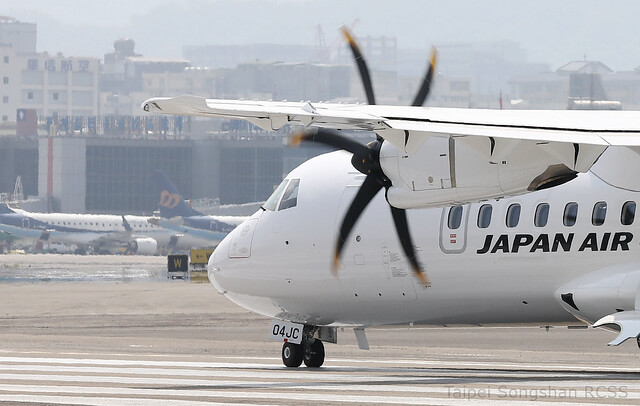
JAC AT42 near Osaka on Feb 15th 2022, upset injures passenger
A JAC Japan Air Commuter Avions de Transport Regional ATR-42-600, registration JA04JC performing flight JL-2326 from Tajima to Osaka (Japan), was…
JAC AT42 at Amami on Jan 5th 2026, hydraulic failure
A JAC Japan Air Commuter Avions de Transport Regional ATR-42-600, registration JA04JC performing flight JL-3837 from Amami O Shima to Kikaiga Shima…
Japan Commuter AT42 at Kagoshima on May 23rd 2024, windshield seals peeled off
A Japan Air Commuter Avions de Transport Regional ATR-42-600 on behalf JAL Japan Airlines, registration JA04JC performing flight JL-3801 from…
Japan Commuter AT42 near Kagoshima on Oct 12th 2019, upset causes injury to flight attendant
A Japan Air Commuter Avions de Transport Regional ATR-42-500, registration JA01JC performing flight JC-3763 from Kagoshima to Tanegashima (Japan),…
JAC DH8D at Tokyo and Oki Island on Jul 30th 2014, 29 sumo wrestlers on board
A Japan Air Commuter de Havilland Dash 8-400, registration JA844C performing flight 3X-2331 from Osaka Itami to Oki Island (Japan), managed to carry…
Japan Air Commuter DH8D near Fukuoka on Aug 8th 2012, engine shut down in flight
A Japan Air Commuter de Havilland Dash 8-400, registration JA846C performing flight 3X-3625 from Fukuoka to Miyazaki (Japan) with 55 people on board,…
Newest articles
Delta B752 at Atlanta on Aug 8th 2026, fumes on flight deck
A Delta Airlines Boeing 757-200, registration N555NW performing flight DL-2204 from Atlanta,GA to Orlando,FL (USA) with 199 passengers and 6 crew,…
United B738 at San Francisco on Aug 6th 2026, tyre damage on departure
A United Boeing 737-800, registration N76504 performing flight UA-1189 from San Francisco,CA (USA) to San Jose del Cabo (Mexico), was climbing out of…
Subscribe today
Are you researching aviation incidents? Get access to AeroInside Insights, unlimited read access and receive the daily newsletter.
Pick your plan and subscribePartner
ELITE Simulation Solutions is a leading global provider of Flight Simulation Training Devices, IFR training software as well as flight controls and related services. Find out more.
SafetyScan Pro provides streamlined access to thousands of aviation accident reports. Tailored for your safety management efforts. Book your demo today
AeroInside Blog
Popular aircraft
Airbus A320Boeing 737-800
Boeing 737-800 MAX
Popular airlines
American AirlinesUnited
Delta
Air Canada
Lufthansa
British Airways