Vietnam B789 at Munich on Aug 15th 2026, late rotation, tailstrike, runway overrun, tyre damage
Last Update: September 29, 2026 / 12:07:50 GMT/Zulu time
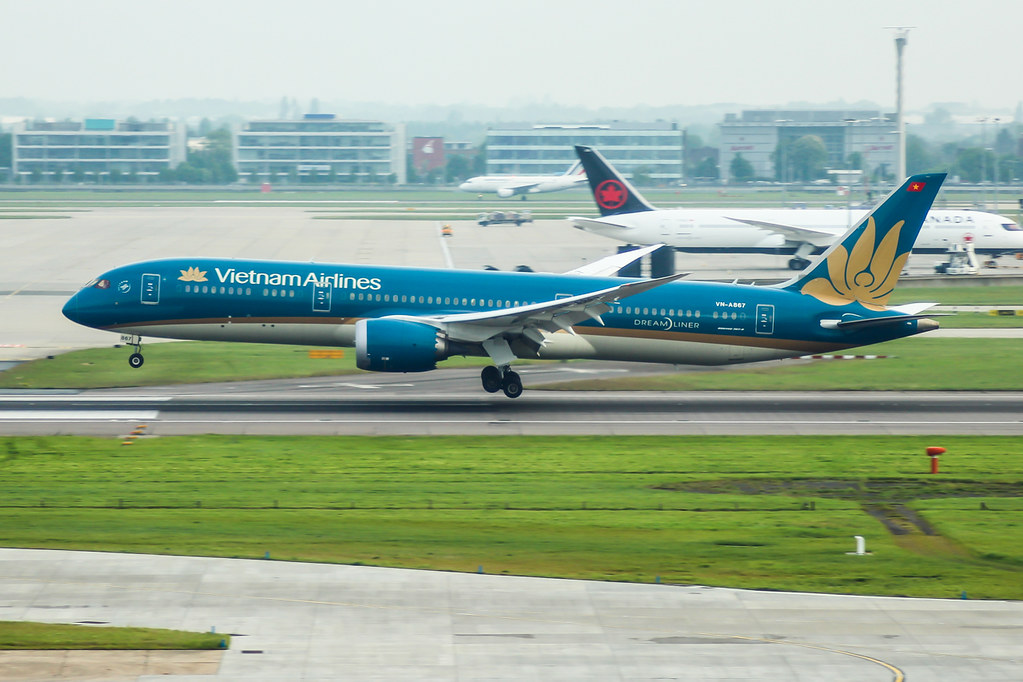
Incident Facts
Date of incident
Aug 15, 2026
Classification
Accident
Airline
Vietnam Airlines
Flight number
VN-34
Departure
Munich, Germany
Destination
Hanoi, Vietnam
Aircraft Registration
VN-A867
Aircraft Type
Boeing 787-9 Dreamliner
ICAO Type Designator
B789
Airport ICAO Code
EDDM
According to preliminary information the aircraft overran the end of the runway and damaged runway lights.
According to photographic evidence available to the AVH (but not permitted to be released to the public) the aircraft became airborne about 120 meters/400 feet past the runway end, already in the grass and at about the first row of approach lights.
On Aug 16th 2026 the AVH got to see video evidence (but is not permitted to release the video to the public), that suggests the right hand main gear brakes activated about 210 meters ahead of the runway end, the wheels blocked at and after crossing the runway end, the track ended when the aircraft became airborne. The video does not permit to see enough of the left hand side of the runway to judge, whether the left hand brakes came on or blocked, too.
An Aerial photo (see below) received on Aug 17th 2026 shows, that both left and right hand brakes were active before reaching the end of the runway, the left hand track faded after crossing the runway end.
On Aug 17th 2026 Vietnam's Civil Aviation Authority submitted a report to the Ministry stating that after takeoff the crew received warning indications of a tail strike and tyre pressure warnings. The crew returned to Munich for a technical inspection. The passengers were provided with alternative travel options. Germany's BFU is going to investigate the occurrence.
On Aug 18th 2026 Germany's BFU reported in a first statement, that they are investigating the occurrence. The aircraft departed runway 26L, rotated very late, the tail contacted the ground during rotation. Tyre tracks were identified at the end of the runway that were attributed to the aircraft. The aircraft landed on runway 26R. The flight data and cockpit voice recorder are to be downloaded and analysed by the BFU and will take some more time.
On Sep 11th 2026 the BFU reported the aircraft sustained substantial damage, the accident is being investigated by the BFU.
On Sep 29th 2026 Germany's BFU released their preliminary report summarizing the sequence of events:
At 11:53:57 UTC, the flight crew received the clearance from the tower controller to line up on runway 26 L. At 11:55:47 UTC, the flight crew received take-off clearance.
At 11:56:12 UTC, the Take-Off / Go-Around mode for the take-off run was activated.
At 11:56:15 UTC, the EAFR recorded rudder pedal input from the two left-hand-seat pedals.
Also, at 11:56:15 UTC, the EAFR recorded brake pedal movement of the two left brake pedals. About abreast of the intersection with taxiway B4 tire tracks of the wheels of the aircraft’s two main landing gears were identified. The braking activation of the Braking System Control Units (BSCUs) was 15% on the left and 6% on the right side.
At 11:57:03 UTC, IAS (EAFR parameter: Airspeed_Comp_Vtd (kn)) was for about 18 s at about 168 kt IAS. Short speed deviations downwards and then back to the original speed were recorded. Another braking activity via the brake pedals and the brakes were recorded during the take-off run. The maximum recorded brake pedal position reported was 7.2° (range: 0° to 12.5°). The EAFR parameter of the left BSCU inboard and outboard channels, at 11:57:12 UTC, had a maximum value (brake application / command) of about 27 %. The maximum value of the right BSCU inboard and outboard was 17 %.
At 11:57:13 UTC, shortly before rotation, the PM increased engine thrust manually from 100 % N1 to 101 % N1.
At 11:57:14 UTC rotation occurred at 163 kt IAS about abreast of the threshold. Pitch angle (EAFR parameter: Pitch_PFD_L (degree)) reached a maximum of 6.88° at the air to ground transition. The Angle of Attack (AOA, EAFR parameter: AOA_Vane_R1_FCM (degree)) reached 6.89°. A pull on the left-hand control column of +93 converted units was recorded (range: -279 to +279).
The aircraft lifted off from the grass area beyond threshold runway 08 R. The tire tracks led beyond the threshold and the 60-meter-long clearway behind it. They ended about 240 m beyond the threshold 08 R in the grass. The tail section and the wheels of both main landing gears collided with parts of the approach lighting.
At 11:57:19 UTC, the speed V1 = 169 kt IAS was reached at 11 ft RA.
At 11:57:20 UTC, at 15 ft Radio Altimeter (RA), pitch angle was 12.2° and AOA 14°.
At 11:57:21 UTC, the leading edge slats extended to the fully extended gap position as the result of automatic stall protection (EAFR-Parameter: Stall_Protection_Mode_FCM).
At 11:57:22 UTC, the EAFR recorded activation of the Take-Off / Go-Around mode (TOGA, EAFR parameter TOGA_SW_VOTED_FCM).
At 11:57:24 UTC, at 76 ft RA, the airspeed V2 of 180 kt IAS was reached, at the same time the landing gear was retracted.
At 11:57:29 UTC, the EAFR recorded the parameter “TAIL_STRIKE”.
At 12:00:49 UTC, the flight crew reported: “[Callsign] äh pan pan pan pan [callsign] äh three disregard pan pan [callsign] three four we request äh maintain seven thousand feet a radar vector to dump fuel äh we expect come back äh äh.“
At 12:16:52 UTC, the flight crew reported: “[Callsign] äh three four for your information now we are […] is a technical problem we expect to dump fuel in about äh maybe in about ten minutes time and then because we have a tire pressure on landing so we expect your assistance on ground for full assistance maybe […] exactly important I give you later thank you.”
The air traffic control unit cleared climb to Flight Level (FL) 100. The flight crew requested to level off at FL 90. When reaching 9,000 ft, the PF was replaced by the PIC, who was then PF.
Then the air traffic control unit issued the clearance to dump fuel. At the time, the flight crew received radar vectors. At 12:22 UTC, this process began at FL 90 and ended at 13:07 UTC. At the time, the flight crew reported: “Yes äh the situation is äh we have ähm we expect a flat tire on the on the take-off.“ A total of 62 t fuel were dumped.
The first approach to runway 26 R was performed with the main landing gear extended so that ground personnel could visually inspect the landing gear. At 5,000 ft AMSL, a go-around was initiated and the landing gear retracted. At 13:29 UTC, the second approach was performed also with the main landing gear extended. At 2,600 ft AMSL, a go-around was initiated and the landing gear retracted again.
Then the approach was performed with flaps in position 30. At 13:56 UTC, the airplane touched down on runway 26 R with a landing mass of 176.5 t and a touch-down speed of 143 kt IAS. Four tires of the left main landing gear were observed to be damaged after landing. The aircraft taxied to taxiway A6 and stopped there. The passengers disembarked the aircraft via mobile stairs and were assisted by rescue personnel. No one was injured.
Editorial Note: The accident is being investigated by Germany's BFU. According to ICAO rules only the investigation leader is permitted to release statements about the occurrence and its investigation, nobody else (including Vietnam's CAA) is permitted to issue statements. Vietnamese media reports claiming first information - including crew testimonies - from Vietnam's CAA therefore have no relevance and no credibility.
Related NOTAM:
A4185/26 NOTAMN
Q) EDMM/QMRLC/IV/NBO/A /000/999/4821N01147E005
A) EDDM B) 2608151404 C) 2608151800EST
E) RWY 08L/26R CLSD.
Metars:
EDDM 151320Z AUTO VRB04KT CAVOK 34/06 Q1015 TEMPO 35005KT=
EDDM 151250Z AUTO VRB03KT CAVOK 34/06 Q1015 TEMPO 35005KT=
EDDM 151220Z AUTO 02005KT 320V070 CAVOK 34/05 Q1015 NOSIG=
EDDM 151150Z AUTO VRB03KT CAVOK 33/06 Q1016 TEMPO 35005KT=
EDDM 151120Z AUTO VRB04KT CAVOK 32/07 Q1016 TEMPO 35005KT=
EDDM 151050Z AUTO 06003KT CAVOK 32/09 Q1016 TEMPO 35005KT=
EDDM 151020Z AUTO 04004KT 350V130 CAVOK 31/10 Q1016 NOSIG=
EDDM 150950Z AUTO VRB04KT CAVOK 31/10 Q1016 NOSIG=
EDDM 150920Z AUTO VRB03KT CAVOK 30/11 Q1016 NOSIG=
EDDM 150850Z AUTO 16001KT CAVOK 28/11 Q1016 NOSIG=
Incident Facts
Date of incident
Aug 15, 2026
Classification
Accident
Airline
Vietnam Airlines
Flight number
VN-34
Departure
Munich, Germany
Destination
Hanoi, Vietnam
Aircraft Registration
VN-A867
Aircraft Type
Boeing 787-9 Dreamliner
ICAO Type Designator
B789
Airport ICAO Code
EDDM
This article is published under license from Avherald.com. © of text by Avherald.com.
Article source
You can read 2 more free articles without a subscription.
Subscribe now and continue reading without any limits!
Read unlimited articles and receive our daily update briefing. Gain better insights into what is happening in commercial aviation safety.
Send tip
Support AeroInside by sending a small tip amount.
Related articles
 Fleet type match
Vietnam B789 enroute on Dec 26th 2023, cracked windshield
A Vietnam Airlines Boeing 787-9, registration VN-A867 performing flight VN-302 from Ho Chi Minh City (Vietnam) to Tokyo Narita (Japan) with 94 people…
Vietnam A321 at Ho Chi Minh City on Mar 18th 2020, rejected takeoff due to uncontained engine failure sets grass alight
A Vietnam Airlines Airbus A321-200, registration VN-A392 performing flight VN-920 from Ho Chi Minh City (Vietnam) to Phnom Penh (Cambodia), was…
Vietnam A321 at Ho Chi Minh City on May 19th 2024, bird strike
A Vietnam Airlines Airbus A321-200, registration VN-A615 performing flight VN-1269 from Hanoi to Ho Chi Minh (Vietnam), was descending towards Ho Chi…
 Fleet type match
Vietnam A321 at Hanoi on May 19th 2024, cracked windshield
A Vietnam Airlines Airbus A321-200, registration VN-A605 performing flight VN-1207 from Hanoi to Can Tho (Vietnam), was climbing through FL170 out of…
 Fleet type match
Vietnam B789 at Melbourne on Sep 19th 2019, tower observes landing gear not down
A Vietnam Airlines Boeing 787-9, registration VN-A870 performing flight VN-781 (dep Sep 18th) from Ho Chi Minh City (Vietnam) to Melbourne,VI…
Newest articles
 Fleet type match
Flydubai B38M near Tabuk on Sep 30th 2026, fight in the cockpit, first officer under investigation for suspected suicide attempt
A FlyDubai Boeing 737-8 MAX, registration A6-FKF performing flight FZ-1073 from Dubai (United Arab Emirates) to Tel Aviv (Israel) with 174 passengers…
Batik A333 at Madinah on Jun 12th 2023, hydraulic leak
A Batik Air Airbus A330-300 on behalf of Nas Air, registration PK-LEM performing flight XY-5146 from Hahaia (Comores) to Madinah (Saudi Arabia), was…
Subscribe today
Are you researching aviation incidents? Get access to AeroInside Insights, unlimited read access and receive the daily newsletter.
Pick your plan and subscribePartner

ELITE Simulation Solutions is a leading global provider of Flight Simulation Training Devices, IFR training software as well as flight controls and related services. Find out more.
SafetyScan Pro provides streamlined access to thousands of aviation accident reports. Tailored for your safety management efforts. Book your demo today
AeroInside Blog
Popular aircraft
Airbus A320Boeing 737-800
Boeing 737-800 MAX
Popular airlines
American AirlinesUnited
Delta
Air Canada
Lufthansa
British Airways