UPS MD11 at Louisville on Nov 4th 2025, burst into flames on takeoff
Last Update: May 18, 2026 / 19:00:41 GMT/Zulu time

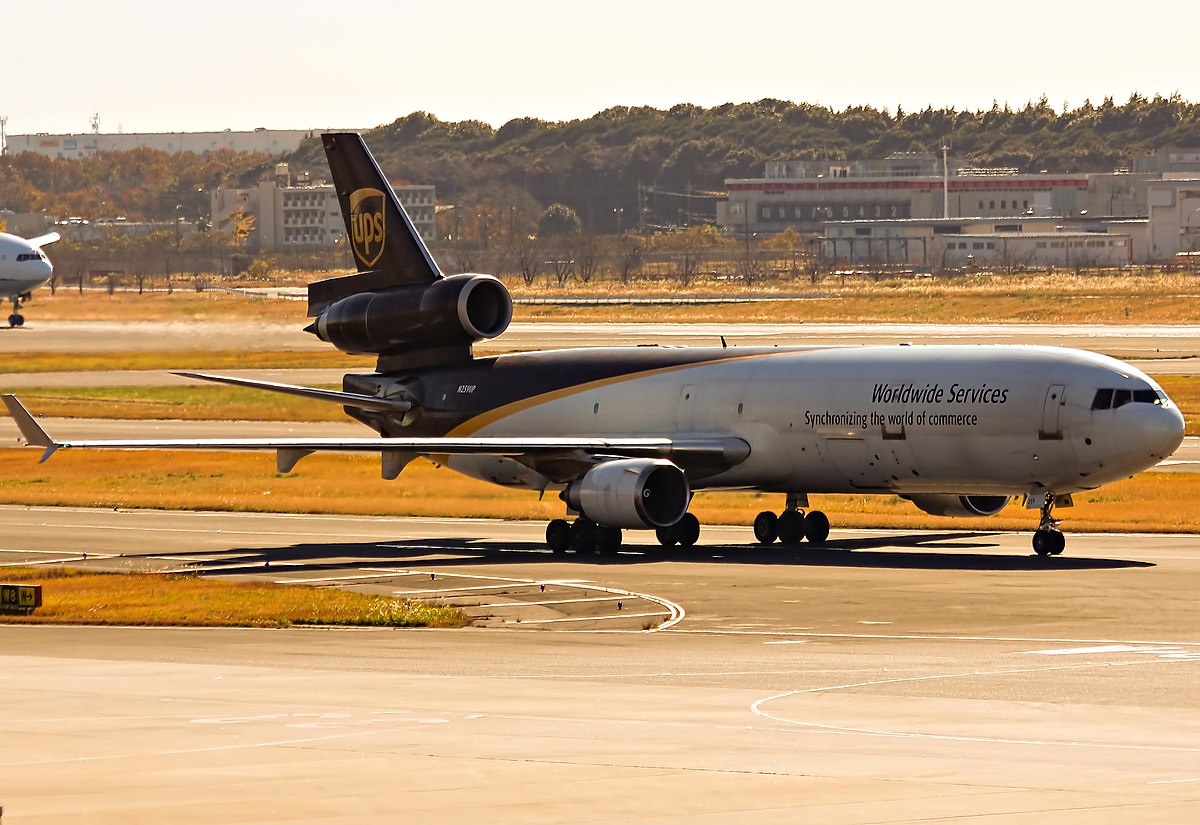
Incident Facts
Date of incident
Nov 4, 2025
Classification
Crash
Airline
UPS
Flight number
5X-2976
Departure
Louisville, United States
Destination
Honolulu, United States
Aircraft Registration
N259UP
Aircraft Type
McDonnell Douglas MD-11
ICAO Type Designator
MD11
Airport ICAO Code
KSDF
The aircraft had already been handed off to departure frequency but did not report on departure frequency anymore.
According to ADS-B data the aircraft achieved 185 knots over ground near the aiming markers runway 35L still on the runway centerline but never became airborne.
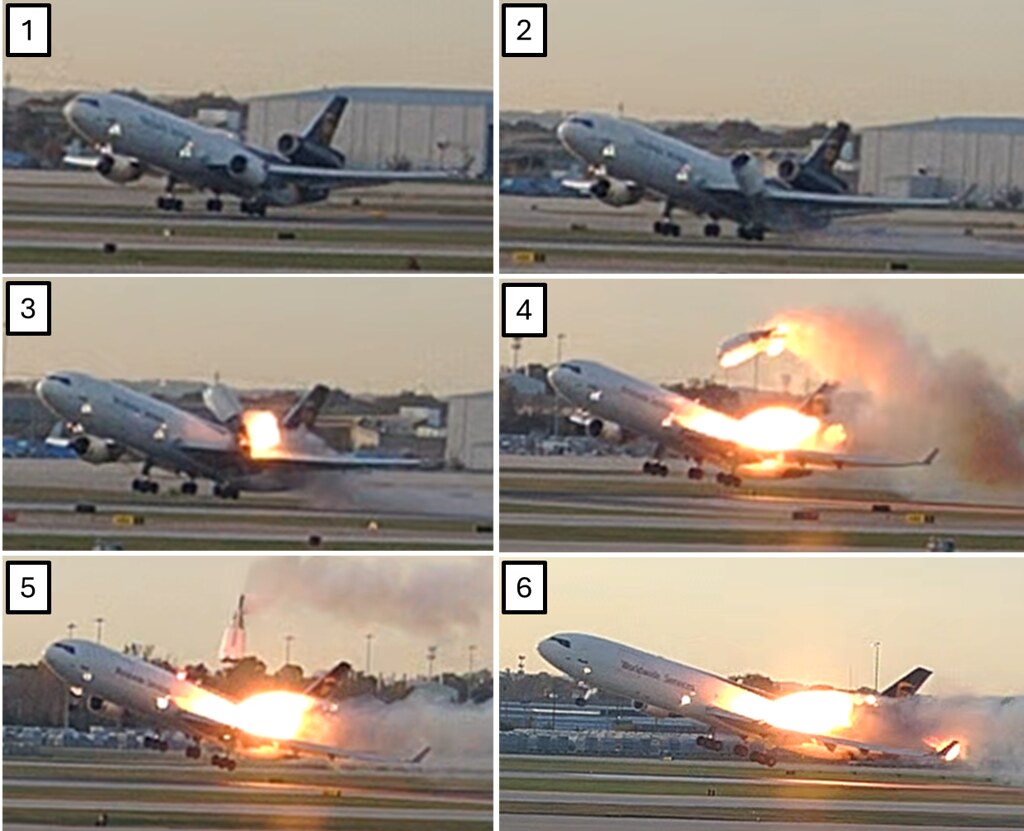
According to pictorial evidence engine #1 (left hand engine, CF6) separated the airframe during rotation for takeoff, the departure of that engine may also have failed the center engine #2.
The FAA reported: "UPS Flight 2976 crashed around 5:15 p.m. local time on Tuesday, Nov. 4, after departing from Louisville Muhammad Ali International Airport in Kentucky. The McDonnell Douglas MD-11 was headed to Daniel K. Inouye International Airport in Honolulu. The FAA and NTSB will investigate."
Ground observers reported the aircraft had been delayed for about two hours for work on the left hand engine (engine #1), the engine #1 separated during the takeoff run, the center engine emitted streaks of flames, the aircraft impacted a UPS warehouse and ploughed through other facilities before coming to rest in a large plume of fire and smoke.
The local governor reported the plane hit two businesses near the airport, the three occupants of the aircraft died, 4 people on the ground are confirmed dead, the death toll could rise. At least 11 people are treated in hospitals for in part serious injuries, that number might rise further, too. The aircraft with 38000 gallons of fuel climbed to about 175 feet AGL before descending again.
UPS reported they are halting package sorting at Louisville.
The NTSB reported: "NTSB is launching a go-team to investigate Tuesday’s crash of a UPS MD-11 cargo aircraft, Flight 2976 near Louisville, Kentucky. NTSB Board Member Todd Inman will serve as the on-scene spokesperson. The investigative team is scheduled to arrive in Kentucky tomorrow. A media briefing will be held tomorrow, with the time and location to be announced."
On Nov 5th 2025 20:00Z the NTSB reported in a press conference, the cockpit voice recorder and flight data recorder have been identified, show some limited fire damage, the NTSB is hopeful to be able to read the recorders out but won't be able to tell before the recorders have been prepared for readout at the NTSB lab. After being cleared for takeoff a large plume of fire occurred at the left hand side, the aircraft gained enough height to clear the airport perimeter fence before impacting a building. The CCTV show the left hand engine separated from the aircraft during the takeoff run. The debris field is about half a mile long. The NTSB is also looking into maintenance of the aircraft. Another briefing will be held on Thursday, which will be the first full day on scene for the NTSB, which is anticipated to stay on scene for a week. End of Media briefing.
In their second media briefing on Nov 6th 2025 the NTSB released a photo of CVR and FDR (see below) and reported, that the FAA, United Parcel Service, IPA, the mechanics for UPS, Boeing and GE engines are parties into the investigation. The NTSB currently consists of over 30 individuals not including the individuals in Washington. According to the ADS-B the aircraft was at 475 feet MSL at 183 knots over ground at 17:13:32L (22:13:32Z) - Editorial note: the threshold of runway 35L/runway end 17R is at 461 feet MSL. The NTSB performed a "FOD Walk" (check for foreign object debris) on both runways 17L and 17R. Multiple pieces of engine fan blades were found on runway 17R along with the main component of the #1 engine, all debris was transferred to a secure facility. The FDR download was successful and revealed 63 hours of flight data, a FDR group was formed at the headquarters in Washington. The CVR was also downloaded successfully, two hours of audio including the accident flight were recovered. Maintenance data have been collected from San Antonio,TX (USA), where the aircraft had undergone maintenance for several weeks. Immediately prior to the departure and crash of the aircraft the NTSB is not aware that any maintenance has been done to the aircraft or that the aircraft was delayed. End of media briefing.
On Nov 7th 2025 Louisville Mayor reported they are mourning the loss of 13 people (including the 3 crew on board of the aircraft), the death toll might still rise. 9 people are still unaccounted for.
In their 3rd media briefing on Nov 7th 2025 the NTSB reported, the CVR contained 124 minutes of good quality recordings. The takeoff run was uneventful initially through the different speed call outs, about 37 seconds after the crew called for takeoff thrust a repeating bell was heard which persisted until the end of the recording 25 seconds later. The crew attempted to control the aircraft. The transcript will be made available when the majority of other factual group reports have been placed into the docket, so a few months down the line. The bulk of the left engine pylon was still attached to the engine when the engine separated from the wing. Additional pieces of the engine attachment have been found in the grass next to runway 17R. The investigation is also looking for possible locations of the still missing people. The 475 feet ADS-B altitude reported the previous day equates to about 100 feet AGL. When the FDR has been analysed the meaning of the repeated bell will become clear though there is working theory it might be related to fire. The NTSB had received the job cards for all work done on the left hand engine. An MD11 simulator test, available at Louisville, will be conducted on Saturday (8.11.).
On Nov 8th 2025 UPS announced: "Out of an abundance of caution and in the interest of safety, we have made the decision to temporarily ground our MD-11 fleet. MD-11s are approximately 9% of the UPS Airlines fleet. The grounding is effective immediately. We made this decision proactively at the recommendation of the aircraft manufacturer. Nothing is more important to us than the safety of our employees and the communities we serve. Contingency plans are in place to ensure we can continue to deliver the reliable service our customers around the world count on."
On Nov 9th 2025 the FAA released Emergency Airworthiness Directive 2025-23-51 grounding all MD-11 aircraft. The EAD states: "This AD prohibits further flight until the airplane is inspected and all applicable corrective actions are performed using a method approved by the Manager, AIR-520, Continued Operational Safety Branch, FAA." reasoning: "This emergency AD was prompted by an accident where the left-hand engine and pylon detached from the airplane during takeoff. The cause of the detachment is currently under investigation. This condition could result in loss of continued safe flight and landing." and providing the determination: "The FAA is issuing this AD because the agency has determined the unsafe condition is likely
to exist or develop in other products of the same type design."
On Nov 15th 2025 the FAA superseeded EAD 2025-23-51 with the new Emergency Airworthiness Directive 2025-23-53 including MD-11, MD-11F, MD-10-10F, MD-10-30F, DC-10-10, DC-10-10F, DC-10-15, DC-10-30, DC-10-30F (KC-10A and KDC-10), DC-10-40, and DC-10-40F aircraft. The FAA reasoned:
Since the FAA issued emergency AD 2025-23-51, it has been determined that additional airplane models are subject to the same unsafe condition. The engine-pylon structure of the Model MD-11 and MD-11F airplanes is similar in design to that of the Model MD-10-10F, MD-10-30F, DC-10-10, DC-10-10F, DC-10-15, DC-10-30, DC-10-30F (KC-10A and KDC-10), DC-10-40, and DC-10-40F airplanes. The FAA, therefore, is superseding emergency AD 2025-23-51 to add these additional airplane models to the applicability of this emergency AD.
FAA’s Determination
The FAA is issuing this emergency AD because the agency has determined the unsafe condition described previously is likely to exist or develop in other products of the same type design.
AD Requirements
This emergency AD prohibits further flight until the airplane is inspected and all applicable corrective actions are performed using a method approved by the Manager, AIR-520, Continued Operational Safety Branch, FAA.
Interim Action The FAA considers this emergency AD to be an interim action. If final action is later identified, the FAA might consider further rulemaking then.
On Nov 20th 2025 the NTSB released their preliminary report stating, that during the rotation for takeoff the pylon of engine #1 and the engine separated from the wing igniting a fire. The aircraft climbed to a maximum of 30 feet AGL radar altimeter according to FDR, the aircraft cleared the blast fence past the runway, however, the left main landing gear impacted the roof of a UPS Supply Chain Solutions warehouse, then the aircraft impacted a storage yard and two additional buildings including a petroleum recycling facility and was mostly consumed by fire. The debris field was about 3000 feet long.
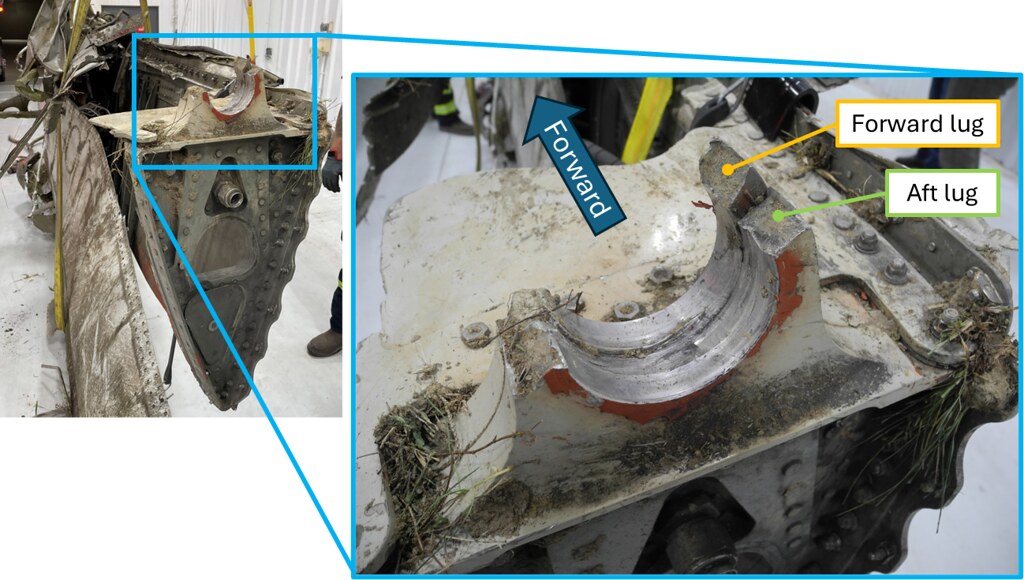
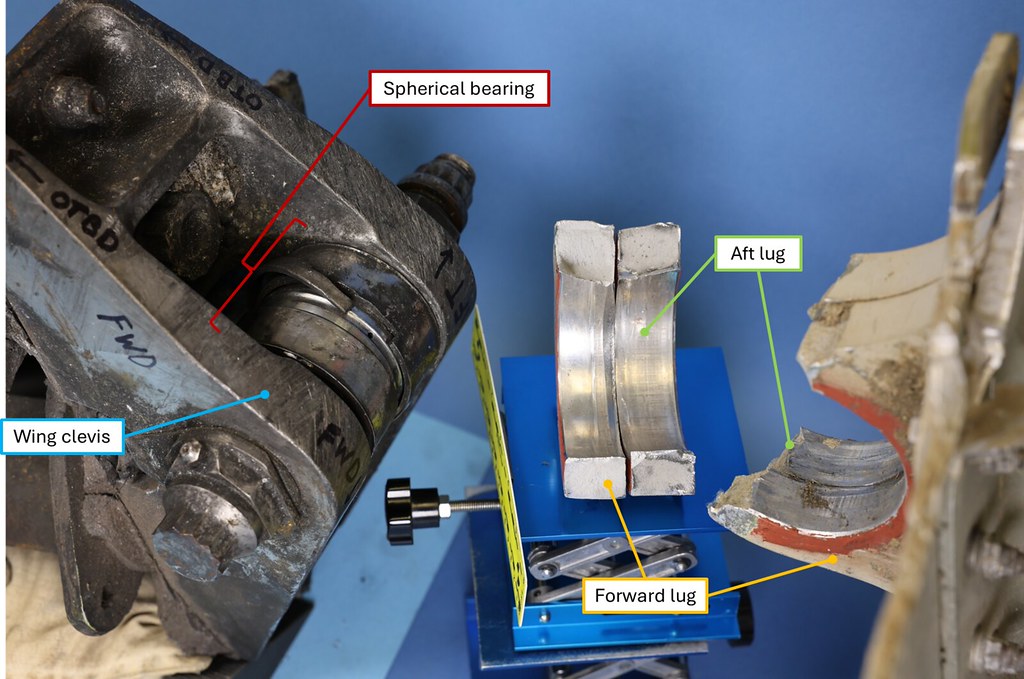
The NTSB summarized laboratory examination of the left hand pylon mounts: "After initial cleaning of the fracture surfaces, examination of the left pylon aft mount lug fractures found evidence of fatigue cracks in addition to areas of overstress failure. On the aft lug, on both the inboard and outboard fracture surfaces, a fatigue crack was observed where the aft lug bore met the aft lug forward face. For the forward lug's inboard fracture surface, fatigue cracks were observed along the lug bore. For the forward lug's outboard fracture surface, the fracture consisted entirely of overstress with no indications of fatigue cracking. The forward top flange of the aft mount assembly was examined for indications of deformation or pre-existing fractures, but no indications were found. The spherical bearing was removed from the wing clevis for further evaluation."
With respect to maintenance the NTSB stated: "At the time of the accident, N259UP had accumulated a total time of about 92,992 hours and 21,043 cycles. The accident airplane was maintained under a continuous airworthiness maintenance program (CAMP). A review of the inspection tasks for the left pylon aft mount found both a general visual inspection (GVI) and a detailed visual inspection of the left pylon aft mount, required by UPS's maintenance program at a 72-month interval, was last accomplished on October 28, 2021. A 24-month/4,800 hour lubrication task of the pylon thrust links and pylon spherical bearings was last accomplished on October 18, 2025. A special detailed inspection (SDI) of the left pylon aft mount lugs would have been due at 29,200 cycles and of the left wing clevis support would have been due at 28,000 cycles. The accident airplane records showed these two SDI tasks had not been accomplished (the airplane had 21,043 cycles)."
With respect to similiar occurrences the NTSB stated:
On May 25, 1979, about 1504 central daylight time, American Airlines flight 191, a McDonnellDouglas DC-10-10 aircraft, crashed into an open field just short of a trailer park about 4,600 ft northwest of the departure end of runway 32R at Chicago-O'Hare International Airport, Chicago, Illinois. Flight 191 was taking off from runway 32R. The weather was clear and the visibility was 15 miles. During the takeoff rotation, the left engine and pylon assembly and about 3 ft of the leading edge of the left wing separated from the airplane and fell to the runway. Flight 191 continued to climb to about 325 ft agl and then began to roll to the left. The airplane continued to roll to the left until the wings were past the vertical position, and during the roll, the airplane's nose pitched down below the horizon.
Flight 191 crashed into the open field and the wreckage scattered into an adjacent trailer park.
The airplane was destroyed in the crash and subsequent fire. Two hundred and seventy-one persons on board Flight 191 were killed; two persons on the ground were killed, and two others were seriously injured. An old aircraft hangar, several automobiles, and a mobile home were destroyed. The NTSB investigated American Airlines flight 191 accident, see NTSB No. DCA79AA017 and aircraft accident report AAR-79-17.
On Jan 14th 2026 the NTSB released an investigative update reporting:
A preliminary review of data from the FDR showed nominal performance of the airplane and engines until about 1713:11, about 20 seconds before the end of recorded data, when the parameters from the No. 1 engine were no longer reliable (see figure 5). Shortly after 1713:11, the FDR showed that only the No. 1 engine fire parameter changed from “no fire” to “fire,” and the throttle resolver angle (TRA) for the Nos. 2 and 3 engines increased. Subsequently, the speed values for the low-speed rotor (N1) and high-speed rotor (N2) for the No. 2 engine showed minor perturbations, while the N1 and N2 values for the No. 3 engine increased and remained steady until about 3 seconds before the end of recorded data. The airplane’s groundspeed was about 184 kts from 1713:11 until about 3 seconds before the end of recorded data at 1713:30.
With respect to the engine pylon the NTSB reported:
As indicated in the preliminary report for this investigation, airport surveillance videos that captured part of the airplane’s takeoff roll showed that the left (No. 1) engine and pylon separated from the wing shortly after airplane rotation, and a fire ignited on the left engine and near the area of the left pylon wing attachment. The pylon aft mount bulkhead is an assembly composed of two independent fittings, bolted together, with lugs (forward lug and aft lug) that house a single spherical bearing assembly. The lugs from the left pylon aft mount bulkhead were found fractured, and the associated spherical bearing assembly for this location, consisting of a ball element and bearing race, was found still installed on the left wing clevis at the accident site and was exposed to the postcrash fire. The spherical bearing race, which is normally one piece and housed within the lugs of the aft mount bulkhead, was found fractured into forward and aft portions.
The NTSB Materials Laboratory in Washington, DC, has subsequently examined this spherical bearing assembly. Investigators observed that the interior surface of the bearing’s race had fracture surfaces that showed evidence of fatigue cracking originating around the entire circumference at the edge of the design recess groove (a design feature on the interior surface of the race). The fatigue cracking extended through the thickness of the bearing race toward the exterior surface, encompassing about 75% of the fracture surface, with the remaining fracture surface consistent with overstress failure (see figures 2 and 3). Remnant grease-like material was found within the spherical bearing assembly (that is, between the ball element and the bearing race).
On Apr 16th 2026 the NTSB announced a two day investigative hearing to be held from May 19th to May 20th, that will be livestreamed. The NTSB reported all 3 crew as well as 11 people on the ground were killed, another person on the ground died 51 days later, and 23 people received injuries.
On May 18th 2026 the NTSB listed the docket access data, however, has not yet released the docket as of this update.
Related NOTAMs:
!SDF 11/010 SDF RWY 17L/35R CLSD 2511031730-2511040300
!SDF 11/031 SDF RWY 35L ALS U/S 2511041300-2511041800
!SDF 11/038 SDF AD AP CLSD 2511042230-2511051200
!SDF 11/077 SDF RWY 17L/35R CLSD 2511050624-2511080300
Metars:
KSDF 050056Z 15005KT 10SM SCT026 SCT250 13/05 A3020 RMK AO2 SLP227 FU SCT026 T01280050=
KSDF 050028Z 15005KT 10SM SCT026 BKN250 13/05 A3020 RMK AO2 FU SCT026 T01330050=
KSDF 042356Z 14004KT 10SM FEW022 BKN026 BKN250 14/06 A3021 RMK AO2 SLP229 FU BKN026 T01390056 10183 20133 56007=
KSDF 042303Z 16008KT 10SM FEW021 BKN028 BKN032 BKN250 16/05 A3021 RMK AO2 FU BKN028 T01560050=
KSDF 042256Z 17006KT 10SM SCT032 BKN250 16/05 A3021 RMK AO2 SLP230 FU SCT032 T01560050=
KSDF 042156Z 12006KT 10SM SCT200 BKN250 17/05 A3022 RMK AO2 SLP233 T01670050=
KSDF 042056Z 15006KT 10SM FEW200 BKN250 17/04 A3023 RMK AO2 SLP237 T01720044 56028=
KSDF 041956Z 14006KT 10SM FEW200 BKN250 18/04 A3025 RMK AO2 SLP241 T01780044=
KSDF 041856Z 15007KT 10SM FEW200 BKN250 18/02 A3028 RMK AO2 SLP253 T01780022=
KSDF 041756Z 17008KT 10SM FEW200 BKN250 17/02 A3031 RMK AO2 SLP264 T01670022 10167 20033 58028=
Aircraft Registration Data
Incident Facts
Date of incident
Nov 4, 2025
Classification
Crash
Airline
UPS
Flight number
5X-2976
Departure
Louisville, United States
Destination
Honolulu, United States
Aircraft Registration
N259UP
Aircraft Type
McDonnell Douglas MD-11
ICAO Type Designator
MD11
Airport ICAO Code
KSDF
Videos
Photos
This article is published under license from Avherald.com. © of text by Avherald.com.
Article source
You can read 2 more free articles without a subscription.
Subscribe now and continue reading without any limits!
Read unlimited articles and receive our daily update briefing. Gain better insights into what is happening in commercial aviation safety.
Send tip
Support AeroInside by sending a small tip amount.
Related articles
 Fleet type match
UPS B763 at Louisville on Oct 14th 2026, flaps/slats problem on departure
A UPS United Parcel Service Boeing 767-300 freighter, registration N323UP performing flight 5X-994 from Louisville,KY to Spokane,WA (USA), was…
 Fleet type match
UPS B752 at Louisville on Oct 14th 2026, unreliable airspeed
A UPS United Parcel Service Boeing 757-200 freighter, registration N431UP performing flight 5X-2992 from Louisville,KY to Portland,OR (USA), was…
UPS A306 at Phoenix on Sep 20th 2026, rejected takeoff
A UPS United Parcel Service Airbus A300-600, registration N137UP performing flight 5X-859 from Phoenix,AZ to Louisville,KY (USA), was accelerating…
 Fleet type match
UPS B748 near Columbus on Sep 1st 2026, smoke and fumes on flight deck
A UPS United Parcel Service Boeing 747-8 freighter, registration N627UP performing flight 5X-223 from Louisville,KY (USA) to Cologne (Germany), was…
UPS B763 at Singapore on Jul 1st 2026, runway incursion
A UPS United Parcel Service Boeing 767-300 freighter, registration N314UP performing flight 5X-167 from Singapore (Singapore) to Hong Kong (China),…
Newest articles
 Fleet type match
BAW A21N over Germany on Oct 17th 2026, losscom prompts intercept
A BAW British Airways Airbus A321-200N, registration G-TNEH performing flight BA-899 from Paphos (Cyprus) to London Heathrow,EN (UK), was enroute…
 Fleet type match
Malta B738 at Trieste on Oct 17th 2026, engine failure
A Malta Air Boeing 737-800 on behalf of Ryanair, registration 9H-QDD performing flight FR-6789 from Trieste (Italy) to Paris Beauvais (France), was…
Subscribe today
Are you researching aviation incidents? Get access to AeroInside Insights, unlimited read access and receive the daily newsletter.
Pick your plan and subscribePartner

ELITE Simulation Solutions is a leading global provider of Flight Simulation Training Devices, IFR training software as well as flight controls and related services. Find out more.
SafetyScan Pro provides streamlined access to thousands of aviation accident reports. Tailored for your safety management efforts. Book your demo today
AeroInside Blog
Popular aircraft
Airbus A320Boeing 737-800
Boeing 737-800 MAX
Popular airlines
American AirlinesUnited
Delta
Air Canada
Lufthansa
British Airways