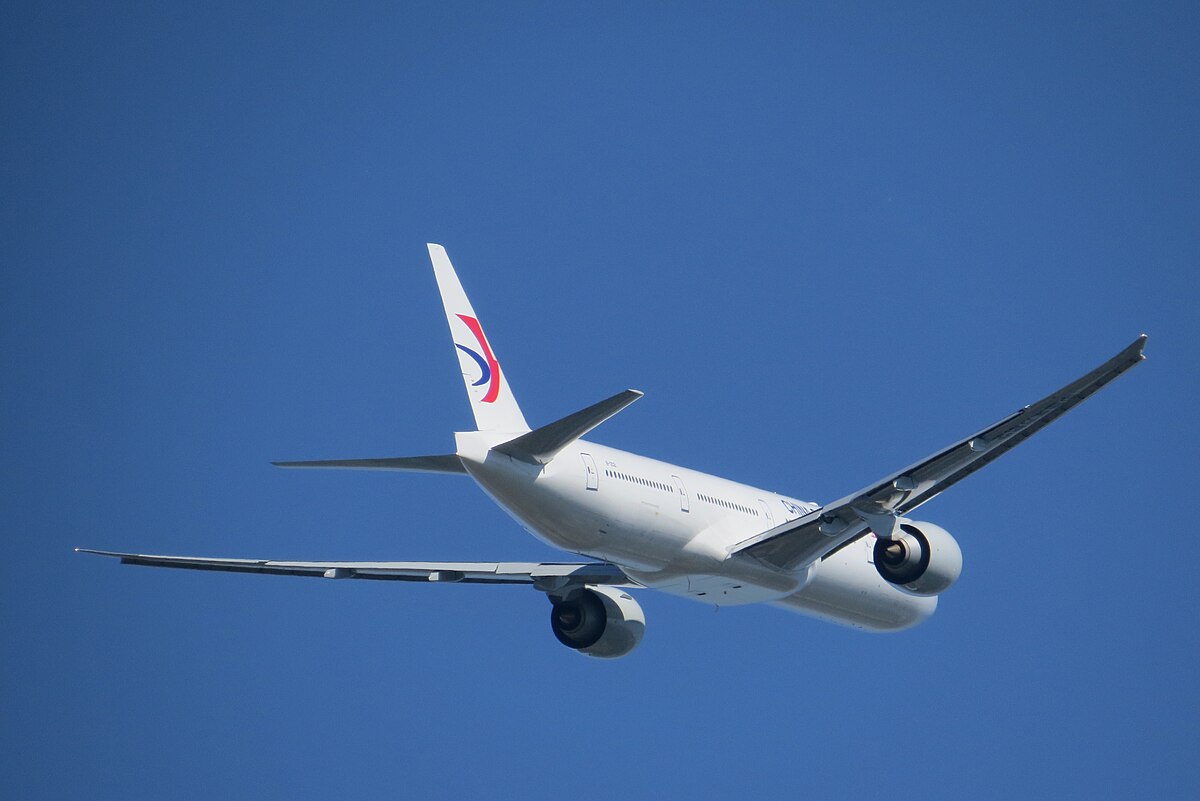
China Eastern B773 at Singapore on Aug 28th 2024, runway incursion
Last Update: August 11, 2025 / 16:39:29 GMT/Zulu time
Incident Facts
Date of incident
Aug 28, 2024
Classification
Report
Cause
Runway incursion
Airline
China Eastern Airlines
Flight number
MU-565
Departure
Shanghai Pudong, China
Destination
Singapore, Singapore
Aircraft Registration
B-2021
Aircraft Type
Boeing 777-300
ICAO Type Designator
B773
The preceding aircraft had landed on runway 20R but had not yet vacated the runway. Assuming that the aircraft would vacate the runway in time, tower cleared the Boeing 777-300 to land on runway 20R. However, the preceding aircraft did not manage to vacate the runway in time. Tower therefore instructed the Boeing 777-300 to go around when the aircraft was at 76 feet AGL and about 296 meters ahead of the runway threshold, however, the crew did not respond and continued the landing. When the Boeing 777-300 touched down, tower assessed that the tail of the preceding aircraft had already cleared the runway edge line, so that a go around instruction was no longer needed.
Singapore's TSIB rated the occurrence a runway incursion and released their final report concluding the probable causes of the runway incursion were:
- The runway incursion occurred as Aircraft B landed on the runway while Aircraft A had yet to vacate the runway strip.
- Aircraft A was adhering to the operator’s taxi speed limit (not exceeding 10 kts) when taxiing on RET T7 while trying to vacate the runway strip. The RWC had expected Aircraft A to vacate the runway strip at a higher speed.
- When the RWC realised that Aircraft A would unlikely be clear of the runway strip by the time Aircraft B arrived over the runway threshold, the RWC issued the go-around instruction to Aircraft B, in line with the ATSP’s procedures.
- The investigation team opined that flight crew of Aircraft B likely missed the RWC’s go-around instruction as they were in a phase of operation where it could be difficult to perceive the instruction.
- The investigation team was unable to establish if the ATSP considered the hazard of go-around instructions not being received or heard by pilots in the establishment of their go-around management procedures.
The TSIB reported that according to their interviews all 4 crew members of MU-565 had not heard the go-around instruction.
The TSIB analysed:
The investigation team looked into the following:
(a) Perceptibility of go-around instruction
(b) ATC’s risk management for low-level go-around
Perceptibility of go-around instruction
The investigation team did not have the opportunity to review the recording of Aircraft B’s CVR and is not able to establish whether the go-around instruction from the RWC was annunciated in the cockpit of Aircraft B, let alone whether the go-around instruction was heard by the flight crew of Aircraft B.
However, the investigation team is inclined to believe that the go-around instruction from the RWC was annunciated in the cockpit of Aircraft B and that the flight crew of Aircraft missed the instruction. This is in view of the following:
(a) There is no evidence of any VHF system or EGPWS malfunction.
(b) There is no evidence that the flight crew of Aircraft B was depressing the PTT switch around the time Aircraft B was about to touch down, which would have prevented any transmission from the RWC to be heard.
(c) When the RWC instructed Aircraft B to go around, the aircraft was at 76ft AGL. The EGPWS of Aircraft B would have been generating aural callouts, in quick succession, for the corresponding radio altitudes which the aircraft was descending past. This go-around instruction was likely annunciated simultaneously with the EGPWS aural callouts and might have affected the audibility of the RWCs transmission.
(d) Aircraft B was landing after Aircraft A (which was operated by the same operator as Aircraft B). There were two transmissions between the RWC and Aircraft A (see paragraph 1.1.12). These two transmissions and the RWC’s go-around instruction to Aircraft B took place within a 10-second period. The first two transmissions included the phrase “China Eastern Six Zero One Seven” whereas the go-around instruction included the phrase “China Eastern Five Six Five”. Given that the callsigns of both the aircraft began with “China Eastern”, the flight crew of Aircraft B might have believed the transmission was for “China Eastern Six Zero One Seven” and disregarded the go-around instruction.
(e) The go-around instruction came at a time when Aircraft B was close to touchdown. The flight crew of Aircraft B was in a phase of operation that demanded heightened attention to the external visual references to ensure the approach was stabilised and the touchdown could be executed safely. Studies have shown that the higher workload on flight crews during critical phases of a flight may result in failure on the part of the flight crews to hear or respond to a communication11. According to a neuroscience study, the senses of hearing and vision share a limited neural resource and the response of a person’s brain to sound could be significantly reduced when the person was engaging in a demanding visual task.
ATCs’ risk management for low-level go-around
The ASMGCS had generated a yellow runway incursion visual alert message, the RWC assessed the traffic situation and proceeded to issue the landing clearance for Aircraft B, having considered that the tail of Aircraft A was clear of the runway edge line and there was no immediate obstruction that would interfere with Aircraft B's landing, and that Aircraft A was in motion and would be clear of the runway strip by the time Aircraft B was over the runway threshold. The RWC still had the option of instructing Aircraft B to go around if it was judged later that Aircraft A would not be able to vacate the runway strip by the time Aircraft B was over the runway threshold.
The RWC’s approach and actions were consistent with the ATSP’s procedures and considerations mentioned in paragraphs 1.11.1.4 to 1.11.1.7.
It appears that when Aircraft A started to slow down when it was on RET W7, the RWC’s first instinct was to expedite the movement of Aircraft A to vacate the runway strip likely in the hope of preventing Aircraft B from performing what the RWC perceived was an unnecessary go-around.
When the RWC assessed that it was unlikely that Aircraft A would be clear of the runway strip in time for Aircraft B’s arrival over the runway threshold, thus becoming a runway incursion hazard, the go-around instruction was issued at 20:13:25 hrs. The RWC’s management of the traffic situation was in compliance with the ATSP’s procedures as the issuance of a go-around instruction is dependent on an air traffic controller’s assessment when a situation constitutes to a runway incursion.
Had the RWC issued the go-around instruction to Aircraft B earlier instead of communicating with Aircraft A at 20:13:19 hrs (see paragraph 1.1.12), in the hope of expediting its vacating from the runway strip, this might have increased the chances of the flight crew of Aircraft B realising that a go-around instruction had been issued to them.
The ATSP had many considerations in its go-around management (see paragraph 1.11.1.7). It had an unenviable task to balance these considerations (air traffic control efficiency, avoidance of creation of stress for ATC personnel and pilots). In the opinion of the investigation team, the ATSP’s procedures created the opportunity where situations could be marginal and there was no room for unexpected situations. In this case, the unexpected situation (where Aircraft B had landed while Aircraft A had yet to vacate the runway strip) occurred when the following happened:
(a) The flight crew of Aircraft A was adhering to the operator’s taxi speed limit, but the RWC appeared to have expected Aircraft A to vacate the runway strip more expeditiously.
(b) The flight crew of Aircraft B did not execute the go-around instruction issued by the RWC as the flight crew could have missed the instruction in view of their high workload (as discussed in paragraph 2.1.2) at the time of its issuance.
Once the flight crew of Aircraft B missed the go-around instruction, there appeared to be insufficient time for the RWC to attempt to transmit the instruction again as the aircraft was just about to touch down.
In the absence of documented safety assessment by the ATSP in respect of the hazard of go-around instructions not being received or heard by pilots (see paragraph 1.11.2), the investigation team was unable to establish whether the ATSP had considered the following aspects in the development of its existing go-around management procedures:
(a) Evaluation of the potential risks associated with this hazard
(b) Definition of an acceptable risk level
(c) Implementation of measures to control and mitigate potential consequences
Incident Facts
Date of incident
Aug 28, 2024
Classification
Report
Cause
Runway incursion
Airline
China Eastern Airlines
Flight number
MU-565
Departure
Shanghai Pudong, China
Destination
Singapore, Singapore
Aircraft Registration
B-2021
Aircraft Type
Boeing 777-300
ICAO Type Designator
B773
This article is published under license from Avherald.com. © of text by Avherald.com.
Article source
You can read 2 more free articles without a subscription.
Subscribe now and continue reading without any limits!
Read unlimited articles and receive our daily update briefing. Gain better insights into what is happening in commercial aviation safety.
Send tip
Support AeroInside by sending a small tip amount.
Related articles
 Fleet type match
China Eastern A359 at Shanghai on May 2nd 2026, IRS fail, brakes fail, multiple collisions with jet bridge
A China Eastern Airbus A350-900, registration B-324W performing flight MU-5406 from Chengdu to Shanghai Hongqiao (China), was climbing out of Chengdu…
 Fleet type match
China Eastern B738 near Guangzhou on Mar 21st 2022, lost altitude and impacted terrain
A China Eastern Boeing 737-800, registration B-1791 performing flight MU-5735 from Kunming to Guangzhou (China) with 123 passengers and 9 crew on…
 Fleet type match
China Eastern A321 at Wuxi on Oct 2nd 2025, bird strike
A China Eastern Airlines Airbus A321-200, registration B-6368 performing flight MU-2701 from Wuxi to Qingdao (China), was climbing out of Wuxi's…
 Fleet type match
China Eastern A332 at Shanghai on Dec 9th 2023, could not retract landing gear
A China Eastern Airbus A330-200, registration B-6538 performing flight MU-533 from Shanghai Pudong (China) to London Heathrow,EN (UK), was climbing…
 Fleet type match
China Eastern A333 near Xiamen on Dec 3rd 2023, uncontained engine failure
A China Eastern Airbus A330-300, registration B-8970 performing flight MU-721 from Shanghai Hongquiao to Hong Kong (China), was enroute at 10400…
Newest articles
Gol B738 at Recife on Oct 5th 2026, engine compressor stalls
A Gol Transportes Aereos Boeing 737-800, registration PR-GXL performing flight G3-1587 from Recife,PE to Sao Paulo Guarulhos,SP (Brazil), was…
United B738 at Santa Ana on Oct 5th 2026, rejected takeoff due to smoke on board
A United Boeing 737-800, registration N78540 performing flight UA-653 from Santa Ana,CA to San Francisco,CA (USA), was accelerating for takeoff from…
Subscribe today
Are you researching aviation incidents? Get access to AeroInside Insights, unlimited read access and receive the daily newsletter.
Pick your plan and subscribePartner

ELITE Simulation Solutions is a leading global provider of Flight Simulation Training Devices, IFR training software as well as flight controls and related services. Find out more.
SafetyScan Pro provides streamlined access to thousands of aviation accident reports. Tailored for your safety management efforts. Book your demo today
AeroInside Blog
Popular aircraft
Airbus A320Boeing 737-800
Boeing 737-800 MAX
Popular airlines
American AirlinesUnited
Delta
Air Canada
Lufthansa
British Airways