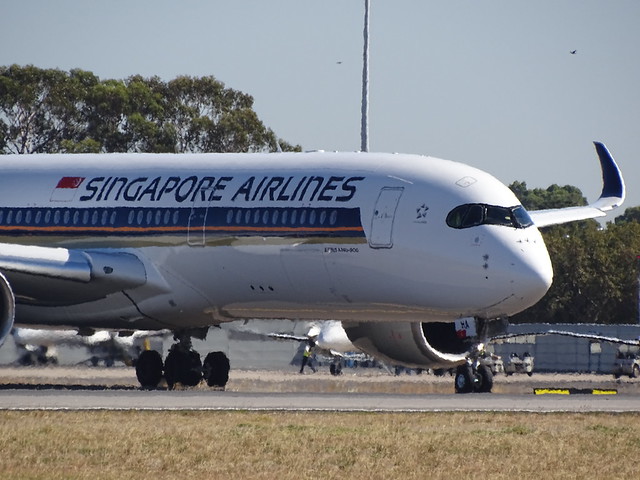
Singapore A359 enroute on Nov 14th 2025, turbulence injures flight attendant
Last Update: October 12, 2026 / 11:36:58 GMT/Zulu time
Incident Facts
Date of incident
Nov 14, 2025
Classification
Report
Airline
Singapore Airlines
Flight number
SQ-919
Departure
Manila, Philippines
Destination
Singapore, Singapore
Aircraft Registration
9V-SHJ
Aircraft Type
Airbus A350-900
ICAO Type Designator
A359
On Oct 12th 2026 Singapore's TSIB published their final report concluding the probable causes of the accident were:
- At about 1140hrs, while the aircraft was cruising at 40,000 feet, the flight crew observed weather about 80nm ahead of them and displayed on the ND as striped green pattern. The flight crew assessed that the top of the weather was at 30,000 feet.
- The flight crew assessed that no lateral deviation was needed, as the aircraft was operating at more than 5,000 feet above when passing the detected weather.
- The flight crew exercised prudence by asking the passengers to be seated and fasten their seat belts and conducted a more gradual descent to maintain greater separation from the detected weather. They instructed cabin crew to continue cabin service with caution.
- The aircraft encountered convectively induced turbulence, despite flying more than 5,000 feet above the detected weather.
- The effects of convective activity may extend above the top of the weather detected by the aircraft WXR and beyond the recommended weather avoidance height of 5,000 feet.
The TSIB analysed:
At about 1140hrs, while the aircraft was cruising at 40,000 feet, the flight crew observed weather about 80nm ahead of them with cloud top at about 30,000 feet, denoted by striped pattern green weather returns on their NDs. They deemed it was safe to continue on their planned route without deviating. Nevertheless, they exercised prudence in the following ways:
(a) The flight crew switched on the fasten-seat-belt signs to get the passengers seated. They also advised the cabin crew to proceed with their service with caution.
(b) When instructed by ATC to descend from 40,000 feet to 34,000 feet, the flight crew opted for a shallower descent to make sure that the aircraft passed above the observed weather higher than the weather avoidance height of 5,000 feet recommended by the aircraft manufacturer and the operator’s FCTM.
Unfortunately, despite these precautions, they could not avoid the turbulence encounter.
This occurrence highlighted that, although the aircraft manufacturer and operator recommend maintaining at least 5,000 feet above observed “area of greatest threat”, the effects of convective activity may extend significantly beyond the top of the weather detected by the aircraft WXR and have the potential to adversely affect aircraft flying more than the recommended avoidance height above the weather. Flight crews should remain cognisant of this possibility and exercise additional caution, such as instructing the cabin crew to stop service and be seated, when opting to overfly weather activity.
Incident Facts
Date of incident
Nov 14, 2025
Classification
Report
Airline
Singapore Airlines
Flight number
SQ-919
Departure
Manila, Philippines
Destination
Singapore, Singapore
Aircraft Registration
9V-SHJ
Aircraft Type
Airbus A350-900
ICAO Type Designator
A359
This article is published under license from Avherald.com. © of text by Avherald.com.
Article source
You can read 1 more free article without a subscription.
Subscribe now and continue reading without any limits!
Read unlimited articles and receive our daily update briefing. Gain better insights into what is happening in commercial aviation safety.
Send tip
Support AeroInside by sending a small tip amount.
Related articles
 Fleet type match
Singapore A359 near Rockhampton on Nov 17th 2026, smoke in cabin
A Singapore Airlines Airbus A350-900, registration 9V-SHA performing positioning flight SQ-9204 from Rockhampton,QL (Australia) to Singapore…
Fleet type match
Singapore A359 near Rockhampton on Nov 11th 2026, smoke in cabin
A Singapore Airlines Airbus A350-900, registration 9V-SHA performing flight SQ-236 from Brisbane,QL (Australia) to Singapore (Singapore), was enroute…
 Fleet type match
Singapore B773 at Zurich on Jul 11th 2026, flaps control problem
A Singapore Airlines Boeing 777-300, registration 9V-SWU performing flight SQ-345 from Zurich (Switzerland) to Singapore (Singapore), was climbing…
 Fleet type match
Singapore A359 at Shanghai on Jun 27th 2025, turbulence causes injuries
A Singapore Airlines Airbus A350-900, registration 9V-SMB performing flight SQ-832 from Singapore (Singapore) to Shanghai Pudong (China), was…
 Fleet type match
Singapore B38M at Kuala Lumpur on Jun 13th 2026, tyre damage on landing
A Singapore Airlines Boeing 737-8 MAX, registration 9V-MBN performing flight SQ-114 from Singapore (Singapore) to Kuala Lumpur (Malaysia) with 147…
Newest articles
 Fleet type match
FAST Congo L410 at Dilolo on Nov 27th 2026, contacted trees on approach
An Air FAST Congo Let L-410, registration ZS-ATL performing a flight from Lubumbashi to Dilolo (DR Congo), was on final approach to Dilolo when the…
 Fleet type match
Delta A321 at Atlanta on Nov 26th 2026, engine failure
A Delta Airlines Airbus A321-200, registration N327DN performing flight DL-2011 from Atlanta,GA to Austin,TX (USA) with 177 people on board, was…
Subscribe today
Are you researching aviation incidents? Get access to AeroInside Insights, unlimited read access and receive the daily newsletter.
Pick your plan and subscribePartner

ELITE Simulation Solutions is a leading global provider of Flight Simulation Training Devices, IFR training software as well as flight controls and related services. Find out more.
SafetyScan Pro provides streamlined access to thousands of aviation accident reports. Tailored for your safety management efforts. Book your demo today
AeroInside Blog
Popular aircraft
Airbus A320Boeing 737-800
Boeing 737-800 MAX
Popular airlines
American AirlinesUnited
Delta
Air Canada
Lufthansa
British Airways