Saudia B773 at Islamabad on Oct 14th 2024, landed on wrong runway
Last Update: January 9, 2026 / 17:52:39 GMT/Zulu time
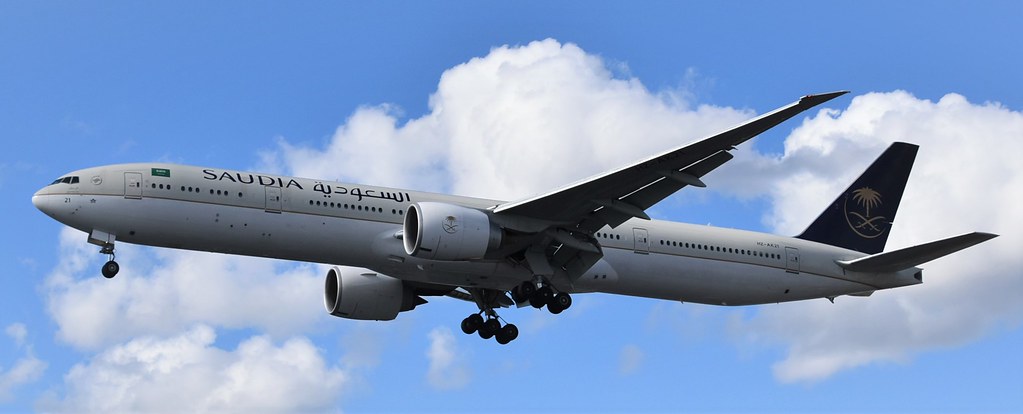
Incident Facts
Date of incident
Oct 14, 2024
Classification
Report
Airline
Saudi Arabian Airlines
Flight number
SV-724
Departure
Riyadh, Saudi Arabia
Destination
Islamabad, Pakistan
Aircraft Registration
HZ-AK21
Aircraft Type
Boeing 777-300
ICAO Type Designator
B773
Pakistan's Bureau of Aircraft Safety Investigation (BASI) released their final report concluding the probable causes of the serious incident were:
The flight crew's incorrect interpretation and insufficient adherence to ATC instructions led to landing on the wrong runway.
Contributory Factors
- Inadequate cross-verification and monitoring within the flight crew regarding ATC clearances and navigational alignment.
- Air traffic controllers did not adequately monitor the crew’s read-backs of landing clearances and failed to prompt for correction when omissions occurred.
- Approach Controller missed earlier signs of misalignment during the approach phase, which could have allowed for timely corrective action.
- The Tower Controller issued appropriate clearances and followed standard protocols but lacked real-time corrective intervention.
The BASI stated, that the crew was told multiple times during the approach to expect an ILS Z approach to runway 10R, the crew readbacks remained unclear however mostly omitting the L or R and only stating runway 10 and not mentioning the type of approach. The BASI wrote (after landing): "SVA-724 contacted Islamabad Tower stating that the aircraft was cleared for RNP Approach RW 10L instead of ILS Approach RW 10R."
The BASI analysed:
SVA-724 took off from King Khalid International airport (OERK), Riyadh, Saudi Arabia and intended to land at Islamabad International Airport (OPIS), Islamabad, Pakistan.
Ground operations were all normal and aircraft departed Riyadh, Saudi Arabia at 2327Z.
Incomplete ATC Clearance Read-Backs – Upon initial contact with the Islamabad Area Control, the pilots did not read-back the complete ATC clearance, even when insisted by the Area Surveillance Controller. A similar behaviour can be observed in further co-ordinations during the initial descent and approach clearance phases; the crew read back only the routing (to SUMEB and IS416) but omitted mentioning “ILS Z Approach” and “RW 10R”.
Crew Expectation Bias – RT extracts indicate that the crew was so focused on the ATS route sequence that they discounted or “filtered out” the runway and approach type; consistent with expectation bias.
Crew Resource Management (CRM) failure – Neither pilot adequately attended to the full ATC clearances or challenged one another throughout the flight, resulting in repeated omissions. This mutual inattentiveness to ATC instructions and lack of inter-crew challenge represents a significant CRM discrepancy, as it removed critical cross-checking layers designed to catch and correct errors before they led to a wrong-runway landing.
Hesitant Read-Back Suggesting Unchallenged Runway Misalignment – When the Tower Controller issued clearance to land for RW 10R, the pilot’s read-back “RW 10…” was followed by a brief hesitation, while omitting the left/right RW designator. This pause and omission implies that the crew might have recognized the aircraft’s alignment with the wrong runway, but still chose not to question the clearance.
Failure to Execute Go-Around under Runway Ambiguity – Crew Resource Management (CRM) protocols mandate that a go-around be initiated whenever there is any doubt about runway alignment or landing clearance during the final approach. In this incident, despite recognizing ambiguity the flight crew continued the descent and touchdown. By not executing a go-around, the pilots bypassed a primary safety barrier designed to prevent runway incursions and misidentification. This deviation from standard CRM procedure eliminated the opportunity to re-establish situational awareness, re-verify the assigned runway, and conduct a stabilized approach. A timely go-around would have allowed the crew to climb to a safe altitude, confirm the correct runway alignment with ATC, and re-attempt the approach under clear, verified conditions.
Weather
The reported weather conditions 4 over Islamabad at 020000 indicate a stable and benign meteorological environment with light south-westerly winds at 06 knots. Visibility of 6,000 meters and the absence of significant cloud cover (NSC) indicate unobstructed flight paths and no ceiling limitations. A temperature of 19°C with a dew point of 14°C reflects moderate humidity which was reported 73% at that time, reducing the likelihood of fog or condensation-related issues. Overall, the conditions were favourable and posed no operational or safety concerns.
Air Traffic Control
Area Control (Islamabad ACC)
Incomplete Read-Back Follow-Up – Although the controller repeated the full clearance after the first incomplete read-back (020407), there was no subsequent challenge to ensure a correct read-back the second time, despite the crew omitting the “ILS Z Approach” and “Runway 10R” elements in their second read-back. Transmissions focused heavily on waypoint sequencing (SUMEB, IS416), but the controller did not reinforce or highlight the runway and approach portion of the clearance when the crew fixated on fixes alone.
Approach Control (Islamabad Approach)
Lack of Read-Back Enforcement on Reissued ILS 10R Clearance – At 021828, Islamabad Approach reissued the identical ILS Z 10R clearance but did not insist on a full, correct read-back. The pilot again replied only with routing (SUMEB and IS416). Controller accepted the partial read-back without requiring the crew to confirm the critical approach / RW elements.
Ambiguous “Report Established” Call – The controller instructed to “report established” at 022429, but did not follow up on the content of that report. A proper ATC Clearance should have reiterated “ILS Z Approach Runway 10 Right” at that point.
Altimeter Setting Read-Back – When QNH 1015 was passed at 022607, the crew’s read-back was not clear, yet the Approach Controller did not prompt for clarity or confirmation.
Omission of Runway Side Designator – In the last approach-control transmission, the controller specified the track miles from RW “10” without specifying “Left” or “Right,” thereby omitting the crucial runway-side qualifier.
Aircraft Flight-path monitoring – As per the Job Description (CAAF-031-HRBS-1.0) of Approach Controller (Radar) at OPIS, Islamabad, the Approach Controller is responsible to “monitor the traffic to be incompliance with ATC Clearance and be aware of any possible abnormal situation”, as well as to “provide radar monitoring service to all aircraft operating within the area of responsibility and the traffic on the final approach till landing”. In this incident, the Approach Controller failed to detect SVA-724’s deviation from the cleared ILS Z approach RW 10R, thereby not providing the required monitoring service.
2.4.3. Tower Control (Islamabad Tower)
Ambiguous Read-Back Accepted – At 022641, Tower Controller issued landing clearance stating “Clear to land Runway 10R”, yet accepted the pilot’s truncated read-back “Runway 10” without querying “Left or Right”, hence failing to challenge an ambiguous read-back directly; enabling the aircraft to continue aligning with RW 10L.
Failure to Issue Go-Around Clearance – Even when the Tower Controller recognized that the aircraft was aligned with the wrong RW, the controller hesitated to issue a Go-Around. By failing to do so, the controller allowed the aircraft to continue its approach unchecked, significantly increasing the potential for a runway incursion or collision.
Organizational Factors
PAA
Dual Supervisory and Operational Roles – The assignment of both Supervisory duties and Approach Control responsibilities to the same individual increased workload and reduced opportunities for independent oversight. With no separate supervisor to crosscheck clearances or relieve the controller during peak traffic periods, critical read-back omissions and procedural lapses become more likely to go unnoticed.
Instruction to Go-Around – Although landing is a critical phase, PCAA Air Safety Circular (ASC-003-ARAN-2.0) Unstable Approaches Air Traffic Control Consideration, explicitly requires ATC to advise the aircraft to consider executing a missed approach “if the position or identification of the aircraft is in doubt during any portion of the final approach”. Despite official instructions, the controller was still hesitant to issue Go-Around clearance to the aircraft even when the position of the aircraft was observed to the left of track, showing lack of confidence and decision making.
Incident Facts
Date of incident
Oct 14, 2024
Classification
Report
Airline
Saudi Arabian Airlines
Flight number
SV-724
Departure
Riyadh, Saudi Arabia
Destination
Islamabad, Pakistan
Aircraft Registration
HZ-AK21
Aircraft Type
Boeing 777-300
ICAO Type Designator
B773
This article is published under license from Avherald.com. © of text by Avherald.com.
Article source
You can read 2 more free articles without a subscription.
Subscribe now and continue reading without any limits!
Read unlimited articles and receive our daily update briefing. Gain better insights into what is happening in commercial aviation safety.
Send tip
Support AeroInside by sending a small tip amount.
Related articles
Saudia A333 at Lucknow on Jan 30th 2026, cabin pressure problems
A Saudi Arabian Airlines Airbus A330-300, registration HZ-AQD performing flight SV-891 from Lucknow (India) to Jeddah (Saudi Arabia) with 275…
 Fleet type match
Saudia B773 at Islamabad on Nov 25th 2025, approached closed runway
A Saudi Arabian Airlines Boeing 777-300, registration HZ-AK11 performing flight SV-728 from Jeddah (Saudi Arabia) to Islamabad (Pakistan), was on…
Saudia B763 at Madinah on Jan 5th 2014, right main gear up landing
A Saudi Arabian Airlines Boeing 767-300, registration HS-BKE performing flight SV-2841 from Mashad (Iran) to Madinah (Saudi Arabia) with 299…
 Fleet type match
Saudia B773 near Karachi on Jun 27th 2025, engine fire indication
A Saudi Arabian Airlines Boeing 777-300, registration HZ-AK17 performing flight SV-701 from Karachi (Pakistan) to Jeddah (Saudi Arabia), was enroute…
 Fleet type match
Saudia B744 at Amsterdam on Mar 5th 2025, engine failure
A Saudi Arabian Airlines Boeing 747-400 freighter, registration 9H-AKJ performing flight SV-934 from Amsterdam (Netherlands) to Riyadh (Saudi…
Newest articles
 Fleet type match
KLM B772 at Amsterdam on Apr 16th 2026, smoke indication
A KLM Boeing 777-200, registration PH-BQF performing flight KL-862 from Tokyo Narita (Japan) to Amsterdam (Netherlands), was on final approach to…
 Fleet type match
Jetblue A321 near Chicago on Apr 17th 2026, odour in cabin
A Jetblue Airbus A321-200, registration N945JT performing flight B6-734 from San Francisco,CA to Boston,MA (USA), was enroute at FL350 about 150nm…
Subscribe today
Are you researching aviation incidents? Get access to AeroInside Insights, unlimited read access and receive the daily newsletter.
Pick your plan and subscribePartner

ELITE Simulation Solutions is a leading global provider of Flight Simulation Training Devices, IFR training software as well as flight controls and related services. Find out more.
SafetyScan Pro provides streamlined access to thousands of aviation accident reports. Tailored for your safety management efforts. Book your demo today
AeroInside Blog
Popular aircraft
Airbus A320Boeing 737-800
Boeing 737-800 MAX
Popular airlines
American AirlinesUnited
Delta
Air Canada
Lufthansa
British Airways