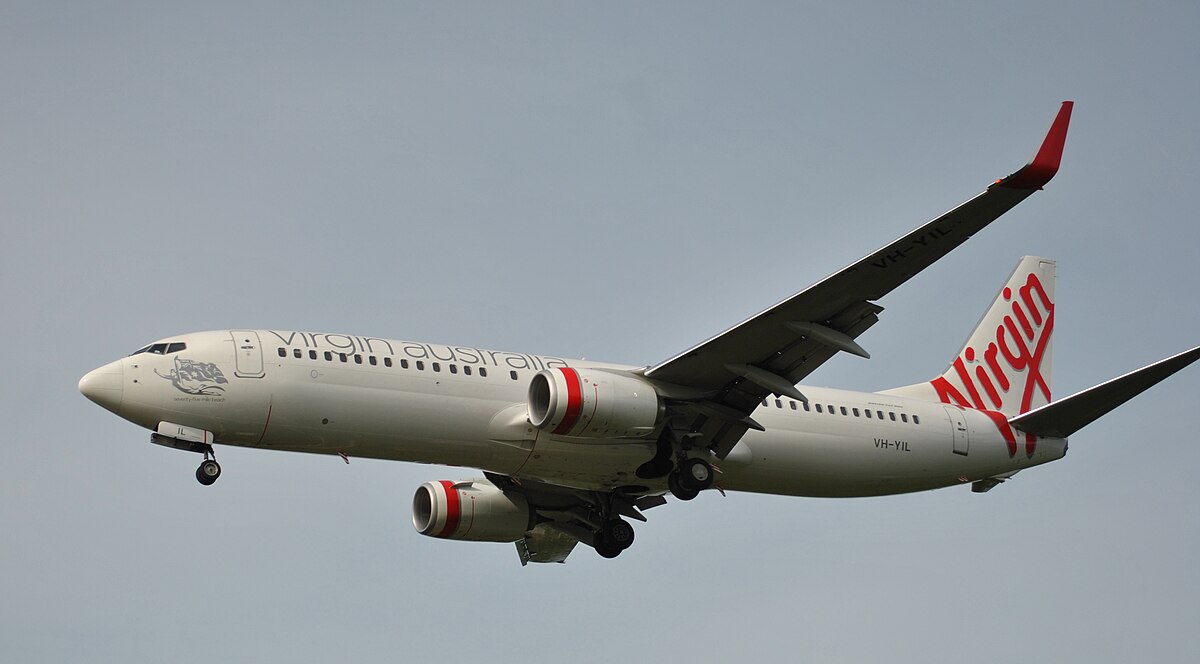
Virgin Australia B738 at Sydney on Jun 12th 2025, unstable approach
Last Update: September 30, 2025 / 18:12:50 GMT/Zulu time
Incident Facts
Date of incident
Jun 12, 2025
Classification
Report
Airline
Virgin Australia
Flight number
VA-920
Departure
Brisbane, Australia
Destination
Sydney, Australia
Aircraft Registration
VH-YIL
Aircraft Type
Boeing 737-800
ICAO Type Designator
B738
The Australian ATSB released ther final report concluding the probable causes of the incident were:
After air traffic control provided clearance for the crew to conduct a visual approach, a required autopilot altitude selection was not completed. As a result, the aircraft later deviated above the desired approach path.
- While re-establishing the approach path, the crew did not complete required landing procedures until after the aircraft descended below the stabilisation criteria check altitude. Subsequently the flight crew did not perform the required missed approach, instead continuing the approach and landing.
The ATSB analysed:
As the aircraft descended towards Sydney, the crew were provided with a visual approach clearance which the captain reported was unusual. After receiving the clearance, the captain unintentionally did not make the required 500 ft selection in the altitude window of the mode control panel. The first officer, as the pilot monitoring, did not identify that this omission had occurred. Consequently, as the aircraft descended to 2,000 ft the autopilot began to level off rather than continuing the descent to 500 ft, which took the aircraft above the desired descent profile. The captain responded with an unplanned manual intervention without alerting the first officer to their intention while the flight crew were also attempting to complete the final landing procedures. This led to an unexpected increase in flight crew workload and reduced the first officer’s situation awareness.
Workload has been defined as ‘reflecting the interaction between a specific individual and the demands imposed by a particular task. Workload represents the cost incurred by the human operator in achieving a particular level of performance’ (Orlady and Orlady, 1999). A discussion of the effect of workload on the completion of a task requires an understanding of an individual’s strategies for managing tasks.
An individual has a finite set of mental resources they can assign to a set of tasks (for example, performing an approach and landing). These resources can change given the individual’s experience and training and the level of stress being experienced at the time. An individual will seek to perform at an optimum workload by balancing the demands of their tasks. When workload is low, the individual will seek to take on tasks. When workload becomes excessive the individual must, as a result of their finite mental resources, shed tasks.
An individual can shed tasks in an efficient manner by eliminating performance on low priority tasks. Alternatively, they can shed tasks in an inefficient fashion by abandoning tasks that should be performed. Tasks make demands on an individual’s resources through the mental and physical requirements of the task, temporal demands and the wish to achieve performance goals (Hart and Staveland, 1988, and Lee and Liu, 2003).
In this case, likely in response to increased workload and the absence of crew coordination, they missed required checklist items (the final flap and speed brake selections). The stabilised approach criteria required that the aircraft be in the final landing configuration by 1,000 ft above the airport elevation. The landing flap selection was made 3 seconds after descending below this height, although the captain believed that the flap selection had been made in time to meet the stabilised approach criteria requirements. However, the flaps did not reach the required position until the aircraft descended through 875 ft above the airport elevation.
The first officer identified that the flap selection was made late and that, therefore, the stabilised approach criteria had not been met. However, as the descent rate, speed and profile were within the criteria, they announced that the approach was ‘stable’ instead of making the required ‘not stable’ announcement. Consequently, the required missed approach was not commenced, and the approach was continued. The first officer did not identify that the speed brake landing procedure action was not completed.
As the approach continued, the descent rate exceeded the stabilised approach criteria for a period of 9 seconds. This exceedance was momentary and not excessive and therefore it did not require the commencement of a missed approach.
When the unarmed speed brake was later identified by the captain, this should have acted as a further trigger for the commencement of a missed approach. Instead, this missed action was quickly rectified by the captain and the approach continued.
Incident Facts
Date of incident
Jun 12, 2025
Classification
Report
Airline
Virgin Australia
Flight number
VA-920
Departure
Brisbane, Australia
Destination
Sydney, Australia
Aircraft Registration
VH-YIL
Aircraft Type
Boeing 737-800
ICAO Type Designator
B738
This article is published under license from Avherald.com. © of text by Avherald.com.
Article source
You can read 2 more free articles without a subscription.
Subscribe now and continue reading without any limits!
Read unlimited articles and receive our daily update briefing. Gain better insights into what is happening in commercial aviation safety.
Send tip
Support AeroInside by sending a small tip amount.
Related articles
Virgin Australia B738 at Melbourne on Mar 15th 2026, passenger device ignited
A Virgin Australia Boeing 737-800, registration VH-YFU performing flight VA-328 from Brisbane,QL to Melbourne,VI (Australia), was descending towards…
Virgin Australia B738 at Hobart on Feb 4th 2026, flaps problems
A Virgin Australia Boeing 737-800, registration VH-YFS performing flight VA-1602 from Adelaide,SA to Hobart,TA (Australia), was on final approach to…
Virgin Australia B738 near Hobart on Jul 21st 2025, fire in cabin
A Virgin Australia Boeing 737-800, registration VH-YFY performing flight VA-1528 from Sydney,NS to Hobart,TA (Australia), had been enroute at FL380…
Virgin Australia B738 at Adelaide on Apr 11th 2025, insufficient takeoff distance
A Virgin Australia Boeing 737-800, registration VH-IJR performing flight VA-222 from Adelaide,SA to Melbourne,VI (Australia), lined up runway 23 via…
Virgin Australia B738 at Adelaide on Apr 11th 2025, insufficient takeoff distance
A Virgin Australia Boeing 737-800, registration VH-VOL performing flight VA-413 from Adelaide,SA to Sydney,NS (Australia), lined up runway 23 via…
Newest articles
China Airlines B744 near Whitehorse on Apr 18th 2026, smoke indication on board
A China Airlines Boeing 747-400 freighter, registration B-18721 performing flight CI-5239 from Chicago O'Hare,IL to Anchorage,AK (USA), was enroute…
KLM B772 at Amsterdam on Apr 16th 2026, smoke indication
A KLM Boeing 777-200, registration PH-BQF performing flight KL-862 from Tokyo Narita (Japan) to Amsterdam (Netherlands), was on final approach to…
Subscribe today
Are you researching aviation incidents? Get access to AeroInside Insights, unlimited read access and receive the daily newsletter.
Pick your plan and subscribePartner
ELITE Simulation Solutions is a leading global provider of Flight Simulation Training Devices, IFR training software as well as flight controls and related services. Find out more.
SafetyScan Pro provides streamlined access to thousands of aviation accident reports. Tailored for your safety management efforts. Book your demo today
AeroInside Blog
Popular aircraft
Airbus A320Boeing 737-800
Boeing 737-800 MAX
Popular airlines
American AirlinesUnited
Delta
Air Canada
Lufthansa
British Airways