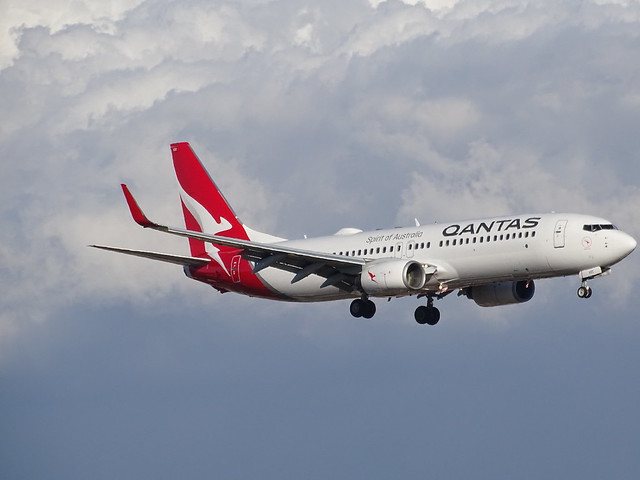
Tasman Cargo B763 at Sydney on Sep 10th 2025, descended below minimum safe altitude on final approach
Last Update: July 10, 2026 / 08:57:05 GMT/Zulu time
Incident Facts
Date of incident
Sep 10, 2025
Classification
Incident
Airline
Tasman Cargo Airlines
Flight number
HJ-22
Departure
Hong Kong, China
Destination
Sydney, Australia
Aircraft Registration
VH-XQU
Aircraft Type
Boeing 767-300
ICAO Type Designator
B763
Airport ICAO Code
YSSY
Australia's ATSB reported: "During approach, the aircraft descended below the minimum safe altitude. The approach controller received a minimum safe altitude warning (MSAW) and issued a safety alert. The crew subsequently conducted a missed approach.", rated the occurrence a serious incident and opened an investigation.
On Jul 10th 2026 the ATSB released their final report
Contributing factors
- Two Airbus A380s on the ground at Sydney Airport taxied through the instrument landing system critical area and in front of the glideslope antenna, causing interference to the glideslope signal. As a result, after detecting the interference, the Boeing 767's autopilot established the aircraft on a flight path that deviated away from the glideslope, before alerting the crew that it was operating in a degraded mode.
- The pilot flying continued the approach with the autopilot in a degraded mode. As a result, the aircraft’s high descent rate triggered an air traffic control minimum safe altitude warning. After disconnecting the autopilot, the pilot flying delayed the initiation of a missed approach and the aircraft descended below the localiser segment minimum safe altitude.
- The pilot monitoring did not effectively monitor the aircraft's flight path during the approach and did not call out deviations or advise the pilot flying to conduct a missed approach.
Other factors that increased risk
- Tasman Cargo Airlines allowed the practice of flight crew exchanging flying and monitoring roles prior to 1,500 ft when conducting a practice autoland. This increased the risk of role confusion or ambiguity during a high workload activity.
- Tasman Cargo Airlines’ training did not inform flight crew of the conditions under which instrument landing system critical areas were protected. Consequently, the flight crew believed that the critical area was being protected, and the risk of glideslope interference had been mitigated.
The ATSB analysed:
Glideslope interference
As the aircraft was intercepting the glideslope prior to the commencement of a practice autoland approach, an A380 aircraft holding at A1, within the ILS critical area, began moving onto the runway. A second A380 then entered the critical area as the first vacated. The movements of both aircraft coincided with anomalies observed in the glideslope signal received by the aircraft.
The weather conditions at Sydney Airport at the time were better than those for which protection of the ILS critical area was required. Therefore, ATC was not required to protect the area for a practice autoland. Furthermore, while the tower controller was required to inform the flight crew that the ILS was not being protected, the flight crew had not yet transferred to this controller. Therefore, there was no opportunity for the flight crew to be given this advice.
After initially attempting to capture the glideslope from below, the aircraft's descent rate increased away from the flight director pitch guidance, and it began deviating away from the glideslope. As described in the flight crew operations manual (FCOM) bulletin for ILS signal interference, when the autopilot flight director system (AFDS) detected an unstable glideslope signal it changed to an attitude stabilising mode. Cockpit alerts were subsequently displayed to alert the flight crew to the degraded performance of the autopilot. These alerts were consistent with those expected when the AFDS had been in attitude stabilising mode for 15 seconds. Therefore, the movement of the first A380 through the ILS critical area caused an interference to the glideslope signal, which was subsequently detected by the AFDS. As a result, after attempting to capture the glideslope prematurely, the AFDS entered and remained in an attitude stabilising mode before alerting the crew.
Descent below glideslope
Pilot flying
After the interference stopped, it is likely that the flight path deviation had increased beyond the threshold at which the AFDS could re-capture the glideslope. Therefore, the AFDS remained in attitude stabilising mode while the annunciations indicating the degraded performance of the autopilot continued to be displayed to the flight crew.
The pilot flying recognised that the autopilot was no longer following the glideslope, and that the aircraft was descending at a high rate. However, believing that they had sufficient time and altitude, they did not disengage the autopilot and commenced discussion and preparation for a change to a localiser approach. Both operator and manufacturer procedures required that if automation was not operating as expected then it should be disengaged and the aircraft flown manually. However, the pilot flying allowed flight below the glideslope to continue beyond the initial approach fix and below the approach commencement altitude.
After the aircraft’s flight path triggered a minimum safe altitude warning (MSAW), but prior to receiving the corresponding low altitude alert from ATC, the pilot flying did disconnect the autopilot. By this time, the aircraft’s position was significantly below the minimum sector altitude, below which a missed approach was required to be conducted when experiencing a failure of the glideslope. Furthermore, the manufacturer’s procedure specific to glideslope interference required a missed approach to be conducted when corresponding failure annunciations were displayed. These annunciations were continuously displayed throughout the approach. Following the disconnection of the autopilot, the pilot further delayed the initiation of a missed approach. During this period of manual flight, the aircraft descended a further 150 ft and below the localiser segment minimum safe altitude before a missed approach was commenced.
The ATSB considered the extended time between the MSAW being triggered and the flight crew receiving a low altitude alert. As the MSAW coincided with an instruction to the crew to contact the tower controller, the low altitude alert could not be given immediately because the approach controller was required to establish which frequency the crew were listening on. However, as the crew had already disconnected the autopilot and arrested the initial descent, this was not considered to be contributory.
Pilot monitoring
During the approach, the pilot monitoring was required to monitor the aircraft’s flight path and advise the pilot flying of any deviations. Specifically, when conducting an ILS approach, they were required to monitor the glideslope for deviation. If glideslope tracking deviated beyond one dot, a callout was required, and the flight path was required to be corrected by the pilot flying. When in instrument meteorological conditions
(IMC) further deviation outside of this required a missed approach. At the commencement of the approach, the glideslope deviation was recorded as already at 2 dots (full scale) and remained so throughout the approach. However, both the pilot flying and the pilot monitoring could not recall that the glideslope deviation pointer was displayed after the autopilot alerts activated. Furthermore, the manufacturer could not determine whether the pointer was displayed to the flight crew after the AFDS entered attitude stabilising mode.
Notwithstanding this, other flight instruments were available to monitor the aircraft’s flight path. The aircraft’s pitch attitude was more nose down than expected during an ILS approach. In addition, the vertical speed indicator would have been indicating a descent rate greater than expected. The FCOM bulletin advised flight crew to monitor both pitch attitude and descent rate during an ILS approach. Furthermore, the relief pilot called out required altitudes and distances during the approach, providing additional information regarding the aircraft’s position below the glideslope. As no deviation calls or requests to conduct a missed approach were reported as being made by the pilot monitoring, it is likely that they were not effectively monitoring the aircraft’s flight path throughout the approach.
...
Metars:
YSSY 100630Z AUTO 17017KT 3300 +RA BKN006 BKN021 OVC052 15/14 Q1005=
YSSY 100600Z 13016KT 5000 RA VCTS BKN006 BKN012 BKN018 FEW030CB 15/15 Q1004=
YSSY 100553Z 13015KT 8000 -RA VCTS SCT005 BKN012 BKN018 FEW025CB 15/15 Q1004 RESHRA=
YSSY 100530Z 14016KT 5000 RA VCSH SCT005 BKN012 16/15 Q1004=
YSSY 100500Z 16006KT 110V200 5000 SHRA SCT008 BKN018 BKN030 FEW025TCU 17/16 Q1004=
YSSY 100451Z 21003KT 5000 SHRA VCTS SCT010 BKN018 BKN030 FEW025CB 17/16 Q1004 RETS=
YSSY 100430Z 06005KT 8000 -TSRA SCT008 BKN018 BKN025 FEW025CB 17/16 Q1004=
YSSY 100425Z 05006KT 8000 -TSRA SCT008 BKN018 BKN025 FEW025CB 17/16 Q1004=
YSSY 100415Z 06008KT 6000 -SHRA SCT006 BKN012 BKN020 17/16 Q1004=
YSSY 100400Z 10006KT 4000 +DZ SCT005 BKN010 BKN018 16/16 Q1004=
Incident Facts
Date of incident
Sep 10, 2025
Classification
Incident
Airline
Tasman Cargo Airlines
Flight number
HJ-22
Departure
Hong Kong, China
Destination
Sydney, Australia
Aircraft Registration
VH-XQU
Aircraft Type
Boeing 767-300
ICAO Type Designator
B763
Airport ICAO Code
YSSY
This article is published under license from Avherald.com. © of text by Avherald.com.
Article source
You can read 2 more free articles without a subscription.
Subscribe now and continue reading without any limits!
Read unlimited articles and receive our daily update briefing. Gain better insights into what is happening in commercial aviation safety.
Send tip
Support AeroInside by sending a small tip amount.
Related articles
Tasman Cargo B763 at Auckland and enroute on Jul 27th 2019, fuel imbalance
A Tasman Cargo Airlines Boeing 767-300 freighter, registration VH-EXZ performing flight HJ-1 from Auckland (New Zealand) to Sydney,NS (Australia),…
Tasman Cargo B752 at Auckland on Feb 5th 2018, hydraulic leak, two hydraulic systems failed
A Tasman Cargo Airlines Boeing 757-200 freighter in DHL Colours, registration VH-TCA performing flight HJ-1 from Auckland (New Zealand) to Sydney,NS…
Newest articles
United B738 at San Francisco on Aug 6th 2026, tyre damage on departure
A United Boeing 737-800, registration N76504 performing flight UA-1189 from San Francisco,CA (USA) to San Jose del Cabo (Mexico), was climbing out of…
Egypt B738 at Brussels on Aug 7th 2026, flaps problem
An Egypt Air Boeing 737-800, registration SU-GDA performing flight MS-725 from Cairo (Egypt) to Brussels (Belgium) with 132 passengers and 6 crew,…
Subscribe today
Are you researching aviation incidents? Get access to AeroInside Insights, unlimited read access and receive the daily newsletter.
Pick your plan and subscribePartner
ELITE Simulation Solutions is a leading global provider of Flight Simulation Training Devices, IFR training software as well as flight controls and related services. Find out more.
SafetyScan Pro provides streamlined access to thousands of aviation accident reports. Tailored for your safety management efforts. Book your demo today
AeroInside Blog
Popular aircraft
Airbus A320Boeing 737-800
Boeing 737-800 MAX
Popular airlines
American AirlinesUnited
Delta
Air Canada
Lufthansa
British Airways