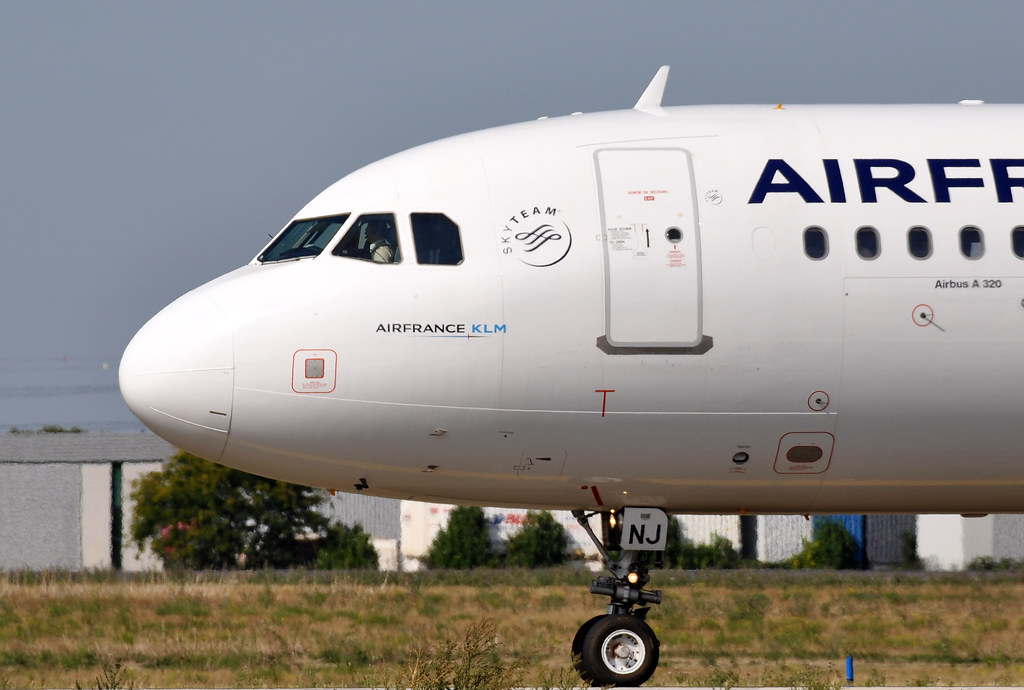
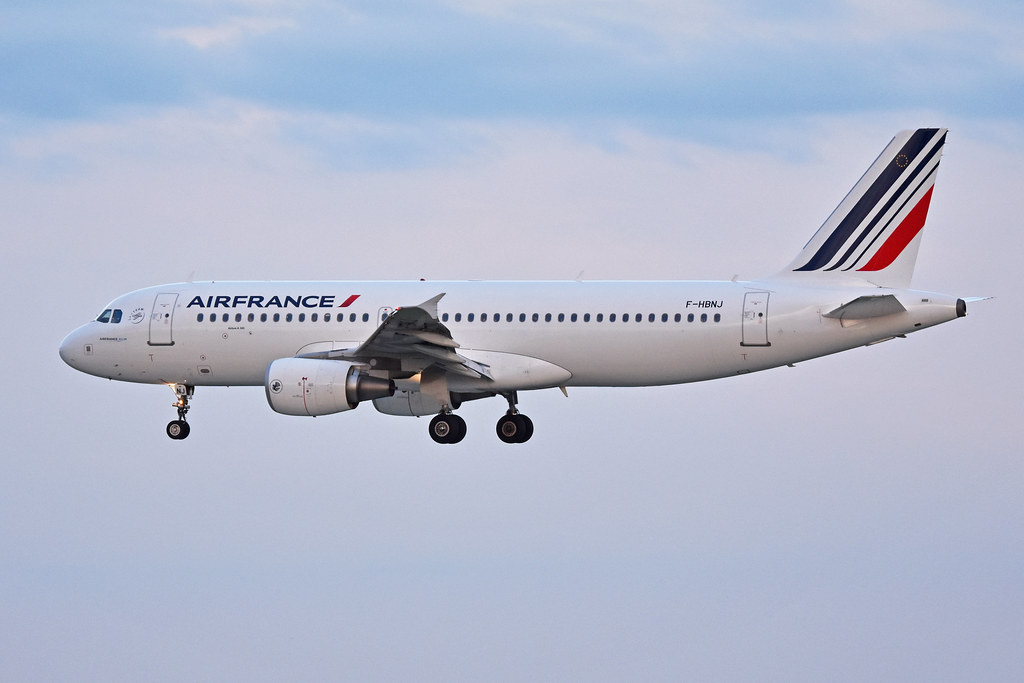
France A320 at Ajaccio on Aug 20th 2025, turbulence injures 5
Last Update: August 12, 2026 / 15:59:38 GMT/Zulu time
Incident Facts
Date of incident
Aug 20, 2025
Classification
Accident
Airline
Air France
Flight number
AF-4236
Departure
Paris Orly, France
Destination
Ajaccio, France
Aircraft Registration
F-HBNJ
Aircraft Type
Airbus A320
ICAO Type Designator
A320
The French BEA reported the aircraft entered an area of severe turbulence, 5 people on board received serious injuries. The occurrence was rated an accident and is being investigated.
On Jul 22nd 2026 the BEA released their final report in French (an English version can be expected in due time) concluding the probable causes of the accident were:
The following may have contributed to the late detection of an area of severe convective turbulence during the descent:
- a relatively high workload in the fifteen minutes or so preceding the passage through the area of turbulence: arrival briefing and performance calculations, course changes, radio frequency changes, discussion regarding the passenger present in the forward galley, checking weather conditions at neighbouring airfields, and announcements to passengers;
- a possible lapse in vigilance whilst flying over the Mediterranean Sea, which may have compromised active radar surveillance. The weather forecasts consulted prior to departure were favourable for the overflight of the sea, and the isolated convective cell was not identified by eWAS, which had been consulted prior to the descent;
- the use of an on-board weather radar requiring regular manual adjustments to the tilt, during an already busy phase of flight. The latest-generation radars have automatic functions that facilitate detection;
- the failure of air traffic control to provide information regarding the development of the convective cell on the aircraft’s flight path. This information could have been displayed on a secondary screen available to the controllers on duty. The guidelines for controllers erroneously suggest that this information is less accurate than that available on board.
on Aug 12th 2026 the BEA released their English Version of the final report
The BEA analysed:
...
A little earlier in the flight, a passenger had asked the purser and PNC 4 if he could lie down in the forward galley to ease pain. The purser did not inform the flight crew of this. The purser indicated that subsequently she had not had time to carry out the last briefing with the flight crew as the partner of the passenger lying down in the galley had requested her help in relieving the pain of her partner. She had joined her partner with the children who were accompanying them, in the galley. In the cockpit, a few minutes before the turbulence, the two pilots had had discussions about the presence of this passenger on the floor.
Detection of the convective cell and flight in area of turbulence
The PF explained that a green radar echo had suddenly appeared on his ND, slightly to the left of their course at a distance of around 70 NM11. Shortly after this, the PM had proposed activating the “Fasten seatbelt” light. The PF had not considered that this echo was a threat, but accepted the preventive measure proposed by the PM. The PM could no longer recall the echoes on the radar, but in hindsight she thought that there must have been small green echoes, without risk, on the aeroplane’s flight path. The PF specified that when he reduced the tilt of the airborne weather radar to analyse the echo he had identified in the distance, the echo disappeared. He increased the tilt and yellow spots then appeared in the green echoes situated nearby. Suddenly, a small red radar echo appeared on the flight path ahead of them, just before the ND became completely red. The airborne radar gain remained in the CAL position. The PM explained that she modified the range of her ND to try to determine an immediate avoidance strategy and that she then looked outside the aeroplane to validate the consistency of the information shown on the ND; she made out a darker area on her right-hand side, embedded in the cloud mass. As a consequence, she indicated to the PF that she would have gone to the left. The PF explained that he first used the HDG lateral navigation mode to head to the right and then returned to NAV mode after the PM’s comment to head left before using the HDG mode again having identified a way out on the right-hand side.
When the seatbelt light was illuminated, PNC 2 contacted the purser to ask whether she should carry out the standard turbulence announcement (see paragraph 2.6) or the last before landing announcement. As the aeroplane was in descent and the air was stable, they chose to make the before landing announcement. The purser specified that she anticipated this announcement, as the checks were longer for flights bound for Corsica12. PNC 2 made the associated announcement. PNC 3 starting from the aft of the cabin and PNC 4 starting from the front, began the cabin checks. The purser asked the passenger in pain and his family present in the forward galley to return to their seats
All the crew members specified that the turbulence was very severe and that they grabbed what they could when they could. After the turbulence, the aim of the injured cabin crew was to protect themselves by fastening their seatbelts (see paragraph 2.2.1). PNC 2 explained that she was able to haul herself up onto a seat in the aft galley, she principally had pain in her back. PNC 3 explained that her foot hurt after striking an armrest and that she was able to sit down in a passenger seat where she stayed until the end of the flight. PNC 4 was able to get up and walk to the forward galley, put away the few objects that had fallen to the ground and sit down. At the same time, the purser went to the rear to check on how PNC 2 and 3 were doing. Two passengers, including one who had fallen to the ground, asked her for help for pain. One passenger who was bleeding from the head, and who she thought seemed to be the most seriously injured, told her that he was fine. The purser explained that she had understood that the two cabin crew had hurt themselves but she did not realise that they had been seriously injured. The two cabin crew explained that they had perhaps not been sufficiently explicit about this, they were stunned. The purser explained that she saw PNC 4 continuing with her tasks and did not realise that she too had been seriously injured. All the crew members added that they were in shock. The purser explained that she lost the notion of time. She indicated that most of the passengers had their seatbelts fastened during the turbulence.
The two flight crew specified that they had not had time to make the prescribed announcement to warn the cabin crew. They added that no element available to them allowed them to identify this area.
End of flight after flight in area of turbulence
The two pilots indicated that given the violence of the turbulence, they suspected that there would be injured persons in the cabin. The message from the purser confirmed this. The purser explained that she communicated with the pilots in the cockpit by interphone to avoid disturbing them as they would have been busy with the end of the flight and that she preferred staying seated at this point. She expected the pilots to ask for medical assistance after her message. The captain explained that he decided not to inform traffic control (nor make an AIREP13 nor ask for assistance) following this occurrence, due to lack of time, in order to prioritize piloting and the flight path and to keep resources available for managing the imminent approach and landing phases. According to him, there would have been no benefit in doing this. He specified that he did not share this thought process with the co-pilot. They were cleared for the approach, were number 1 and close to their destination. The co-pilot specified that in hindsight, the provision of information could have raised the awareness of other pilots in the area of the severity of the phenomenon encountered, however, there was little available time.
After landing, the purser realised that the cabin crew in the aft galley could not disarm the slides and open the door for the passengers to disembark. She headed towards the rear and saw a passenger in uniform, a pilot for another operator, carry out, on being requested to do so by the aft galley cabin crew, the passenger disembarkation actions. On the apron, the purser entered the cockpit and asked the pilots to call the emergency services. The pilots then asked for medical assistance.
The BEA reported the purser received minor injuries, the other three cabin crew received serious injuries (fractures). Two passengers, one of them seated with the seat belt fastened but loosening during the turbulence encounter, also received fractures.
Incident Facts
Date of incident
Aug 20, 2025
Classification
Accident
Airline
Air France
Flight number
AF-4236
Departure
Paris Orly, France
Destination
Ajaccio, France
Aircraft Registration
F-HBNJ
Aircraft Type
Airbus A320
ICAO Type Designator
A320
This article is published under license from Avherald.com. © of text by Avherald.com.
Article source
You can read 2 more free articles without a subscription.
Subscribe now and continue reading without any limits!
Read unlimited articles and receive our daily update briefing. Gain better insights into what is happening in commercial aviation safety.
Send tip
Support AeroInside by sending a small tip amount.
Related articles
France A320 near Lyon on Dec 20th 2025, engine shut down in flight
An Air France Airbus A320-200, registration F-HBNJ performing flight AF-7562 from Paris Orly to Ajaccio (France), had just levelled off at FL390 when…
France B773 at New York on Aug 19th 2026, bird strike
An Air France Boeing 777-300, registration F-GZNT performing flight AF-5 from New York JFK,NY (USA) to Paris Charles de Gaulle (France), departed…
France A320 near Porto on Aug 9th 2026, odour in cabin
An Air France Airbus A320-200, registration F-HEPD performing flight AF-1162 from Paris Charles de Gaulle (France) to Tenerife South,CI (Spain), was…
France BCS3 near Amsterdam on May 25th 2026, fumes on board
An Air France Bombardier C-Series CS-300, registration F-HPNZ performing flight AF-1750 from Paris Charles de Gaulle (France) to Copenhagen…
France B772 near Munich on May 7th 2026, engine problem
An Air France Boeing 777-200, registration F-GSPY performing flight AF-111 from Shanghai (China) to Paris Charles de Gaulle (France), was enroute at…
France B773 at Los Angeles on Apr 8th 2026, rejected takeoff due to runway incursion
An Air France Boeing 777-300, registration F-GZNP performing flight AF-25 from Los Angeles,CA (USA) to Paris Charles de Gaulle (France), was cleared…
Newest articles
ANA B789 at Houston on Feb 27th 2026, tail strike on landing
An ANA All Nippon Airways Boeing 787-9, registration JA873A performing flight NH-114 from Tokyo Haneda (Japan) to Houston Intercontinental,TX (USA)…
21 Air B763 at Miami on Sep 6th 2026, overran runway
A 21 Air Boeing 767-300 freighter on behalf of Amazon Prime, registration N1997A performing flight 2I-7598 from San Juan (Puerto Rico) to Miami,FL…
Subscribe today
Are you researching aviation incidents? Get access to AeroInside Insights, unlimited read access and receive the daily newsletter.
Pick your plan and subscribePartner
ELITE Simulation Solutions is a leading global provider of Flight Simulation Training Devices, IFR training software as well as flight controls and related services. Find out more.
SafetyScan Pro provides streamlined access to thousands of aviation accident reports. Tailored for your safety management efforts. Book your demo today
AeroInside Blog
Popular aircraft
Airbus A320Boeing 737-800
Boeing 737-800 MAX
Popular airlines
American AirlinesUnited
Delta
Air Canada
Lufthansa
British Airways