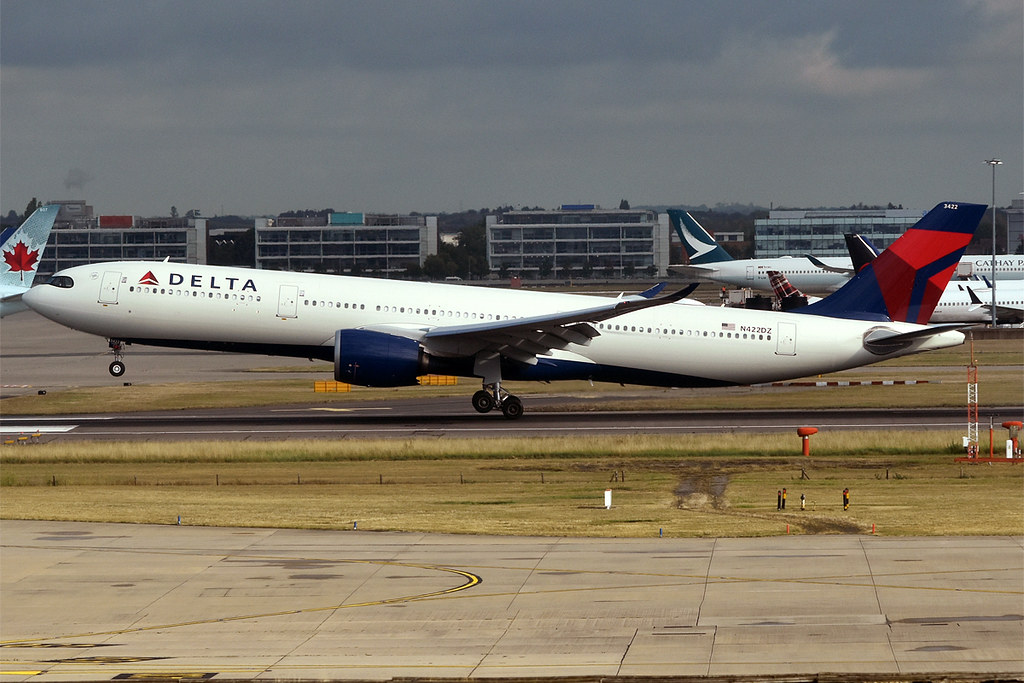
Delta A339 near Minneapolis on Jul 30th 2025, turbulence injures 25
Last Update: September 10, 2025 / 14:30:34 GMT/Zulu time
Incident Facts
Date of incident
Jul 30, 2025
Classification
Accident
Airline
Delta Airlines
Flight number
DL-56
Departure
Salt Lake City, United States
Destination
Amsterdam, Netherlands
Aircraft Registration
N422DZ
Aircraft Type
Airbus A330-900
ICAO Type Designator
A339
The airline reported 25 people were taken to hospitals.
Passengers reported they were told one of the flight attendants had suffered a broken rib, another person a fractured leg. The trolleys had been lifted and impacted the cabin ceiling and fell to the floor several times, passengers not wearing their seat belts also hit the cabin ceiling. The crew announced they had lost more than 1000 feet of altitude, they hadn't seen such severe turbulence ever before.
According to radar data the aircraft encountered altitude deviations from FL370 up to FL376 and down to FL360 about 80nm southwest of Casper,WY (USA) about 55 minutes prior to leaving FL370 for the diversion to Minneapolis.
The FAA reported: "AIRCRAFT ENCOUNTERED SEVERE TURBULANCE ENROUTE", stated the location as near Rawlins,WY (USA). One cabin crew received serious, 3 other cabin crew "unknown" injuries.
On Aug 8th 2025 the NTSB reported the aircraft was in cruise when it skirted an area of adverse weather, encountered an updraft and severe turbulence. The aircraft's altitude increased from FL370 to FL380 and then decreased to about FL360. There were a number of serious injuries, the occurrence was rated an accident and is being investigated by the NTSB.
The occurrence aircraft returned to service on Aug 2nd 2025.
On Sep 10th 2025 the NTSB released their preliminary report summarizing the sequence of events:
According to the flight crew, prior to departure they had discussed the conditions along the route, noting that they could expect some weather during the climb, and that turbulence was predicted over the mountains east of SLC. They anticipated deviating after crossing the mountains. The departure was relatively smooth, until they reached the Wasatch Mountains, where they experienced some turbulence. As they passed through flight level (FL) 300, the ride had smoothed out enough to allow the cabin crew to begin service. At FL350, where they remained for about 5 minutes due to traffic, they noted that the turbulence predicted on their electronic flight bag weather application was “in the green” and they had observed only light cirrus clouds. About this time the captain turned off the seatbelt sign. As the climb continued to FL370, they noticed some weather buildups and requested a right deviation from air traffic control (ATC). ATC suggested a left turn to a heading of 350°. The crew assessed that heading would keep them above the cloud deck, upwind of weather buildups, and they had not heard any adverse ride reports. After scanning the horizon and the weather radar, noting that the only returns of concern were 40-50 miles away, they accepted the left turn.
After completing the turn, the airplane encountered an overspeed event (exceeding the maximum operating speed by about 15-20 knots), along with an updraft that carried it to FL380 over the course of about 20 seconds, during which the autopilot disengaged. Shortly thereafter, the airplane descended ‘rapidly’ to FL355, and a climb/descent cycle repeated about three times over a two- to three-minute period, which resulted in the airplane re-entering a cloud layer. The first officer who was the pilot flying (PF), initiated the All Attitude Upset Recovery Strategy procedure at least once during this time, before having recovered and re-engaged the autopilot.
A review of preliminary flight data recorder information revealed that the upset lasted approximately 2.5 minutes. During this time, the vertical acceleration oscillated, reaching a maximum positive peak of about 1.75 g and a minimum negative peak of about -0.5 g. The pitch angle also oscillated, ranging from a low of about 5° nose down to a high of about 10° nose up. Roll angle variations included a maximum of about 40° left wing down and about 5° right wing down. Computed airspeed fluctuated as well, with peaks ranging from about 230 knots to about 290 knots.
A convective Significant Meteorological Information (SIGMET) was in effect for the time and area of the accident. It warned of thunderstorms moving from the southwest at 10 knots, with cloud tops above FL450. Figure 1 shows the airplane’s ground track and radar imagery from the National Weather Service at the time of the accident.
After the event, the captain divided cockpit duties. The PF continued to fly and manage ATC communications, while the captain coordinated with the cabin crew and dispatch. The relief first officer, who had been in the crew rest bunk, walked through the cabin to assess injuries and gather information. A passenger who was a physician assistant aided the cabin crew with triage. After the relief first officer returned to the flight deck, the crew planned for a diversion and declared an emergency with ATC. They elected to divert to MSP to avoid weather and reviewed overweight landing performance data and suitable runways. After landing, they noticed that the right main landing gear brakes were hot and notified ground personnel. They taxied to the gate and were met by airport rescue firefighting, medical, and maintenance personnel.
Aircraft Registration Data
Incident Facts
Date of incident
Jul 30, 2025
Classification
Accident
Airline
Delta Airlines
Flight number
DL-56
Departure
Salt Lake City, United States
Destination
Amsterdam, Netherlands
Aircraft Registration
N422DZ
Aircraft Type
Airbus A330-900
ICAO Type Designator
A339
This article is published under license from Avherald.com. © of text by Avherald.com.
Article source
You can read 2 more free articles without a subscription.
Subscribe now and continue reading without any limits!
Read unlimited articles and receive our daily update briefing. Gain better insights into what is happening in commercial aviation safety.
Send tip
Support AeroInside by sending a small tip amount.
Related articles
Delta A339 over Canada on Sep 22nd 2023, pilot incapacitated
A Delta Airlines Airbus A330-900, registration N422DZ performing flight DL-291 from Paris Charles de Gaulle (France) to Los Angeles,CA (USA), was…
Delta A333 at Sao Paulo on Mar 29th 2026, engine failure starts fire on ground
A Delta Airlines Airbus A330-300, registration N813NW performing flight DL-104 from Sao Paulo Guarulhos,SP (Brazil) to Atlanta,GA (USA) with 272…
Delta BCS1 near Oakland on Apr 7th 2026, odour on board
A Delta Airlines Bombardier C-Series CS-100, registration N136DQ performing flight DL-1430 from Santa Ana,CA to Seattle,WA (USA), was enroute at…
Delta B738 at Chicago on Apr 7th 2026, loss of cabin pressure
A Delta Airlines Boeing 737-800, registration N3765 performing flight DL-2041 from Chicago O'Hare,IL to Seattle,WA (USA), was climbing out of…
Delta A359 near Antofagasta on Mar 31st 2026, engine problems
A Delta Airlines Airbus A350-900, registration N513DZ performing flight DL-147 (dep Mar 30th) from Atlanta,GA (USA) to Santiago (Chile), was enroute…
Delta B739 near Richmond on Mar 27th 2026, engine failure
A Delta Airlines Boeing 737-900, registration N908DN performing flight DL-1082 from Atlanta,GA to Hartford,CT (USA) with 83 people on board, was…
Newest articles
Batik Malaysia B738 at Kuala Lumpur on Apr 12th 2026, engine problems
A Batik Air Malaysia Boeing 737-800, registration 9M-LNP performing flight OD-293 from Kuala Lumpur (Malaysia) to Male (Maldives), was climbing out…
United B753 at Chicago on Apr 12th 2026, door problem
A United Boeing 757-300, registration N57857 performing flight UA-576 from Chicago O'Hare,IL to Los Angeles,CA (USA), was climbing out of Chicago…
Subscribe today
Are you researching aviation incidents? Get access to AeroInside Insights, unlimited read access and receive the daily newsletter.
Pick your plan and subscribePartner
ELITE Simulation Solutions is a leading global provider of Flight Simulation Training Devices, IFR training software as well as flight controls and related services. Find out more.
SafetyScan Pro provides streamlined access to thousands of aviation accident reports. Tailored for your safety management efforts. Book your demo today
AeroInside Blog
Popular aircraft
Airbus A320Boeing 737-800
Boeing 737-800 MAX
Popular airlines
American AirlinesUnited
Delta
Air Canada
Lufthansa
British Airways