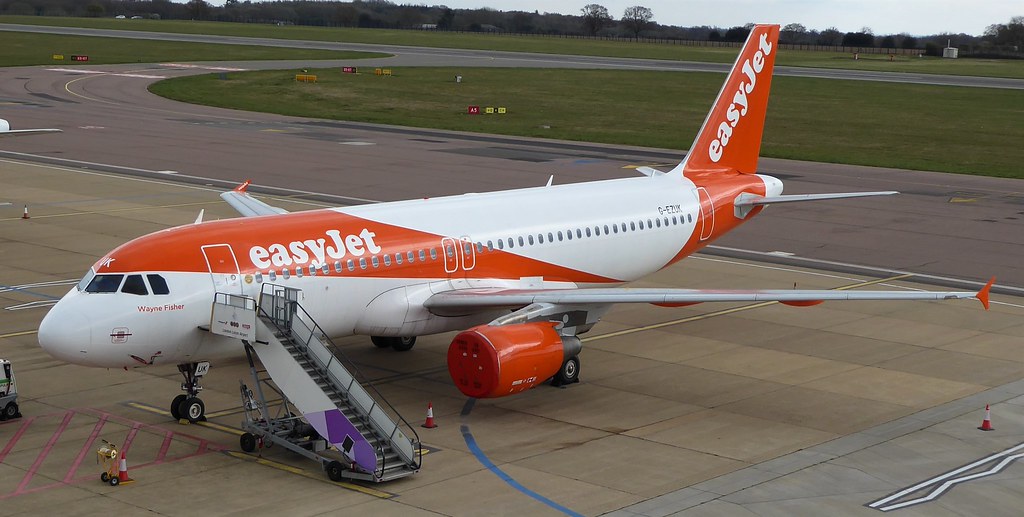
Easyjet A320 at London on Jun 13th 2025, unplanned intersection takeoff
Last Update: June 12, 2026 / 18:09:57 GMT/Zulu time
Incident Facts
Date of incident
Jun 13, 2025
Classification
Incident
Airline
Easyjet
Flight number
U2-2335
Departure
London Luton, United Kingdom
Destination
Malaga, Spain
Aircraft Registration
G-EZUK
Aircraft Type
Airbus A320
ICAO Type Designator
A320
Airport
London Luton Airport, London
Airport ICAO Code
EGGW
The British AAIB rated the occurrence a serious incident and opened an investigation stating: "Under the conditions of the day, it was not possible to calculate the take-off performance from intersection A."
On a second flight departing Luton that day the aircraft did backtrack and used the full length of the runway for departure.
On Jun 11th 2026 the AAIB released their final bulletin concluding the probable causes of the serious incident were:
The aircraft took off using a shorter TORA than had been used to calculate aircraft takeoff performance. While there were a few opportunities to trap this error, they were missed, probably by a combination of the crews’ habitual behaviour and confirmation bias.
Takeoff performance serious incidents continue to occur, and this one demonstrated that crews must be resilient to confirmation bias and the normalising of regular types of departure.
The AAIB stated:
The crew calculated takeoff performance using flaps at CONF 1+F, for a takeoff from Runway 25 at LTN, at a weight of 68,887 kg. They input a wind from 160° at 4 kt as a worst case. Figure 2 shows the indications on the EFB showing that the takeoff was not permitted from Intersection Alpha for the conditions input.
The operator’s FDM recorded that the aircraft lifted off about 310 m from the threshold of Runway 07 and was at 65 ft radio altitude over the threshold of Runway 07.
Analysis by the aircraft manufacturer suggested that in the event of an engine failure at V1, with the takeoff continued, the obstacle clearance requirements of the net takeoff flight path would have been met. They also calculated that in the event of a rejected takeoff at V1 with One Engine Inoperative (OEI) that the Accelerate Stop Distance Required (ASDR) would have been 1,666 m. In the event of a rejected takeoff at V1 with All Engine Operative (AEO) the ASDR would have been 1,680 m. Given the ASDA from Intersection Alpha is 1,828 m, the margin would have been 187 m OEI and 173 m AEO. There was thus no runway overrun potential for all rejected takeoff scenarios.
The AAIB analysed:
The aircraft was ready to depart slightly ahead of schedule and there were no external distractions that may have led to the crew rushing or forgetting their requirement to depart from the full-length of Runway 25.
While the crew briefed potential threats, including the aircraft’s higher-than-normal weight, an opportunity was missed to highlight the requirement to takeoff from the lesser used full-length, as opposed to the more common intersection.
Once the push back was completed the commander requested clearance to taxi. ATC responded with, “are you [Intersection] alpha able?” to which the commander incorrectly replied “affirm”. As the commander had departed from an intersection many times recently, this was likely to have been a habitual response, and it was not noticed by the co-pilot.
Despite another aircraft stating that they were “requiring full-length”, just before the aircraft was transferred to the Tower frequency, this did not cause the crew to realise that that they too required the full-length, as they may have been busy completing other tasks before departure. Added to the fact that they observed three preceding aircraft line-up and depart from the Intersection Alpha it is likely their mental model was reinforced by confirmation bias.
The PEDS review aimed to be the final check of the actual takeoff performance data versus that computed, and it relied on crew’s memory. There was no requirement to crosscheck the performance that was stated by the PM against what was calculated. In this case the commander, as PM, believed he stated that they were taking off from the intersection and had planned to do so, probably because of habitual behaviour and confirmation bias. This was not captured by him or the co-pilot as it was likely engrained in their mental model from the initial call from ATC, and it was an habitual call.
It was not standard practice to enter the takeoff shift in the MCDU. Had it been used regularly, and had the crew seen it was blank for their full-length take off, it may have reminded them of the requirement to do so, or they might have queried why the takeoff shift distance had not been entered for the departure from the intersection.
Metars:
EGGW 130650Z AUTO 19005KT 140V230 9999 NCD 18/15 Q1019=
EGGW 130620Z AUTO 16005KT 140V210 9999 NCD 17/15 Q1018=
EGGW 130550Z AUTO 15005KT 130V190 9999 NCD 16/15 Q1018=
EGGW 130520Z AUTO 18004KT 130V220 9999 NCD 15/14 Q1018=
EGGW 130450Z AUTO 19004KT 150V230 9000 NCD 15/14 Q1018=
EGGW 130420Z 19003KT 160V220 9000 NSC 14/14 Q1017=
EGGW 130350Z AUTO 19005KT 160V220 9000 NCD 14/14 Q1017=
EGGW 130320Z AUTO 18004KT 150V220 9999 NCD 15/14 Q1017=
EGGW 130250Z AUTO 19004KT 160V220 9999 NCD 15/14 Q1017=
Incident Facts
Date of incident
Jun 13, 2025
Classification
Incident
Airline
Easyjet
Flight number
U2-2335
Departure
London Luton, United Kingdom
Destination
Malaga, Spain
Aircraft Registration
G-EZUK
Aircraft Type
Airbus A320
ICAO Type Designator
A320
Airport
London Luton Airport, London
Airport ICAO Code
EGGW
This article is published under license from Avherald.com. © of text by Avherald.com.
Article source
You can read 2 more free articles without a subscription.
Subscribe now and continue reading without any limits!
Read unlimited articles and receive our daily update briefing. Gain better insights into what is happening in commercial aviation safety.
Send tip
Support AeroInside by sending a small tip amount.
Related articles
 Fleet type match
Easyjet A320 near Bristol on Nov 28th 2021, loss of cabin pressure
An Easyjet Airbus A320-200, registration G-EZUK performing flight U2-6816 from Jersey,CI to Glasgow,SC (UK), had been scheduled for Nov 27th, but…
 Fleet type match
Easyjet A319 at Rimini on Aug 19th 2026, engine problem
An Easyjet Airbus A319-100, registration G-EZAN performing flight U2-8378 from Rimini (Italy) to London Gatwick,EN (UK), was climbing out of Rimini's…
 Fleet type match
Easyjet A20N at Keflavik on Jun 20th 2026, pilot incapacitated
An Easyjet Airbus A320-200N, registration G-UZLY performing flight U2-3315 from Edinburgh,SC (UK) to Keflavik (Iceland) with 168 passengers and 6…
 Fleet type match
Easyjet A320 near Munich on Jun 17th 2026, pilot incapacitated
An Easyjet Airbus A320-200, registration G-EZUN performing flight U2-3223 from Edinburgh,SC (UK) to Heraklion (Greece), was enroute at FL370 about…
 Fleet type match
Easyjet A20N near Rome on May 19th 2026, charging power bank in cargo hold
An Easyjet Airbus A320-200N, registration G-UZEH performing flight U2-2618 from Hurghada (Egypt) to London Luton,EN (UK), was enroute at FL360 about…
 Fleet type match
Easyjet A21N near Milan on May 12th 2026, first officer incapacitated
An Easyjet Airbus A321-200N, registration G-UZME performing flight U2-2058 from Heraklion (Greece) to Manchester,EN (UK), was enroute at FL340 about…
Newest articles
Transair B735 at Nouakchott on Sep 10th 2026, runway excursion
A Transair Boeing 737-500, registration 6V-AJD performing charter flight R2-4401 from Dakar (Senegal) to Nouakchott (Mauritania) carrying the soccer…
Sepehran B733 at Mashhad on Sep 14th 2026, rejected takeoff due to severe vibrations
A Sepehran Boeing 737-300, registration EP-FSU performing flight SHI-4358 from Mashhad to Kermanshah (Iran), was accelerating on Mashhad's runway 31L…
Subscribe today
Are you researching aviation incidents? Get access to AeroInside Insights, unlimited read access and receive the daily newsletter.
Pick your plan and subscribePartner

ELITE Simulation Solutions is a leading global provider of Flight Simulation Training Devices, IFR training software as well as flight controls and related services. Find out more.
SafetyScan Pro provides streamlined access to thousands of aviation accident reports. Tailored for your safety management efforts. Book your demo today
AeroInside Blog
Popular aircraft
Airbus A320Boeing 737-800
Boeing 737-800 MAX
Popular airlines
American AirlinesUnited
Delta
Air Canada
Lufthansa
British Airways