Eurowings Malta A320 at Paderborn on May 22nd 2025, tail strike on landing
Last Update: July 9, 2026 / 16:22:29 GMT/Zulu time

Incident Facts
Date of incident
May 22, 2025
Classification
Incident
Cause
Tail strike on landing
Airline
Eurowings Europe Malta
Flight number
EW-6838
Departure
Palma de Mallorca, Spain
Destination
Paderborn, Germany
Aircraft Registration
9H-EUT
Aircraft Type
Airbus A320
ICAO Type Designator
A320
Airport ICAO Code
EDLP
Passengers reported the aircraft touched down extremely hard, then climbed steeply out. The crew later announced that a sudden gust of wind forced them to go around. After second touch down emergency services attended to the aircraft. Checked luggage was damaged.
The airline reported the aircraft unexpectedly lost height shortly before touchdown and touched down hard with its main gear, the crew initiated a go around, the tail contacted the runway surface. The aircraft is currently being examined.
The aircraft remained on the ground in Paderborn until Jun 6th 2025, then positioned to Sofia (Bulgaria) and returned to service on Jul 9th 2025.
On Jun 13th 2025 the BFU reported the rear fuselage hit the runway, the damage was minor, the occurrence was rated an incident and is being investigated by the BFU.
On Oct 11th 2025 The Aviation Herald received information, that the first officer was pilot flying, the captain pilot monitoring. The approach had been stable until about 80 feet AGL when a significant wind change occurred resulting in 3 knots tail wind instead of 9 knots headwind causing loss of lift and airspeed. Just before touchdown dual nose up inputs were recorded however insufficient to arrest the descent, the aircraft touched down at +2.26G at about 7 degrees nose up. The dual nose up input continued for several seconds and amounted temporarily to full nose up deflection and caused the aircraft to pitch up to 13.4 degrees nose up, the tail contacted the runway surface. 2 seconds after touch down TOGA was applied at 121 KIAS, together with the pitch up effect by the go around thrust and the stick inputs the aircraft remained in a tail strike attitude. After becoming airborne again the captain took control of the aircraft, positioned for another approach and landed without further incident.
On Dec 4th 2025 Germany's BFU released their preliminary report summarizing the sequence of events:
At 14:17:51 UTC, the announcement ‘Minimum’ was automatically generated by the aircraft system. Shortly thereafter, the pilot-in-command said: ‘Keep sinking, keep descending’.
At 14:17:59 UTC, the announcement ‘One hundred’, automatically generated by the aircraft system, was heard. The pilot-in-command instructed the co-pilot to direct the aircraft towards the centre of the runway. Shortly thereafter, he said several times to the co-pilot: ‘Flare’.
At 14:18:07 UTC, the aircraft touched down on the runway 24 with a vertical acceleration of 2.26 g. The digital flight data recorder recorded the following parameters at that time:
- The pitch command from the copilot was +11.34° (PITCH CMD+ POS-F/O (deg)).
- The longitudinal angle of inclination was +7° in the landing flare phase and reached a maximum value of +13° as the main landing gear touched the runway.
- The angle of attack (AOA) reached a value of +20.4°.
- The minimum recorded flight speed was 123 kt IAS.
- A dual input of the sidesticks (PITCH CMD+ POS-CAPT (deg) & PITCH CMD+POS-F/O (deg)) was recorded between 14:18:07 UTC and 14:18:15 UTC.
At 14:18:08 UTC, the aircraft system automatically generated ‘Dual Input’ and ‘Pitch’ announcements.
At 14:18:09 UTC, the pilot-in-command initiated the go-around manoeuvre and took over the control (pilot flying). At that moment, the copilot became the pilot monitoring.
The pilot-in-command pressed one of the two TO/GA buttons on the engine thrust levers and initiated the climb. The engines reached the TO/GA engine thrust shortly thereafter.
At 14:18:10 UTC, the ‘pitch’ and ‘retard’ announcements automatically generated by the aircraft system were heard.
The landing gear was retracted at 14:18:21 UTC.
At 14:18:41 UTC, the tower controller informed the cockpit crew that they observed tail strike.
The landing flaps were fully retracted at 14:19:08 UTC and the pilot-in-command ordered the After Take Off checklist. The cockpit crew changed the radio frequency to 125,225 MHz according to the instructions of the tower controller. In consultation with the approach radar controller from Langen traffic control station, they climbed to the altitude of 5,000 ft AMSL and entered the holding pattern at the radio beacon PAD (Distance Measuring Equipment (DME)).
At 14:20:35 UTC, the pilot-in-command ordered the Tail Strike checklist.
At 14:21:24 UTC, the copilot began reading the QRH Tail Strike checklist and working through the corresponding checklist points. These included, among other, ‘RAM AIR - ON’ and ‘PACK 1 & 2 - OFF’. At 14:22:30 UTC, the checklist work was completed and shortly thereafter the pilot-in-command said the word ‘FORDEC’ and mentioned the individual points of this method for structured decision-making.
At 14:25:43 UTC, the pilot-in-command asked the head of the cabin crew about the status.
At 14:34 42 UTC, the second landing took place. The aircraft then rolled to the parking position.
After the aircraft stopped and the engines were shut down, the aircraft was inspected and damage to the tail of the aircraft was discovered.
The airport operator arranged a runway check. Traces were found on the surface of the runway, which could be assigned to the aircraft.
On Jun 9th 2026 the BFU released their final report concluding the probable causes of the occurrence rated an incident were:
The tail strike is to be assessed as the result of an excessive descent rate in conjunction with procedural deviations. These factors led to a delayed flare, dual-inputs with no clear division of tasks, and communication deficiencies between PF and PM.
The BFU stated that there was only damage to the skin surface and drain mast, but no structural damage.
The BFU analysed:
In short final, at about 300 ft RA, the rate of descent was too low, causing the aircraft to deviate above the glide path. The PM recognized this and pointed it out to the PF with the instruction ‘Keep sinking, keep descending’. The PF's corrective control inputs then brought the aircraft back onto the glide path with an increased rate of descent. However, the rate of descent remained at an elevated level.
Almost at the same time, a wind change at a height of about 80 ft RA occurred, which caused the airspeed and lift to decrease. As a result the rate of descend increased.
According to FCTM ‘PR-NP-SOP-250 Flare and Touchdown’, the flare should be initiated at a height of 30 ft RA. The PF attempted to intercept the aircraft at an altitude of about 20 ft RA by pulling the sidestick. The PM pulled almost simultaneously on its sidestick and it came to the dual input. However, this did not prevent the aircraft from touching down on the runway with 2.26 g. Extension of the ground spoilers intensified the existing pitch-up effect and the pitch angle then increased beyond the limit resulting in a tail strike.
In the period from touchdown to about 2 seconds after ground contact, control inputs were applied to the sidestick up to full deflection. The result of the dual input kept the aircraft in a position where a tail strike occurred at a longitudinal pitch angle of 13.4°.
The ‘dual input’ phase started at about 15 ft RA and lasted about 6 s. The takeover pushbutton was not pressed. This, in turn, shall have been done in accordance with the FCTM ‘AOP-10-30-20 Use of Sidestick’.
While the PM initiated the go-around maneuver, the speed reduced to 121 kt IAS (VAPP −12 kt). The actions of the cockpit crew in this phase of flight must be critically evaluated, since instead of waiting for the airspeed to increase again, it would have been necessary to first reduce the sidestick control commands.
...
On Jul 9th 2026 the BFU released their final report concluding the probable causes of the incident were:
The tail strike is to be assessed as the result of an excessive descent rate in conjunction with procedural deviations. These factors led to a delayed flare, dual-inputs with no clear division of tasks, and communication deficiencies between PF and PM.
Metars:
EDLP 221620Z 32007KT 280V350 9999 FEW023 12/M00 Q1013=
EDLP 221550Z 33009KT 300V020 9999 -DZ FEW023 13/M00 Q1013=
EDLP 221520Z 31010KT 250V350 CAVOK 13/00 Q1013=
EDLP 221450Z 31011KT 260V340 CAVOK 13/01 Q1013=
EDLP 221420Z 32009KT 270V350 CAVOK 12/01 Q1013=
EDLP 221350Z 33010KT 290V030 CAVOK 12/01 Q1013=
EDLP 221320Z 32012KT 270V360 CAVOK 13/01 Q1012=
EDLP 221250Z 30010KT 250V340 CAVOK 12/00 Q1012=
EDLP 221220Z 30010KT 270V340 CAVOK 14/M00 Q1012=
EDLP 221150Z 30011KT 240V350 CAVOK 12/M02 Q1012=
EDLP 221120Z 29010KT 230V010 CAVOK 13/M01 Q1012=
EDLP 221050Z 30011KT 250V350 CAVOK 12/M01 Q1012=
EDLP 221020Z 30010KT 240V340 CAVOK 13/00 Q1012=
Incident Facts
Date of incident
May 22, 2025
Classification
Incident
Cause
Tail strike on landing
Airline
Eurowings Europe Malta
Flight number
EW-6838
Departure
Palma de Mallorca, Spain
Destination
Paderborn, Germany
Aircraft Registration
9H-EUT
Aircraft Type
Airbus A320
ICAO Type Designator
A320
Airport ICAO Code
EDLP
This article is published under license from Avherald.com. © of text by Avherald.com.
Article source
You can read 2 more free articles without a subscription.
Subscribe now and continue reading without any limits!
Read unlimited articles and receive our daily update briefing. Gain better insights into what is happening in commercial aviation safety.
Send tip
Support AeroInside by sending a small tip amount.
Related articles
 Fleet type match
Eurowings Malta A320 at Dusseldorf on Sep 22nd 2026, smoke on board
An Eurowings Europe Malta Airbus A320-200, registration 9H-EUX performing flight EW-9854 from Dusseldorf (Germany) to Brindisi (Italy) with 144…
 Fleet type match
Eurowings Malta A320 at Stuttgart on Jul 30th 2026, lightning strike
An Eurowings Europe Malta Airbus A320-200, registration 9H-EUR performing flight EW-2758 from Stuttgart (Germany) to Vienna (Austria) with 106 people…
 Fleet type match
Eurowings Malta A320 at Salzburg on Sep 24th 2025, engine vibrations
An Eurowings Europe Malta Airbus A320-200, registration 9H-EUP performing flight EW-4382 from Salzburg (Austria) to Kos (Greece), was climbing out of…
 Fleet type match
Eurowings Malta A320 at Berlin on Dec 15th 2023, unsafe gear
A Eurowings Europe Malta Airbus A320-200, registration 9H-EWD performing flight EW-4342 from Salzburg (Austria) to Berlin (Germany) with 144 people…
Fleet type match
Eurowings Malta A320 at Palma Mallorca on Jul 27th 2023, bird strike
An Eurowings Europe Malta Airbus A320-200, registration 9H-EWD performing flight EW-6870 from Palma Mallorca,SP (Spain) to Graz (Austria), was…
Newest articles
 Fleet type match
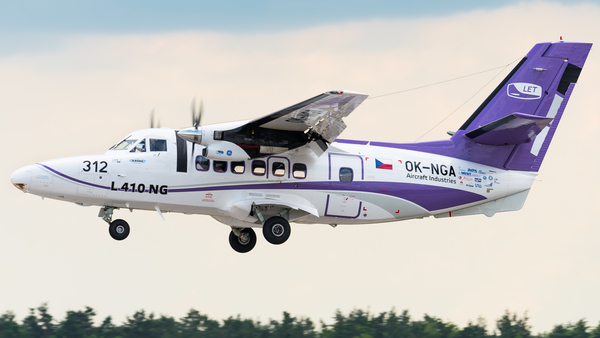
Tracep L410 at Kenge on Sep 25th 2026, crashed on landing
A Tracep Let L-410, registration 9S-GUC performing a flight from Kikwit to Kinshasa N'Dolo (DR Congo) with 13 people on board, diverted to Kenge due…
 Fleet type match
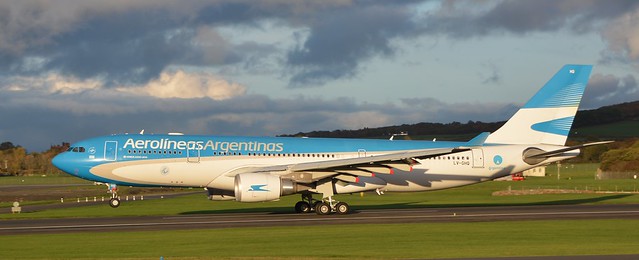
Argentinas A332 at Buenos Aires on Sep 24th 2026, engine compressor stalls
An Aerolineas Argentinas Airbus A330-200, registration LV-GHQ performing flight AR-1132 from Buenos Aires Ezeiza,BA (Argentina) to Madrid,SP (Spain),…
Subscribe today
Are you researching aviation incidents? Get access to AeroInside Insights, unlimited read access and receive the daily newsletter.
Pick your plan and subscribePartner

ELITE Simulation Solutions is a leading global provider of Flight Simulation Training Devices, IFR training software as well as flight controls and related services. Find out more.
SafetyScan Pro provides streamlined access to thousands of aviation accident reports. Tailored for your safety management efforts. Book your demo today
AeroInside Blog
Popular aircraft
Airbus A320Boeing 737-800
Boeing 737-800 MAX
Popular airlines
American AirlinesUnited
Delta
Air Canada
Lufthansa
British Airways