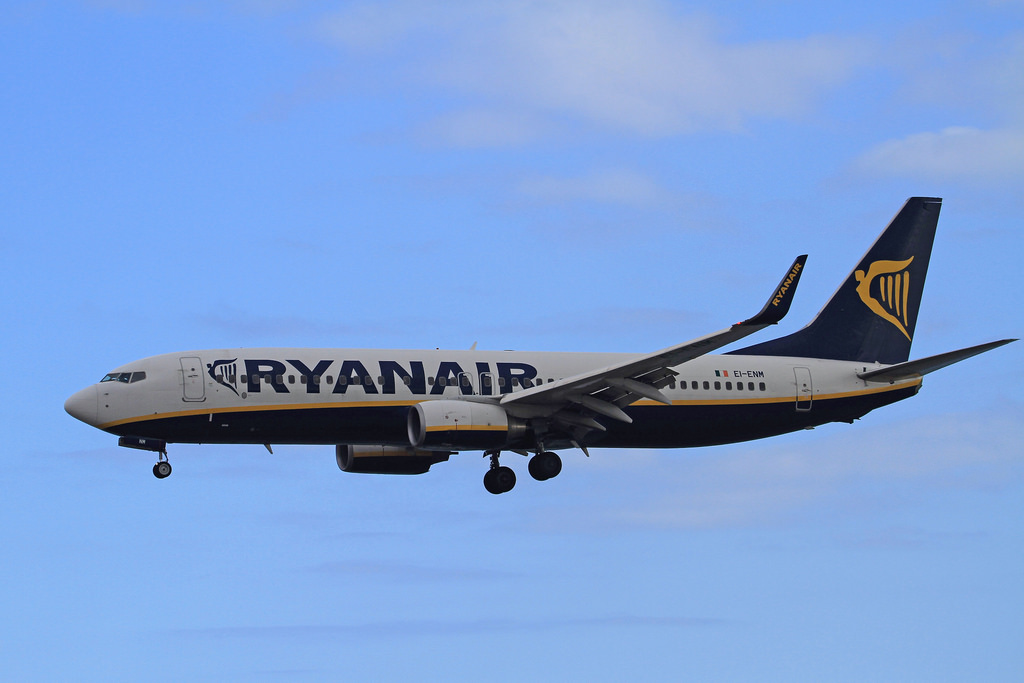
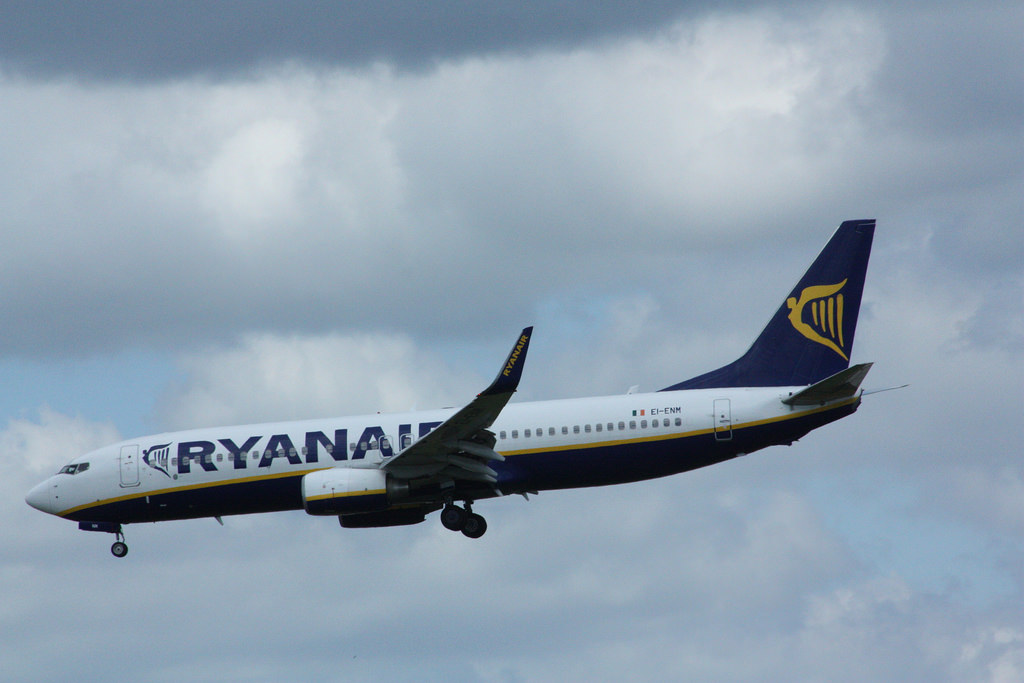
Ryanair B738 and Citation at Ibiza on Aug 10th 2023, loss of separation
Last Update: April 24, 2025 / 18:16:26 GMT/Zulu time

Incident Facts
Date of incident
Aug 10, 2023
Classification
Report
Cause
Loss of separation
Airline
Ryanair
Flight number
FR-9177
Departure
Dublin, Ireland
Destination
Ibiza, Spain
Aircraft Registration
EI-ENM
Aircraft Type
Boeing 737-800
ICAO Type Designator
B738
On Apr 24th 2025 Spain's CIAIAC released their final report concluding the probable causes of the incident were:
The investigation has found that the incident was caused because the control services did not take effective and timely action to prevent the in-flight loss of separation between the conflicting aircraft.
The following factors are thought to have contributed to the incident:
- The incorrect analysis of the existing scenario in the GXX sector by the air traffic control services when identifying potential conflicts between aircraft and when transferring the HERON aircraft to sector F1X.
- The lack of monitoring the descent rate of the HERON aircraft by the air traffic control services, incorrectly assuming that it would set a descent rate in line with their expectations.
- The existing limitations in the software in which ENAIRE has the STCA
implemented, which prevented the STCA from identifying the potential loss of
separation between both aircraft earlier.
The CIAIAC analysed:
Firstly, at the time of the loss of separation, the RYANAIR aircraft was in the airspace of the GXX sector and in communication with its controllers, while the HERON aircraft was in the GXX sector airspace but communicating with the F1X sector. Therefore, it was a situation where the conflicting aircraft were on different frequencies. Nevertheless, it is not thought that the fact that the crews were unable to hear the other crew's communications with their respective controller directly contributed to the incident.
Secondly, the phraseology used and the manner in which the communications were conducted, both by the air traffic controllers and the flight crews, were clear and in accordance with procedure.
Finally, the ENAIRE report indicates that the GXX sector's workload at the time of the incident was 93.5%. However, based on the audio recordings of the communications analysed and the PALESTRA data, no evidence of a high workload was observed either in the communications or in the execution of the tasks, nor was there a high number of traffics in the GXX control sector during the incident and the moments preceding the incident. Consequently, the workload is not thought to have directly contributed to the incident.
At 08:27:00 h, the HERON, TAP, and RYANAIR aircraft were, together with other aircraft, in a volume of airspace pertaining to the GXX control sector of the Palma terminal control area. The HERON and TAP aircraft were flying in sequence on an easterly course towards LEPA, while the RYANAIR aircraft was flying on a southerly course towards LEIB. All were in communication with said control sector.
The trajectory of each of the three aircraft converged in the vicinity of the Andratx NDB vertical, which represented a potential conflict in the GXX control sector.
It is thought that the GXX sector envisaged that any potential conflict would be between the TAP aircraft and the RYANAIR aircraft based on:
- The decision to transfer the HERON aircraft to the F1X control sector with the instruction to descend to the transfer level (FL 130) when it was still some 23 NM from the F1X sector boundary, erroneously assuming that HERON aircraft would descend at a "good rate", rather than actually monitoring that this was the case. On transferring the HERON aircraft, the colour of its label changed to "blue of interest" on the control console as it was still in GXX airspace but in radio communication with the control sector to which the aircraft had been transferred (F1X).
- The image of the control console (see Figure 15), where it can be seen that the controller was monitoring the distance between the TAP aircraft and the HERON aircraft (probably to monitor the sequence) and the distance between the TAP aircraft and the RYANAIR aircraft (because it is believed that the controller identified that the potential conflict would be between the TAP and RYANAIR aircraft).
It is considered that, with HERON aircraft transferred to the F1X control sector on the assumption that it was conflict-free, the controller focused on ensuring the separation between the TAP aircraft and the RYANAIR aircraft. This is evidenced by the communications maintained with the TAP aircraft and the RYANAIR aircraft, whereby the RYANAIR aircraft was instructed to descend to the clear levels left by the TAP aircraft (which, in reality, were not clear due to the presence of the HERON aircraft).
It is considered that the earlier decision to transfer the HERON aircraft to the F1X sector and focus on separating and monitoring the separation between the TAP and RYANAIR aircraft was:
- Erroneous, because there should have been certainty that the HERON aircraft (the first in the approach sequence) was free of traffic, which was not the case due to the presence of the RYANAIR aircraft, resulting in a conflicting transfer.
- Hasty, as the transfer was carried out when it was still 23 NM from the boundary of the F1X sector and with very little traffic in the GXX sector, which meant that the transfer of HERON aircraft could have been delayed in order to be sure that it would not present a conflict.
It is thought that the GXX sector did not realise that the HERON aircraft was being transferred in conflict because the situational analysis did not take into account the descent rate of the HERON aircraft, which was slower than expected. This meant that the HERON aircraft's descent profile was significantly stretched out, leading to an unexpected situation, since it was probable expected that the HERON aircraft and the RYANAIR aircraft would converge at the Andratx NDB while established, respectively, at FL 130 and FL 150.
The GXX sector, therefore, did not detect the potential conflict between the HERON aircraft and the RYANAIR aircraft because it expected that the potential conflict would be between the TAP aircraft and the RYANAIR aircraft. Consequently, no attention was paid to the HERON aircraft, which was ahead in the arrivals sequence, and the free levels being left by the TAP aircraft were given to the RYANAIR aircraft without taking into account the flight levels of the HERON aircraft.
As regards the F1X control sector, It is considered that it should have taken into account that the HERON aircraft was flying unusually high in the vicinity of the F1X boundary (as can be seen in Figure 5, the HERON aircraft was flying at FL 196 in the vicinity of the F1X sector boundary, when in that area it should already be established at around FL 145, according to Figure 13), especially given that the aircraft had been transferred to the sector 23 NM before its boundary.
Aircraft Registration Data
Incident Facts
Date of incident
Aug 10, 2023
Classification
Report
Cause
Loss of separation
Airline
Ryanair
Flight number
FR-9177
Departure
Dublin, Ireland
Destination
Ibiza, Spain
Aircraft Registration
EI-ENM
Aircraft Type
Boeing 737-800
ICAO Type Designator
B738
This article is published under license from Avherald.com. © of text by Avherald.com.
Article source
You can read 2 more free articles without a subscription.
Subscribe now and continue reading without any limits!
Read unlimited articles and receive our daily update briefing. Gain better insights into what is happening in commercial aviation safety.
Send tip
Support AeroInside by sending a small tip amount.
Related articles
 Fleet type match
Ryanair B738 near Frankfurt on Jul 13th 2018, loss of cabin pressure, 33 passengers feeling unwell
A Ryanair Boeing 737-800, registration EI-ENM performing flight FR-7312 from Dublin (Ireland) to Zadar (Croatia) with 190 passengers and 6 crew, was…
 Fleet type match
Ryanair B738 near Amsterdam on May 11th 2026, medical situation, cockpit secured, first officer responsive
A Ryanair Boeing 737-800, registration EI-EKM performing flight FR-7665 from Warsaw (Poland) to Leeds,EN (UK), was enroute at FL380 about 130nm…
 Fleet type match
Ryanair B738 at Palma Mallorca on May 2nd 2026, smoke indication
A Ryanair Boeing 737-800, registration EI-DYA performing flight FR-2051 from Madrid,SP to Palma Mallorca,SP (Spain), was descending towards Palma…
 Fleet type match
Ryanair B738 at Brussels on Apr 10th 2026, flaps problem
A Ryanair Boeing 737-800, registration EI-GXK performing flight FR-4523 from Milan Bergamo (Italy) to Brussels Charleroi (Belgium) with 189 people on…
 Fleet type match
Ryanair B738 at Bucharest and Berlin on Apr 8th 2026, tyre damage on departure
A Ryanair Boeing 737-800, registration EI-DWR performing flight FR-315 from Bucharest Otopeni (Romania) to Berlin (Germany) with 164 people on board,…
 Fleet type match
Ryanair B38M near London on Apr 24th 2025, fuel leak
A Ryanair Boeing 737-8 MAX, registration EI-HEZ performing flight FR-2899 from Venice (Italy) to Manchester,EN (UK) with 191 passengers and 6 crew,…
Newest articles
 Fleet type match
Transavia B738 at Amsterdam on May 20th 2026, engine problem
A Transavia Airlines Boeing 737-800, registration PH-HSK performing flight HV-6675 from Amsterdam (Netherlands) to Tenerife South,CI (Spain), was…
 Fleet type match
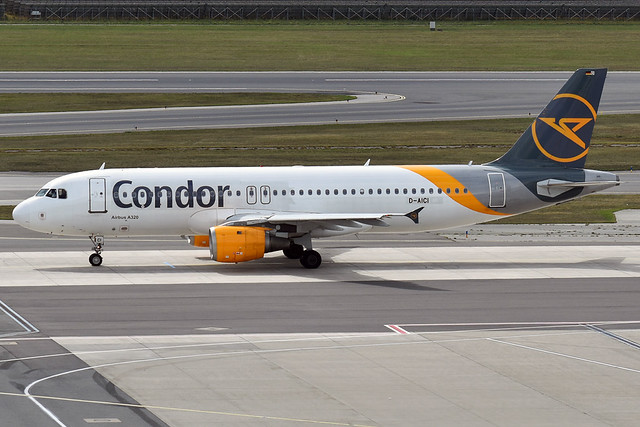
Condor A320 at Berlin on May 17th 2026, bird strike into both engines
A Condor Airbus A320-200, registration D-AICI performing flight DE-4095 from Frankfurt/Main to Berlin (Germany), was on final approach to Berlin's…
Subscribe today
Are you researching aviation incidents? Get access to AeroInside Insights, unlimited read access and receive the daily newsletter.
Pick your plan and subscribePartner

ELITE Simulation Solutions is a leading global provider of Flight Simulation Training Devices, IFR training software as well as flight controls and related services. Find out more.
SafetyScan Pro provides streamlined access to thousands of aviation accident reports. Tailored for your safety management efforts. Book your demo today
AeroInside Blog
Popular aircraft
Airbus A320Boeing 737-800
Boeing 737-800 MAX
Popular airlines
American AirlinesUnited
Delta
Air Canada
Lufthansa
British Airways