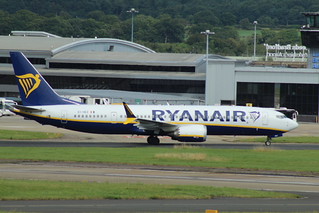
Ryanair B38M at Milan on Oct 1st 2024, all main tyres damaged on landing
Last Update: July 28, 2026 / 12:16:29 GMT/Zulu time
Incident Facts
Date of incident
Oct 1, 2024
Classification
Incident
Airline
Ryanair
Flight number
FR-846
Departure
Barcelona, Spain
Destination
Milan Bergamo, Italy
Aircraft Registration
EI-IGI
Aircraft Type
Boeing 737-800MAX
ICAO Type Designator
B38M
Airport ICAO Code
LIME
According to emergency services the runway was damaged over a distance of 450 meters/1500 feet, too.
Italy's ANSV reported on Oct 3rd 2024: "On Monday 1 October, at 7:55 local time, the Boeing 737 MAX 8-200 aircraft registration EI-IGI, coming from Barcelona, suffered a burst of the 4 tires of the main landing gear during landing at Bergamo Orio al Serio airport. No consequences for the passengers and the crew. The ANSV, which has ordered the opening of a safety investigation into the event, has already acquired, during the operational inspection carried out by its own investigative team, the flight recorders of the aircraft, together with other evidence."
On Jul 28th 2026 Italy's ANSV releeased their final report concluding the probable causes of the serious incident were:
The serious incident was caused by the MLG wheels locking, due to an incorrect sequence of actions unintentionally applied by the fight crew during landing, occurred with antiskid inoperative.
The delayed deployment of the speedbrakes caused a delayed WOW, the latter with effects on the timely activation of the thrust reversers; the application of the brakes preceded the speedbrakes and the WOW, leading to the blockage of the wheel brakes and consequent damage of both aircraft and runway.
The following contributing factors have been identified:
- The prevalence of automatic responses in procedural memory (motor programme) due to the many landings carried out with the anti-skid system active;
- the crew’s lack of FSTD training in landing with the anti-skid system inoperative;
- the deactivation of both anti-skid channels, despite indications that only the inboard channel was ineffective.
Furthermore, it is thought that the following may also have contributed:
- the discrepancy between the mandatory requirement set out in the AMM and the conditional requirement set out in the MEL regarding the need to disable only anti-skid channels that are faulted;
- the less than adequate evidence in the applicable manuals of a clear and timely sequence of the required actions to perform a landing with the anti-skid system inoperative;
- the differences between the two variants regarding system logic for the deployment of the thrust reversers may have contributed to the PF's prolonged action on the reverses levers and possibly delayed the deployment of the speedbrakes.
The ANSV analysed in part:
FLIGHT OPERATIONS
The flight crew of the B737-MAX aircraft, registration EI-IGI, operating flight FR846, were on their first leg of the day; the prescribed rest periods had been observed.
The scheduled flight, carrying 162 passengers, was also a training flight as part of the FO’s LIFUS training programme, with the captain acting as LT.
The captain accepted the aircraft subject to a MEL procedure, 32-42-01, with both antiskid channels (INBOARD and OUTBOARD) deactivated.
The flight proceeded normally; as the aircraft approached Bergamo Airport, the flight crew prepared to land with the anti-skid system inoperative by conducting a briefing on the limitations and the correct sequence of actions to be taken.
From the CVR recording, it can be understood that the flight crew was fully aware of the implications to land without the anti-skid system, which was in-line with the training they had received and the guidance available to them in the MEL and the QRH.
The crew conducted an ILS approach to runway 28 at Bergamo Airport, maintaining a stable flight profile with correct flight parameters.
The crew received landing clearance at 05:53:20, in almost calm conditions (10°, 2 kt).
Moments before touchdown, as part of the flare, the rate of descent was reduced to a VS of approximately -100 ft/min, until contact with the runway.
The aircraft’s first contact with the runway occurred at 05:54:53, when the radalt reached 0 ft and the vertical acceleration reached its peak. For the purposes of the following analysis, this time will be taken as T0.
At T0 time, the KIAS was 138 kt (VREF + 4 kt) and the GS was 142 kt (VREF + 8 kt), suggesting the presence of a slight tailwind component.
The PF/CPT announces: “Reverse and Speedbrake”, however in the interview stated that he initially had difficulty engaging the thrust reverses.
The AIR/GROUND is not in GROUND condition yet and, although the throttle levers are set to IDLE, the engine thrust is still at APPROACH IDLE.
It is likely that the aircraft was in a state of “ground effect” which prevented the aircraft’s weight from fully pushing down the MLG struts, thereby increasing the landing distance and deceleration time, in absence of any corrective action by the pilot.
At time T0+4.125 seconds, pressure was applied to the right-side brakes, initially reaching 1500 psi and subsequently increasing to 2961 psi (effectively the maximum pressure) by time T0+7.125”.
At T0+4.625 seconds (0.500 seconds after the initial pressure was applied to the right-hand brakes), pressure was applied to the left-hand brakes, initially reaching 700 psi, before increasing to 2940 psi at T0+6.625 seconds.
During this period, the noises caused by vibrations began to be clearly audible in the cockpit; the PF/CPT believed that these might be attributable to a wheel lock.
At T0+7.125 seconds, the start of speedbrake deployment was recorded, coinciding with the WOW signal from the left landing gear.
At T0+8.125 seconds, the ‘Speedbrake/Spoiler’ control lever was recorded as being set to ‘UP’ (corresponding to the actual deployment of the surfaces) and, at the same time, the WOW signal from the right landing gear was recorded, resulting in the system recognizing that the aircraft was on the ground.
Subsequently, the FO/PM announced that the speed brakes had been extended (a check that can only be carried out by observing the position of the speed brake control lever) and that the reversers had been deployed (the ‘REV’ indicator in green above the engine N1 indicators); the PF acted to increase thrust on the reversers.
At the same time, T0+8.125seconds, the release of brake pressure on the right-hand side was recorded.
At T0+8.650 seconds, the WOW signal from the front NLG was recorded.
At T0+9.125 seconds, the start of brake pressure release on the left side was recorded.
At T0+10.125 seconds, the deployment of engine #1 thrust reverse was recorded.
At T0+10.625, the deployment of engine #2 thrust reverse was recorded.
At T0+26.125 seconds, the actuation of the “Speedbrake/Spoiler” control lever in the closing position “DOWN” (indicating the actual closure of the surfaces), was recorded.
At T0+32.125 seconds, the aircraft came to a halt on the runway. At the same time, the retraction of engine #2’s thrust reverser was recorded, followed, at T0+33.125 seconds, by the retraction of engine #1’s thrust reverser.
At T0+37.125 seconds, the TWR reported a probable engine fire.
At T0+43.125 seconds, the crew, having assessed the situation, informed TWR that they had experienced brake problems during landing and therefore requested emergency assistance.
The crew then decided to carry out the necessary procedures and coordination to ensure the safety of the aircraft, the passengers and the emergency services personnel who had arrived at the scene of the serious incident. The aircraft comes to a stop on the runway approximately 1.700 m from the runway threshold and about 1.000 m from the end of the runway.
Finally, the passengers were disembarked using the usual disembarkation procedures and buses.
Related NOTAM:
A8171/24 NOTAMN
Q) LIMM/QMRLC/IV/NBO/A /000/999/4540N00942E005
A) LIME B) 2410010731 C) 2410011200 EST
E) RUNWAY 10/28 AND ALL TWY CLSD DUE TO DAMAGED ACFT.
REF AIP AD 2 LIME 2-1
Metars:
LIME 010620Z AUTO 01002KT 9999 SCT069/// 15/11 Q1017=
LIME 010550Z AUTO 02002KT 9999 FEW055/// 15/11 Q1017=
LIME 010520Z AUTO VRB01KT 9999 SCT042/// 14/11 Q1017=
LIME 010450Z 00000KT 9999 SCT060 14/11 Q1017 NOSIG=
LIME 010420Z 01003KT 360V060 9999 SCT060 14/11 Q1017 NOSIG=
LIME 010350Z VRB01KT 9999 SCT065 14/10 Q1017 NOSIG=
LIME 010320Z VRB02KT 9999 SCT070 15/11 Q1017 NOSIG=
LIME 010250Z 01003KT 9999 FEW070 14/10 Q1017 NOSIG=
LIME 010220Z 36003KT 9999 SCT065 15/11 Q1017 NOSIG=
LIME 010150Z 36004KT 9999 SCT060 14/11 Q1017 NOSIG=
LIME 010120Z 01003KT 330V040 9999 SCT060 14/10 Q1018 NOSIG=
LIME 010050Z 35002KT 9999 SCT060 14/10 Q1018 NOSIG=
Aircraft Registration Data
Incident Facts
Date of incident
Oct 1, 2024
Classification
Incident
Airline
Ryanair
Flight number
FR-846
Departure
Barcelona, Spain
Destination
Milan Bergamo, Italy
Aircraft Registration
EI-IGI
Aircraft Type
Boeing 737-800MAX
ICAO Type Designator
B38M
Airport ICAO Code
LIME
This article is published under license from Avherald.com. © of text by Avherald.com.
Article source
You can read 2 more free articles without a subscription.
Subscribe now and continue reading without any limits!
Read unlimited articles and receive our daily update briefing. Gain better insights into what is happening in commercial aviation safety.
Send tip
Support AeroInside by sending a small tip amount.
Related articles
Ryanair B38M near Shannon on Aug 1st 2026, engine anti ice problem
A Ryanair Boeing 737-8 MAX, registration EI-IJA performing flight FR-4109 from Alicante,SP (Spain) to Knock (Ireland), was descending towards Knock,…
Ryanair B738 near Bologna on May 28th 2026, captain incapacitated
A Ryanair Boeing 737-800, registration EI-DYA performing flight FR-2770 from Milan Malpensa to Bari (Italy), was climbing out of Milan when the first…
Ryanair B738 near Amsterdam on May 11th 2026, medical situation, cockpit secured, first officer responsive
A Ryanair Boeing 737-800, registration EI-EKM performing flight FR-7665 from Warsaw (Poland) to Leeds,EN (UK), was enroute at FL380 about 130nm…
Ryanair B738 at Palma Mallorca on May 2nd 2026, smoke indication
A Ryanair Boeing 737-800, registration EI-DYA performing flight FR-2051 from Madrid,SP to Palma Mallorca,SP (Spain), was descending towards Palma…
Ryanair B738 at Brussels on Apr 10th 2026, flaps problem
A Ryanair Boeing 737-800, registration EI-GXK performing flight FR-4523 from Milan Bergamo (Italy) to Brussels Charleroi (Belgium) with 189 people on…
Newest articles
Delta B752 at Atlanta on Aug 8th 2026, fumes on flight deck
A Delta Airlines Boeing 757-200, registration N555NW performing flight DL-2204 from Atlanta,GA to Orlando,FL (USA) with 199 passengers and 6 crew,…
United B738 at San Francisco on Aug 6th 2026, tyre damage on departure
A United Boeing 737-800, registration N76504 performing flight UA-1189 from San Francisco,CA (USA) to San Jose del Cabo (Mexico), was climbing out of…
Subscribe today
Are you researching aviation incidents? Get access to AeroInside Insights, unlimited read access and receive the daily newsletter.
Pick your plan and subscribePartner
ELITE Simulation Solutions is a leading global provider of Flight Simulation Training Devices, IFR training software as well as flight controls and related services. Find out more.
SafetyScan Pro provides streamlined access to thousands of aviation accident reports. Tailored for your safety management efforts. Book your demo today
AeroInside Blog
Popular aircraft
Airbus A320Boeing 737-800
Boeing 737-800 MAX
Popular airlines
American AirlinesUnited
Delta
Air Canada
Lufthansa
British Airways