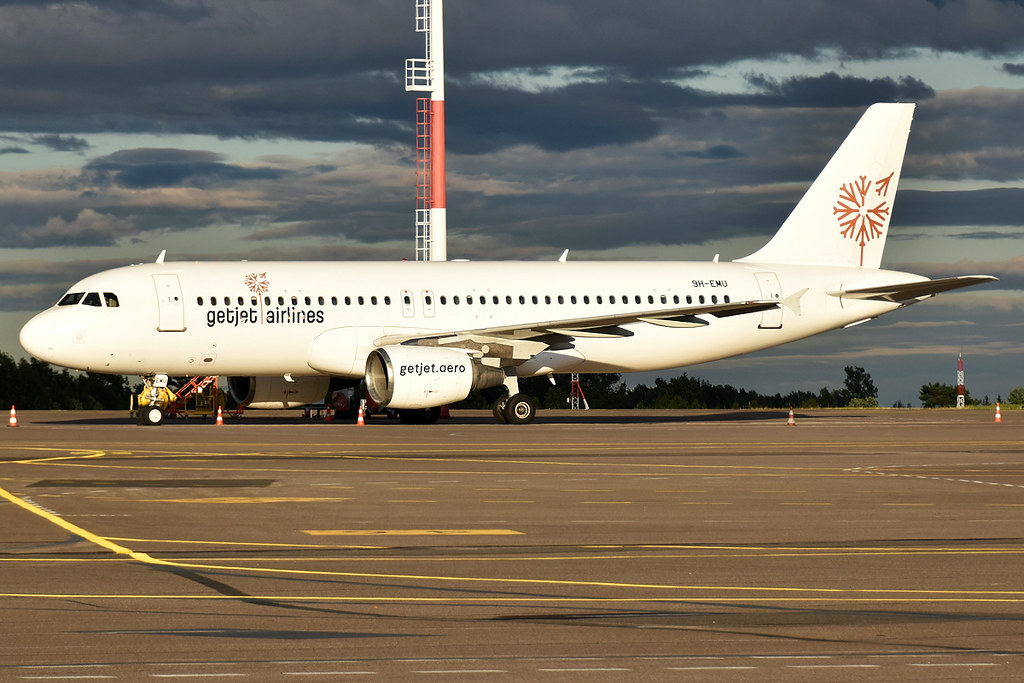
Airhub A320 at Paris on May 23rd 2022, descended below safe height on approach twice
Last Update: July 11, 2024 / 08:30:16 GMT/Zulu time
Incident Facts
Date of incident
May 23, 2022
Classification
Incident
Airline
Getjet Airlines Malta
Flight number
D8-4311
Departure
Stockholm, Sweden
Destination
Paris Charles de Gaulle, France
Aircraft Registration
9H-EMU
Aircraft Type
Airbus A320
ICAO Type Designator
A320
Airport ICAO Code
LFPG
The French BEA rated the occurrence a serious incident (category Controlled Flight Into Terrain) and opened an investigation.
On Jul 11th 2022 the BEA released their preliminary report in French (subsequently also their preliminary report in English) reporting that for the first approach the approach controller provided an erroneous QNH (1011 hPa instead of 1001 hPa) causing the aircraft to continue 260 feet below the correct altitudes. Although the crew read back 1011hPA several times and other aircraft were given the correct QNH of 1001 hPa, the error was not picked up by ATC or by the crew. The MSAW alarm went off and the crew initiated a go around about 1nm before the runway threshold, the aircraft reached a minimum of 405 feet according to QNH 1001hPa (679 feet QNH 1011 hPa), the radio altimeter indicated 6 feet above ground level. However, no TAWS alerts were recorded during the approach. The controller cleared the aircraft: "turn right heading 360, climb to 5000 feet, 1001", the crew read back: "360 and climb to 5000, 1011" which was not picked up by the controller. The controller was relieved and another controller took this position over. However, the (correct) QNH was not provided to the crew or any other crew until after the aircraft landed. Still with the erroneous QNH the aircraft positioned for another approach. 3.1nm before the runway threshold a MSAW alarm activated again, the controller informed the crew who did not understand the reason for the MSAW and reported they were visual - in later testimony they reported they saw the PAPIs, one white, one pink, two red, maybe three red, however, definitely not 4 red. They applied a pitch up to correct their trajectory and continued for a landing without further incident.
On Jul 11th 2024 the BEA released their final report concluding the probable causes of the serious incident were:
9H-EMU’s near collision with the ground was due to a barometric approach being carried out with an incorrect altimeter setting (QNH) of +10 hPa, in a rain shower and with no external visual references.
Barometric approaches are particularly affected by the altimeter setting as it has an impact on the altitude adopted by the aeroplane and consequently the descent profile and vertical position along the flight path, including at minima.
The approach was thus carried out on a vertical profile around 280 ft below the published vertical profile, up to a minimum recorded and corrected radio-altimeter height of 6 ft, i.e. approximately 2 m, when the aircraft was about 0.9 NM from the runway threshold, without the crew being aware of this.
The following factors contributed to two barometric approaches being flown with an incorrect altimeter setting:
- human error in the exchanges communicating the QNH, the probability of which can never be reduced to zero;
- operating procedures for crews and air traffic controllers that are not very robust, or even ineffective against this threat;
- on-board and ground systems that are not very robust, or even ineffective against this threat.
The following factors contributed to the aeroplane descending to a near collision with the ground (near-CFIT):
- the approach lights not being illuminated;
- the absence of an on-board ground proximity warning, even though the TAWS system was operating in accordance with its design;
- the late triggering of the Minimum Safe Altitude Warning (MSAW) system, even though the system was operating in accordance with its design;
- a late and inadequate reaction by the air traffic controller to the triggering of this MSAW alert. The insufficient training of controllers with respect to the actions to be taken in response to this alert contributed to this inappropriate reaction.
The CFIT risk linked to an incorrect altimeter setting during a barometric approach has been known about for decades. However, the widespread use of ILS approaches probably helped to mask this threat and its consequences for a long time. More recently, satellite approaches with barometric vertical guidance have been promoted to increase the level of safety where previously only non-precision approaches existed. However, the increased use of these satellite approaches with barometric vertical guidance, in particular as a replacement for ILS approaches, has not led the aviation community to question the impact on safety levels, even though overall safety requirements are increasingly stringent.
The BEA analysed:
At CDG, the ILS for runway 27R had been out of service for several days for work and the RNP procedures were in force on this runway. The local barometric pressure adjusted to mean sea level (QNH) was 1001 hPa. There was a rain shower in progress on the final approach path, significantly degrading visibility. The lights on the landing runway had been switched on with the arrival of the rain shower but not the approach lights, an omission by the tower controller.
As the aeroplane was not equipped to carry out an RNP APCH operation down to LPV minima (approach offering satellite lateral and vertical guidance), the crew carried out an RNP APCH operation down to LNAV/VNAV minima (an approach procedure with barometric vertical guidance).
On the intermediate approach, the crew were twice given a QNH value with an error of 10 hPa by the approach air traffic controller (1011 hPa instead of 1001) which they used to set the aeroplane’s altimetric systems. Now an error in the altimeter setting results in a difference between the aeroplane's actual altitude and the altitude displayed. For approaches with barometric vertical guidance, the vertical profile and the vertical guidance are affected. This meant that on using a QNH value 10 hPa higher than the actual value, the approach was carried out on a vertical profile around 280 ft below the published vertical profile without the crew being aware of this and without any external visual references.
The design of the IFR procedures did not take into account an error in the altimeter setting, and the crews’ operating procedures and those of the air traffic controllers did not prevent the use of an incorrect altimeter setting. In addition, neither the aeroplane’s instruments nor the air traffic controllers’ tools were designed to detect this type of error.
At a height of 239 ft RA, shortly before the aeroplane reached the indicated altitude corresponding to the decision altitude, a Minimum Safe Altitude Warning (MSAW) was triggered in the control tower. Nine seconds later, the tower air traffic controller who was in contact with the crew informed them of the situation using an incorrect and inappropriate phraseology. The crew did not hear this call and continued the descent.
A few seconds after the indicated altitude had passed the decision altitude (increased by 50 ft as per operator policy), the crew carried out a go around as they had not acquired sight of the ground. During the manoeuvre, the minimum recorded and corrected radio-altimeter height was 6 ft, i.e. about 2 m, when the aeroplane was about 0.9 NM from the runway threshold, outside the limits of Paris-Charles de Gaulle airport. As per design, there was no on-board ground proximity alert (TAWS) during the event. In their statements, the crew indicated that they had not been aware of this proximity with the ground.
During the go-around, the local QNH value was correctly given to the crew by the TWR controller. However, the copilot read back the incorrect information that was being used on board the aeroplane. This error was not picked up by the air traffic controller and the crew lined up for a second approach to runway 27R with once again, a flight path altitude that was 280 ft below the published altitude.
During this second approach, the MSAW alert triggered at a height of around 850 ft RA, much higher than during the first approach. The air traffic controller who had relieved the tower controller in position during the first approach warned the crew of the situation, and also used an incorrect and inappropriate phraseology. The crew replied that they were on the correct path and that they had sight of the runway. The approach lights were, this time, illuminated and the weather conditions had improved. The crew corrected the flight path and landed without further incident.
At the end of the flight, and according to the various statements gathered, no front-line actor had been aware of what had happened and the seriousness of the event.
Metars:
LFPG 231300Z 30014KT 7000 -SHRA FEW007 SCT013 BKN020 16/14 Q1001 NOSIG=
LFPG 231230Z 30010KT 6000 -SHRA FEW008 SCT019 BKN026 FEW050TCU 16/14 Q1001 NOSIG=
LFPG 231200Z 29010KT 5000 SHRA FEW010 BKN015 BKN028 FEW050CB 16/15 Q1001 TEMPO 3500 SHRA SCT060CB=
LFPG 231130Z 26008KT 9999 SCT016 BKN028 18/15 Q1001 RESHRA TEMPO 3500 SHRA SCT060CB=
LFPG 231100Z 25008KT 9999 SHRA SCT016 BKN028 19/14 Q1001 TEMPO 3500 SHRA SCT060CB=
LFPG 231030Z 26010KT 230V290 9999 SCT016 BKN031 19/14 Q1001 TEMPO 3500 SHRA SCT060CB=
LFPG 231000Z 26010KT 9999 BKN015 18/15 Q1001 NOSIG=
LFPG 230930Z 24011KT 9999 BKN010 BKN016 18/16 Q1001 NOSIG=
LFPG 230900Z 19011KT 9999 -SHRA BKN009 BKN016 18/16 Q1001 NOSIG=
LFPG 230830Z 17005KT 9999 SCT008 BKN018 BKN026 18/16 Q1001 TEMPO 4000 TSRA BKN008 SCT060CB=
LFPG 230800Z 16008KT 9999 FEW010 BKN018 BKN026 17/15 Q1001 TEMPO 4000 TSRA BKN008 SCT060CB=
Incident Facts
Date of incident
May 23, 2022
Classification
Incident
Airline
Getjet Airlines Malta
Flight number
D8-4311
Departure
Stockholm, Sweden
Destination
Paris Charles de Gaulle, France
Aircraft Registration
9H-EMU
Aircraft Type
Airbus A320
ICAO Type Designator
A320
Airport ICAO Code
LFPG
This article is published under license from Avherald.com. © of text by Avherald.com.
Article source
You can read 2 more free articles without a subscription.
Subscribe now and continue reading without any limits!
Read unlimited articles and receive our daily update briefing. Gain better insights into what is happening in commercial aviation safety.
Send tip
Support AeroInside by sending a small tip amount.
Newest articles
 Fleet type match
Skywest E175 near Austin on Aug 28th 2025, turbulence causes 4 injuries
A Skywest Embraer ERJ-175 on behalf of United, registration N110SY performing flight UA-5971 from Aspen,CO to Houston Intercontinental,TX (USA) with…
 Fleet type match
United B739 at Las Vegas on Jul 3rd 2025, tail strike on landing
A United Boeing 737-900, registration N66831 performing flight UA-2136 (dep Jul 2nd) from Washington Dulles,DC to Las Vegas,NV (USA) with 147…
Subscribe today
Are you researching aviation incidents? Get access to AeroInside Insights, unlimited read access and receive the daily newsletter.
Pick your plan and subscribePartner

ELITE Simulation Solutions is a leading global provider of Flight Simulation Training Devices, IFR training software as well as flight controls and related services. Find out more.
SafetyScan Pro provides streamlined access to thousands of aviation accident reports. Tailored for your safety management efforts. Book your demo today
AeroInside Blog
Popular aircraft
Airbus A320Boeing 737-800
Boeing 737-800 MAX
Popular airlines
American AirlinesUnited
Delta
Air Canada
Lufthansa
British Airways