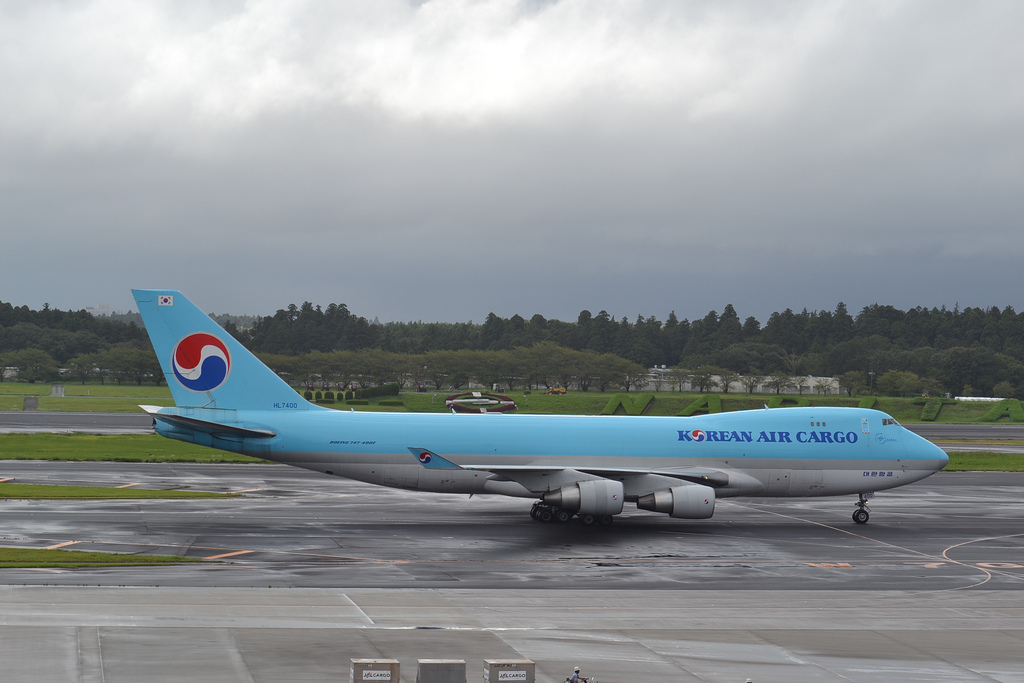
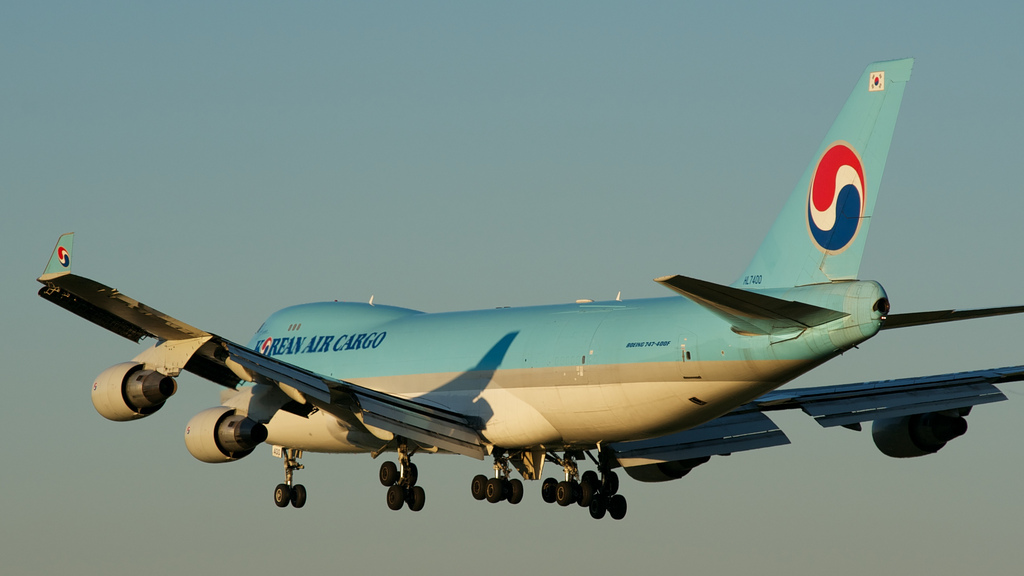
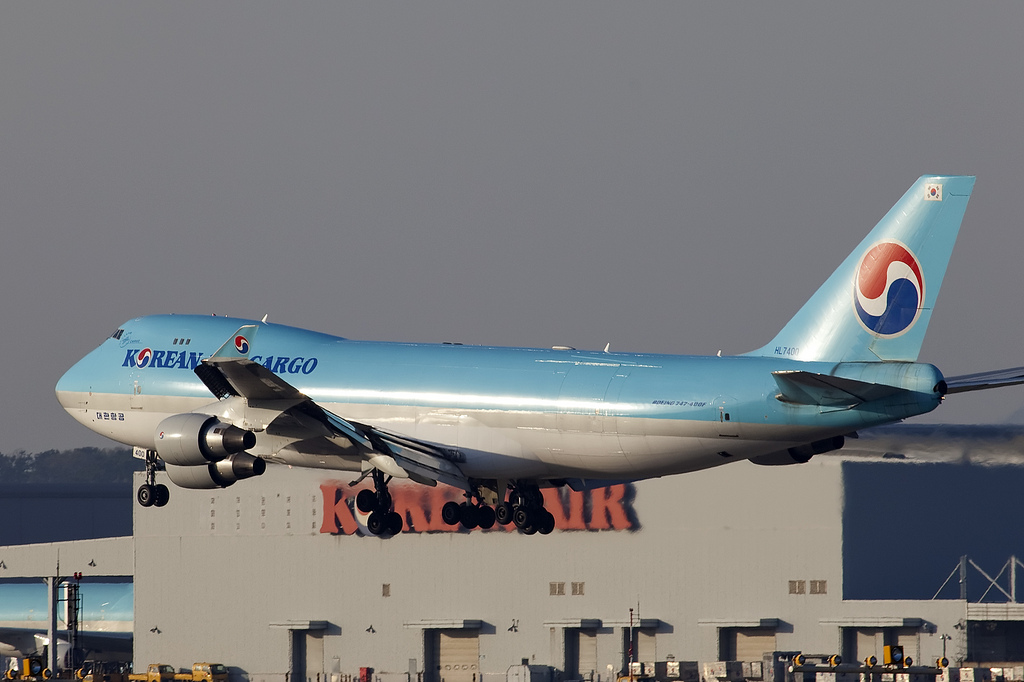
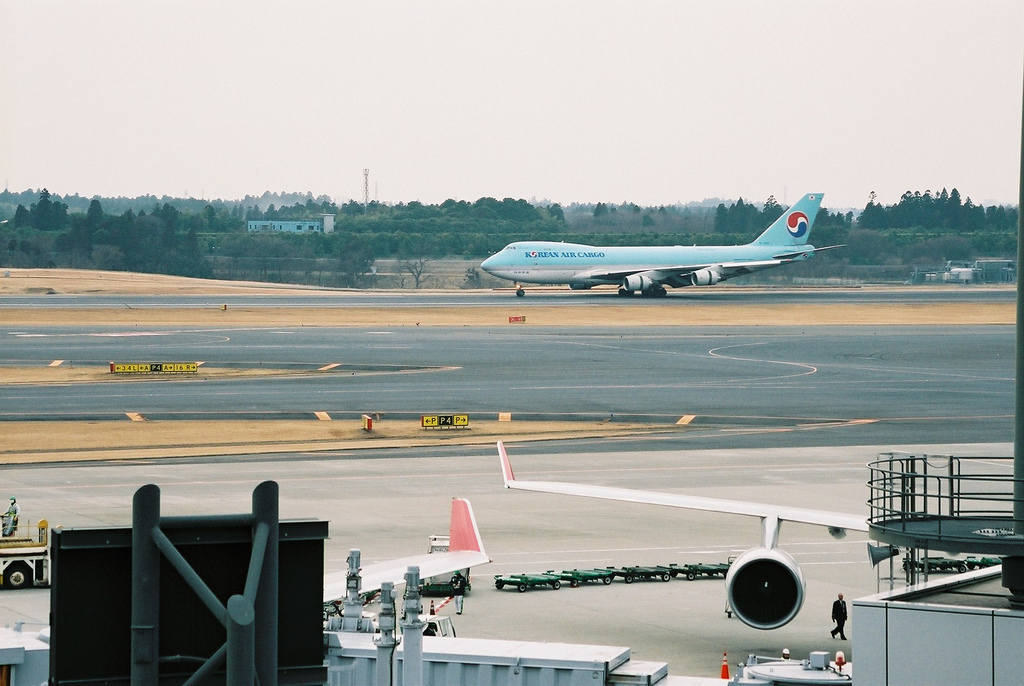
Korean B744 at Frankfurt on Oct 8th 2014, dropped flap
Last Update: April 26, 2018 / 18:42:47 GMT/Zulu time
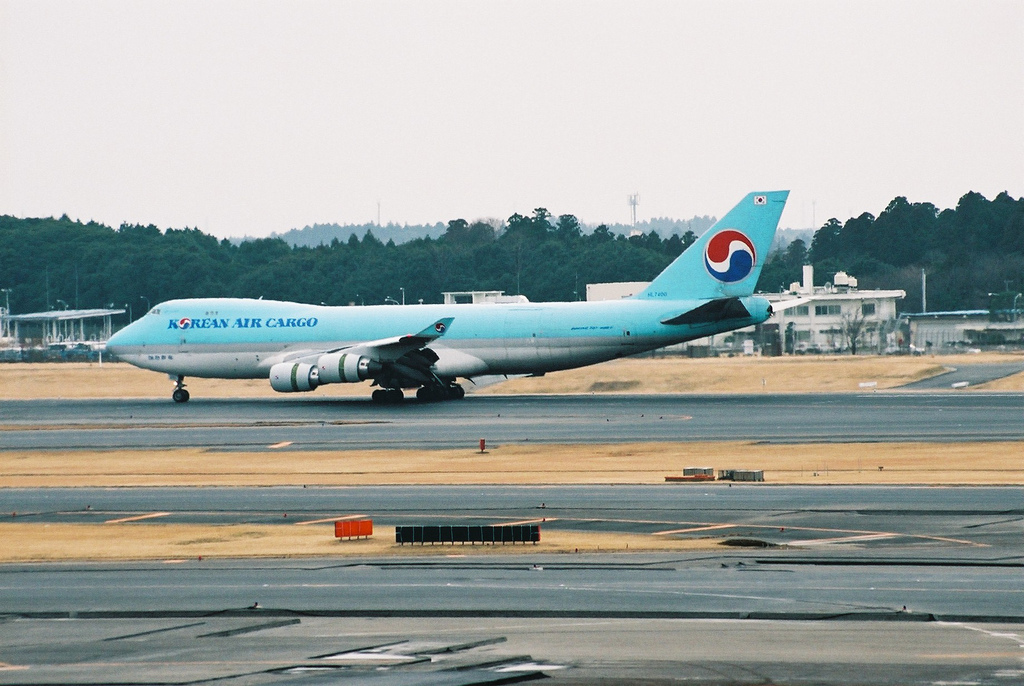
Incident Facts
Date of incident
Oct 8, 2014
Classification
Accident
Airline
Korean Airlines
Flight number
KE-529
Departure
Moscow Sheremetyevo, Russia
Destination
Frankfurt/Main, Germany
Aircraft Registration
HL7400
Aircraft Type
Boeing 747-400
ICAO Type Designator
B744
Germany's BFU opened an investigation into the occurrence, after examining the aircraft a part of the trailing edge flap was identified missing.
The aircraft was unable to resume its schedule but was able to ferry back to Korea on Oct 13th.
Police confimed observers on the ground reported to police on Oct 8th that an aircraft had lost a part while on approach to Frankfurt. The part was not found until Oct 15th, when it was located in a forest near Frankfurt Airport.
A part number on the debris, sized about 5 by 1 meters (197 by 39 inches) identifies the part as an inboard trailing edge foreflap.
The airline confirmed that one of their Boeings received damage on Oct 8th 2014, but cautioned that is yet to be verified the found part belongs to their aircraft. The aircraft was repaired and returned to Korea.
On Feb 24th 2015 Germany's BFU reported in their October bulletin, that there were four flight crew in the cockpit (captain and first officer operating the aircraft and two relief crew occupying the observer seats in the back of the cockpit). The aircraft was on final ILS approach to runway 25L on autopilot at about 2500 feet MSL, the crew had just selected the flaps from 20 to 30 degrees, when a sound similiar to an gear extension was heard by the crew and the aircraft unexpectedly rolled about 8 degrees to the left, airspeed was 160 KIAS. The captain (64, ATPL, 18,009 hours total, 13,671 hours on type) disconnected the autopilot, steered the aircraft back onto the localizer and continued for a landing without further incident.
The BFU reported that a post flight inspection revealed the inboard fore flap, dimension about 4.5 by 1 meters, was missing from the left wing. The missing flap was found and recovered from a forest near Frankfurt. The BFU reported that examination of the fractures identified the fracture began in an area of corrosion.
On Apr 26th 2018 the BFU released their final report concluding the probable cause of the occurrence was:
The flap attach fitting was destroyed by an extended fatigue fracture. It is highly likely that it started with a corrosion depression.
The BFU analysed:
According to the crew’s statement, which was confirmed by the FDR recording, the fracture of the flap occurred during approach to Frankfurt/Main Airport shortly after the flaps had been fully extended.
The fracture of the attach fitting was due to fatigue corrosion. The corrosion, in consequence of the used material, resulted in kerfs which, in correlation with stress, served as crack origin for fatigue fracture. The fatigue fracture propagated until the remaining section was destroyed by ductile forced rupture. Because of a wellpreserved fracture surface of the attach fitting the fracture origin and the fracture propagation could be established conclusively. Trigger for the fracture of the remaining section was the extension of the flap and the corresponding stress increase, which the section could no longer tolerate.
The corrosive damage is not uncharacteristic for the used material. Literature referring to corrosion characteristics of aluminium alloys, such as the cupreous EN AW 7075, describes the corrosion susceptibility due to their copper content.
The area of the lubrication groove of the bronze bushing showed a different surface condition which was clearly less susceptible to corrosion.
Due to the fracture of the attach fitting the flap lost its outer mounting. Subsequently, it flapped upward and fractured.
This resulted in additional damages in the periphery of the flap. The airplane itself was not hit or damaged by severed components. The FDR recordings showed that the loss of a flap part did not have any significant influence on the flight characteristics of the airplane. The PIC was able to manually counteract the loss of lift capacity during approach. The landing occurred without further problems.
There is an increased risk for third parties, because an airplane is usually in final approach to an airport and therefore often above metropolitan areas, when the flaps are extended. That in the past as well as in this case no persons or objects suffered injuries or damages is a stroke of luck. The BFU is of the opinion that there exists general need for action to improve the flap attach fitting for this aircraft type.
In November 2003 the manufacturer issued the Service Letter 747-SL-57-097, which describes the fracture of the inner attach fitting of the inboard fore flap. The described facts are also true for the outer attach fitting of this particular case. According to the manufacturer the improvement consisted of the change of aluminium alloy to the material 7075-T351. This alloy is already used for the outer attach fitting, as the present case shows. It is therefore possible that enhancement of corrosion resistance could be achieved by surface treatment. The investigation revealed that the area of the lubrication groove on the surface of the attach fitting was less corrosion susceptible. The BFU views this as a possible future solution method to improve corrosion protection.
The SB 747-57-2119 Revision 2 issued in June 1975 covered damaged and fractured outer attach fittings of inboard fore flaps. Back then different causes had been identified. There was no explicit description of damages and fractures caused by corrosion.
Incident Facts
Date of incident
Oct 8, 2014
Classification
Accident
Airline
Korean Airlines
Flight number
KE-529
Departure
Moscow Sheremetyevo, Russia
Destination
Frankfurt/Main, Germany
Aircraft Registration
HL7400
Aircraft Type
Boeing 747-400
ICAO Type Designator
B744
This article is published under license from Avherald.com. © of text by Avherald.com.
Article source
You can read 2 more free articles without a subscription.
Subscribe now and continue reading without any limits!
Read unlimited articles and receive our daily update briefing. Gain better insights into what is happening in commercial aviation safety.
Send tip
Support AeroInside by sending a small tip amount.
Related articles
 Fleet type match
Korean B789 near Jeju on Apr 16th 2025, cracked windshield
A Korean Airlines Boeing 787-9, registration HL7208 performing flight KE-651 from Seoul (South Korea) to Bangkok (Thailand) with 270 people on board,…
 Fleet type match
Korean A333 at Cebu on Oct 23rd 2022, overran runway on landing
A Korean Airlines Airbus A330-300, registration HL7525 performing flight KE-631 from Seoul (South Korea) to Cebu City (Philippines) with 162…
 Fleet type match
Korean B789 at Da Nang on Oct 20th 2024, bird strike
A Korean Airlines Boeing 787-9, registration HL8081 performing flight KE-461 from Seoul (South Korea) to Da Nang (Vietnam), landed on Da Nang's…
 Fleet type match
Korean A333 over China on Aug 4th 2024, severe turbulence injures 14 people
A Korean Airlines Airbus A330-300, registration HL7584 performing flight KE-197 from Seoul (South Korea) to Ulaanbaator (Mongolia) with 281 people on…
 Fleet type match
Korean B38M near Seoul on Jun 22nd 2024, loss of cabin pressure
A Korean Airlines Boeing 737-8 MAX, registration HL8352 performing flight KE-189 from Seoul (South Korea) to Taichung (Taiwan), was climbing through…
Newest articles
 Fleet type match
Swiss A20N at Ljubljana on Aug 5th 2026, sensor problem at emergency exit
A Swiss International Airlines Airbus A320-200N, registration HB-JDA performing positioning flight LX-5225 from Ljubljana (Slovenia) to Zurich…
 Fleet type match
Lufthansa B748 near Brazzaville on Aug 6th 2026, odour in cabin
A Lufthansa Boeing 747-8, registration D-ABYO performing flight LH-573 from Johannesburg (South Africa) to Frankfurt/Main (Germany), was enroute at…
Subscribe today
Are you researching aviation incidents? Get access to AeroInside Insights, unlimited read access and receive the daily newsletter.
Pick your plan and subscribePartner

ELITE Simulation Solutions is a leading global provider of Flight Simulation Training Devices, IFR training software as well as flight controls and related services. Find out more.
SafetyScan Pro provides streamlined access to thousands of aviation accident reports. Tailored for your safety management efforts. Book your demo today
AeroInside Blog
Popular aircraft
Airbus A320Boeing 737-800
Boeing 737-800 MAX
Popular airlines
American AirlinesUnited
Delta
Air Canada
Lufthansa
British Airways