Virgin Australia B738 near Adelaide on May 9th 2015, control inputs cause injuries to flight attendant
Last Update: October 8, 2016 / 18:29:50 GMT/Zulu time
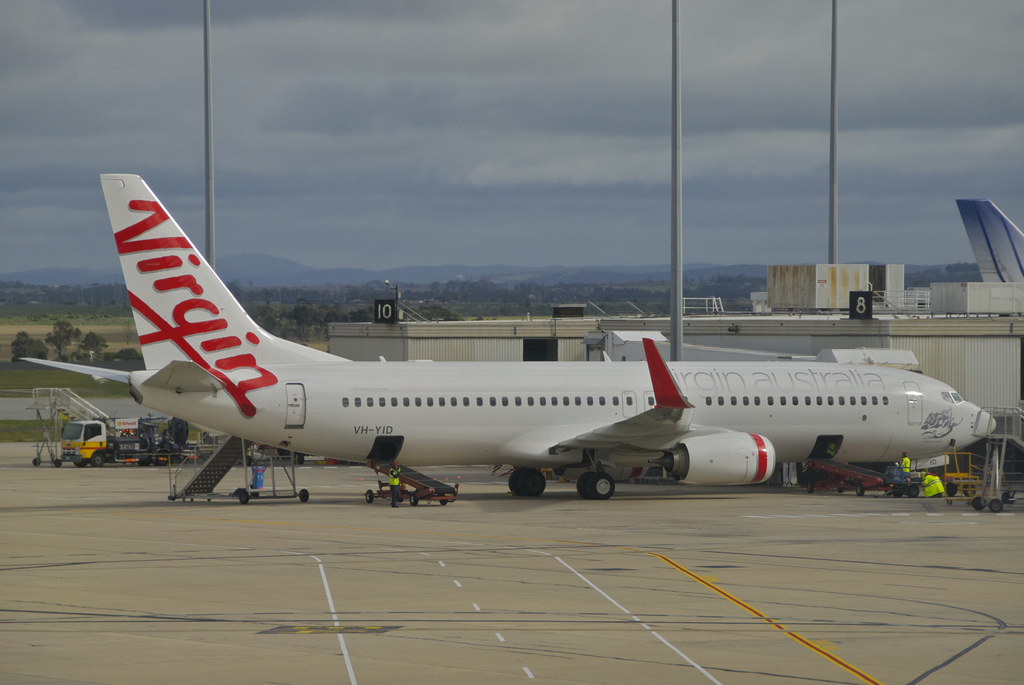
Incident Facts
Date of incident
May 9, 2015
Classification
Report
Airline
Virgin Australia
Flight number
VA-436
Departure
Sydney, Australia
Destination
Adelaide, Australia
Aircraft Registration
VH-YID
Aircraft Type
Boeing 737-800
ICAO Type Designator
B738
Australia's TSB released their final report concluding the probable causes of the aviation occurrence were:
Although routinely used for high-speed descents, the selected speed for the descent of 320 kt was close the aircraft’s maximum speed of 340 kt and, in combination with the increased headwind as the aircraft descended through about 8,000 ft, increased the risk of an overspeed.
- After identifying the unexpected rapid increase in airspeed, the first officer applied sufficient back pressure on the control column to override the autopilot with the intention of avoiding the impending overspeed. This increased the g loading on the aircraft to an extent where safely walking in the cabin would be difficult.
- In response to feeling the increased g loading, the first officer abruptly released the back pressure on the control column, resulting in a sudden pitch change and reduced g loading that led to the cabin crew member losing their footing and sustaining a knee injury.
Other factors that increased risk
- The Virgin Australia Airlines Pty. Ltd. procedures did not require flight crew to update the QNH, temperature deviation or the descent winds in the flight management computer after departure. In some circumstances, this would reduce the accuracy of the calculated flight path and increase crew workload in managing the aircraft’s energy state.
- At the time of the occurrence, the Virgin Australia Airlines Pty. Ltd. training included a focus on the management of overspeeds. However, the associated simulator training session had not been completed by the crew, increasing the risk that they would not react in accordance with the published operational guidance material.
Other findings
- The earlier-than-usual preparation of the cabin for landing meant that, at the time of the occurrence, the cabin crew were in the final stages of that activity. This reduced the risk of more serious and numerous injuries to the cabin crew and passengers.
The ATSB reported that the VNAV PATH flight management/autopilot mode is primarily designed to maintain a selected vertical flight path, thus permitting minor airspeed deviations while prioritizing to remain on the vertical path. 10 knots above target speed the FMS would issue a message "drag required", which would usually prompt the crew to extend the speed brakes.
The ATSB wrote in describing the CWS-P mode: "Pushing a CWS engage switch on the mode control panel engages the autopilot (A/P) pitch and roll axes in the CWS mode. At the time of the occurrence, CWS-P could also be engaged by applying 40 lb back pressure to the control column to manually override the A/P. By doing so, a desired pitch attitude could be set. The ability to manually engage CWS-P and override the A/P was later removed from the flight control computer’s software to avoid inadvertent and undetected reversion from a descent mode to CWS-P. With CWS-P engaged, the A/P manoeuvres the aircraft in response to control pressures applied by either pilot. The control pressure is similar to that required for manual flight. When control pressure is released, the A/P holds the existing attitude. While the FO’s routine use of CWS-P as a means to manage overspeeds was not part of Virgin training, it was reported used by the FO and other pilots. This was because it was an effective way to handle an overspeed on descent without disconnecting the A/P, particularly when changing weather conditions meant that an overspeed could occur with little time for the crew to react."
The ATSB reported that between 10,500 and 8,136 feet MSL the head wind increased from 30 to 39 knots, the airspeed increased from 320 to 333 KIAS. During the next 5 seconds the aircraft descended to 7,790 feet, the head wind increased to 48 knots and the airspeed increased to 339 KIAS (Vmo 340 KIAS). The first officer applied a back pressure of 41.5lbs which resulted in a vertical acceleration of +2.14G. One second later the first officer released the back pressure to 2lbs, which resulted in a minimum vertical acceleration of +0.066G.
The ATSB analysed that high speed descents at 320 KIAS was routine for the flight crew, an overspeed event was not considered likely. The crew knew there was no turbulence forecast, but had also not been informed about the changing wind situation at Adelaide.
The ATSB analysed:
the FO identified an immediate need to prevent an overspeed, and did so by pulling back on the control column and activating control wheel steering-pitch (CWS-P). This had previously been successful for the FO in addressing an impending overspeed, but the difference in this case was that the force required was larger than experienced by the FO in past situations. The flight data recorded a 41 lb back pressure on the FO’s control column with a resulting 2.14 g loading on reversion to CWS-P. Given the altitude at the time, reversion to CWS-P was considered contrary to Virgin Australia Pty Ltd’s (Virgin) guidance and training in overspeed management. However, the use of the CWS-P mode was reported common among some pilots and, in this case, had possibly become a stored condition-action pattern.
Surprise is a cognitive-emotional response to something unexpected. It results from a mismatch between the individual’s mental expectations and what actually happens around them. Experiencing surprise is a combination of physiological, cognitive and behavioural responses (Rivera and others 2014). If a pilot is not expecting things to go wrong, then the level of surprise can result in taking no action, or the wrong action (Martin 2012).
With respect to cabin preparation for landing the ATSB analysed:
The procedures for preparing the cabin for landing required t eir commencement no later than FL 200. In this case, the flight crew identified that turbulence on descent may increase the risk of injury to crew and passengers and therefore decided to initiate the cabin preparation at about FL 270. Flight data for the descent showed that this provided an additional 2 minutes before the occurrence for the crew to secure galley equipment and prepare the cabin, including seating all passengers. This reduced the risk of more serious and numerous injuries to the cabin crew and passengers.
Aircraft Registration Data
Incident Facts
Date of incident
May 9, 2015
Classification
Report
Airline
Virgin Australia
Flight number
VA-436
Departure
Sydney, Australia
Destination
Adelaide, Australia
Aircraft Registration
VH-YID
Aircraft Type
Boeing 737-800
ICAO Type Designator
B738
This article is published under license from Avherald.com. © of text by Avherald.com.
Article source
You can read 2 more free articles without a subscription.
Subscribe now and continue reading without any limits!
Read unlimited articles and receive our daily update briefing. Gain better insights into what is happening in commercial aviation safety.
Send tip
Support AeroInside by sending a small tip amount.
Related articles
 Fleet type match
Virgin Australia B738 at Melbourne on Mar 15th 2026, passenger device ignited
A Virgin Australia Boeing 737-800, registration VH-YFU performing flight VA-328 from Brisbane,QL to Melbourne,VI (Australia), was descending towards…
 Fleet type match
Virgin Australia B738 at Hobart on Feb 4th 2026, flaps problems
A Virgin Australia Boeing 737-800, registration VH-YFS performing flight VA-1602 from Adelaide,SA to Hobart,TA (Australia), was on final approach to…
 Fleet type match
Virgin Australia B738 near Hobart on Jul 21st 2025, fire in cabin
A Virgin Australia Boeing 737-800, registration VH-YFY performing flight VA-1528 from Sydney,NS to Hobart,TA (Australia), had been enroute at FL380…
Virgin Australia B738 at Adelaide on Apr 11th 2025, insufficient takeoff distance
A Virgin Australia Boeing 737-800, registration VH-IJR performing flight VA-222 from Adelaide,SA to Melbourne,VI (Australia), lined up runway 23 via…
 Fleet type match
Virgin Australia B738 at Adelaide on Apr 11th 2025, insufficient takeoff distance
A Virgin Australia Boeing 737-800, registration VH-VOL performing flight VA-413 from Adelaide,SA to Sydney,NS (Australia), lined up runway 23 via…
Newest articles
 Fleet type match
Ryanair B738 near Amsterdam on May 11th 2026, medical situation, cockpit secured, first officer responsive
A Ryanair Boeing 737-800, registration EI-EKM performing flight FR-7665 from Warsaw (Poland) to Leeds,EN (UK), was enroute at FL380 about 130nm…
 Fleet type match
BAW A320 at Edinburgh on May 11th 2026, first officer incapacitated
A BAW British Airways Airbus A320-200, registration G-EUYW performing flight BA-1458 from London Heathrow,EN to Edinburgh,SC (UK), was descending…
Subscribe today
Are you researching aviation incidents? Get access to AeroInside Insights, unlimited read access and receive the daily newsletter.
Pick your plan and subscribePartner

ELITE Simulation Solutions is a leading global provider of Flight Simulation Training Devices, IFR training software as well as flight controls and related services. Find out more.
SafetyScan Pro provides streamlined access to thousands of aviation accident reports. Tailored for your safety management efforts. Book your demo today
AeroInside Blog
Popular aircraft
Airbus A320Boeing 737-800
Boeing 737-800 MAX
Popular airlines
American AirlinesUnited
Delta
Air Canada
Lufthansa
British Airways