Swift B734 at Vilnius on Nov 25th 2024, impacted building on final approach
Last Update: March 31, 2025 / 20:29:17 GMT/Zulu time

Incident Facts
Date of incident
Nov 25, 2024
Classification
Accident
Airline
Swiftair
Flight number
QY-5960
Departure
Leipzig, Germany
Destination
Vilnius, Lithuania
Aircraft Registration
EC-MFE
Aircraft Type
Boeing 737-400
ICAO Type Designator
B734
Airport ICAO Code
EYVI
Rescue services reported one body was taken away from the accident site, two others (including the pilot) were taken to hospital with injuries. Later rescue services reported one person was killed and three people were taken to hospitals with injuries.
Police reported the causes of the crash are being investigated, most likely technical causes or human error, but terrorism as another possibility can not be ruled out. Investigators are currently at the hospital hoping to be able to interview the pilot. Collection of evidence could take a week.
DHL reported the aircraft needed to perform a forced landing about one kilometer before the airport.
The hospital reported one of the survivors is in critical condition.
The US NTSB, the German BFU as well as the Spanish CIAIAC are joining the investigation led by Lithuania's TAIIB (Transport Accident and Incident Investigation Bureau).
On Nov 26th 2024 Lithuania's Ministry of Justice reported cockpit voice and flight data recorders have been removed from the wreckage at about 11:30am (09:30Z) Nov 26th 2024.
On Nov 26th 2024 Lithuania's Prosecution Office stated, that they have no evidence of sabotage or terrorism, the investigation currently focusses on an accident scenario like human error or technical malfunction, however, remains open in all directions. The on site collection of evidence should be completed in 2-3 days. So far 19 witnesses have been interviewed. The investigation by law enforcement runs in parallel to the aviation investigation and will likely conclude way ahead of the aviation investigation, which is expected to last a year.
On Nov 27th 2024 Lithuania's Ministry of National Defense said, that preliminary investigation results suggest that there was no sabotage though nothing is yet ruled out. Visual analysis shows there was no external influence. Conversations with the crew did not indicate there was any concern inside the aircraft, there was no smoke or chaos.
On Nov 27th 2024 Lithuania's Ministry of Justice reported the blackboxes are planned to be read out in Germany, a final decision by the investigation committee is about to be made.
On Dec 20th 2024 Lithuania's Ministry of Transport reported that preliminary analysis of flight data and cockpit voice recorders does not reveal any signs of unlawful interference with the aircraft.
On Mar 26th 2025 Lithuania's General Prosecution Office stated that the accident likely happened due to a disabled hydraulic system responsible to deploy flaps according to preliminary investigation results, other versions were refuted by the data obtained during the investigation. Investigators asked Spanish authorities to question the pilot, a Spanish national.
On Mar 31st 2025 Lithuania's AIB released their preliminary report reporting the first officer was pilot flying, post accident examination of the wreckage revealed the flaps in the retracted position and summarized the approach:
At 03:01:42 hrs the crew started the approach briefing. The crew discussed the relevant charts and set frequencies and courses.
At 03:06:25 hrs the crew completed the descent checklist, omitting the landing data step. Then the crew discussed to expect icing, moderate turbulence and clouds below FL 220.
At 03:08:50 hrs Warszawa area control centre (ACC) indicated the frequency of Vilnius ACC 133.305 MHz.
At 03:09:09 hrs the captain tried to contact Vilnius ACC reporting to descend to FL 290, but got no response.
At 03:09:25 hrs the captain made further explanation of Vertical Navigation (VNAV) descent with anti-ice on.
At 03:09:56 hrs the captain tried to contact Vilnius ACC again. After a discussion with the co-pilot about the correct frequency, the captain changed the frequency and radioed Vilnius ACC at 03:10:11 hrs. Vilnius ACC responded and gave the clearance to descent to FL 100.
At 03:12:43 hrs the crew discussed again about anti-ice on in accordance with weather conditions.
At 03:17:27 hrs Vilnius ACC instructed the crew to change frequency to Vilnius Aerodrome Control Centre (VACC) Vilnius approach air traffic controller on 120.705 MHz. During this radio transmission, at 03:17:30 hrs, the Cockpit Voice Recorder (CVR) recorded an audible double click. At 03:17:32 hrs the captain read back the radio frequency correctly. The Flight Data Recorder (FDR) data shows that at 03:17:34 hrs the HYD SYS B ELEC pump and HYD SYS B EDP both went into the OFF position. At 03:17:35 hrs the HYD SYS ENG R indicated low pressure (Appendix B). The autopilot, which was engaged in CMD B, disconnected and an aural alert was triggered. A master caution light was also triggered but was immediately cancelled by the crew. Two additional attempts were made to re-engage the autopilot B, however they were both unsuccessful. The co-pilot flew the aircraft from this point forward with autopilot disengaged and auto-thrust engaged.
According to the CVR the captain made two attempts to contact VACC Vilnius approach air traffic controller. The captain switched to the previous frequency of Vilnius ACC and at 03:18:19 hrs asked to confirm 118.705 MHz as frequency of VACC Vilnius approach air traffic controller. Vilnius ACC corrected the frequency to 120.705 MHz.
At 03:18:47 hrs the captain established radio contact to VACC Vilnius approach air traffic controller.
At 03:20:01 hrs the captain recognized that the autopilot was disconnected at about the same time as he attempted to engage engine anti-ice switches. The point was not further discussed by the crew. FDR data show that the anti-ice switches were not engaged at this time.
At 03.22:42 hrs the crew accomplished the approach checklist, but no the landing checklist was accomplished.
At 03:22:57 hrs the co-pilot asked if anti-ice is on. The captain confirmed.
At 03:23:44 hrs the crew discussed measures to reduce speed, the captain deployed the speed brakes and advised the co-pilot to raise the nose.
At 03:24:29 hrs the captain stated for flaps 5. The CVR recorder an audible several clicks, which were most likely coming from a flap handle movement. FDR data show that the actual flap position remained at flaps zero (flaps up).
At 03:26:15 hrs the aircraft reached the final approach phase (Figure 2). At the same time the co-pilot asked the captain for gear down and flaps 15. The captain stated that there were still very fast and that the co-pilot has to reduce speed first.
At 03:26:58 hrs VACC Vilnius approach air traffic controller contacted the crew and stated for “Postman one eight delta, four miles from touchdown, contact tower, one one eight two zero five”. According to the CVR the captain responded to the radio call for change to tower frequency “one one eight zero five, postman one eight delta”, but was transmitted “zero five, postman one eight delta”. The crew was not on VACC Vilnius approach air traffic controller or VACC Vilnius aerodrome air traffic controller frequency from the point on (Figure 2). The captain made two more attempts to contact VACC Vilnius aerodrome air traffic controller on the incorrect frequency.
At 03:27:42 hrs the captain stated that the runway is in sight and the co-pilot should further reduce speed (Figure 2). This happened simultaneously with the captain recognizing that he selected the wrong frequency.
At 03:27:56 hrs the co-pilot recognized that flaps are retracted. Immediately after, the stick shaker activated and a “Sink Rate, Pull Up” warning was triggered by the enhanced ground proximity warning system (EGPWS). At 03:28:02 hrs the crew called for go around. The auto throttle was set to Go-Around (GA) mode and the engines accelerated to above 90% N1 at impact.
At 03:28:07 hrs a “too low – terrain” warning was triggered by the EGPWS. One second later the aircraft impacted into the ground.
Runway Elevation is 647 feet MSL, the last ADS-B position suggesting a flight level 007 thus indicates at 1020 hPa a height of 253 feet when the aircraft on a 3 degree glidepath should be at a height of 336 feet. Elevation at the point of first impact is 675 feet MSL. The ADS-B data suggest an average rate of descent of 972fpm at an average speed of 149 knots over ground between 03:27:29Z and 03:28:06Z.
Related NOTAM:
A5300/24 NOTAMN
Q) EYVL/QFALC/IV/NBO/A /000/999/5438N02517E005
A) EYVI B) 2411250354 C) 2411250500 EST
E) AERODROME CLOSED DUE TO AN EMERGENCY
Metars:
EYVI 250520Z 17016KT 9999 OVC008 01/M00 Q1020 NOSIG=
COR EYVI 250450Z 18016KT 9999 OVC008 01/M00 Q1020 NOSIG=
EYVI 250420Z 18016KT 9999 OVC008 01/M00 Q1020 NOSIG=
EYVI 250350Z 18015KT 9999 OVC008 01/M00 Q1020 TEMPO OVC005=
EYVI 250320Z 18017KT 9999 OVC007 01/M01 Q1020 TEMPO OVC005=
COR EYVI 250250Z 17017KT 9999 OVC008 01/M01 Q1020 TEMPO OVC005=
EYVI 250220Z 18016KT 9999 OVC009 01/M01 Q1020 TEMPO OVC005=
EYVI 250150Z 17016KT 9999 OVC010 01/M01 Q1020 NOSIG=
EYVI 250120Z 18016KT 9999 OVC011 01/M01 Q1020 NOSIG=
EYVI 250050Z 17016KT 9999 OVC012 01/M01 Q1020 NOSIG=
EYVI 250020Z 17015KT 9999 -SNRA OVC013 01/M01 Q1021 NOSIG=
EYVI 242350Z 17016KT 9999 -SNRA BKN014 BKN041 01/M02 Q1021 NOSIG=
EYVI 242320Z 17016KT 9999 BKN016 01/M02 Q1021 NOSIG=
EYVI 242250Z 17014KT 9999 OVC021 00/M02 Q1021 NOSIG=
Incident Facts
Date of incident
Nov 25, 2024
Classification
Accident
Airline
Swiftair
Flight number
QY-5960
Departure
Leipzig, Germany
Destination
Vilnius, Lithuania
Aircraft Registration
EC-MFE
Aircraft Type
Boeing 737-400
ICAO Type Designator
B734
Airport ICAO Code
EYVI
Videos
This article is published under license from Avherald.com. © of text by Avherald.com.
Article source
You can read 2 more free articles without a subscription.
Subscribe now and continue reading without any limits!
Read unlimited articles and receive our daily update briefing. Gain better insights into what is happening in commercial aviation safety.
Send tip
Support AeroInside by sending a small tip amount.
Related articles
 Fleet type match
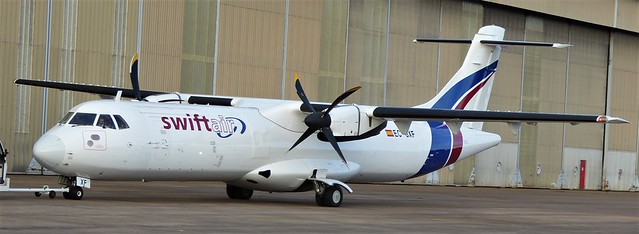
Swift AT72 near Marseille on May 4th 2026, flight control and other system issues
A Swiftair Avions de Transport Regional ATR-72-200 freighter, registration EC-JXF performing flight WT-4759 from Marseille to Paris Charles de Gaulle…
Swift B738 at Basel on Sep 30th 2025, unstable go around
A Swift Air Boeing 737-800 on behalf of DHL, registration EC-IXE performing flight QY-4908 from Brussels (Belgium) to Basel/Mulhouse…
 Fleet type match
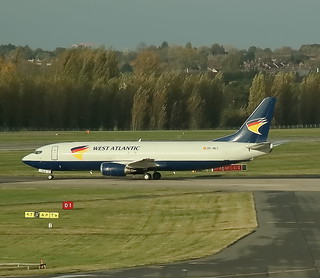
Swift B734 at Montpellier on Sep 24th 2022, overran runway on landing
A Swiftair Boeing 737-400 freighter on behalf of West Atlantic Sweden, registration EC-NLS performing flight SWN-5745 from Paris Charles de Gaulle to…
 Fleet type match
Swift AT42 at Ostrava on Oct 31st 2023, engine fire
A Swiftair Avions de Transport Regional ATR-42-300 freighter, registration EC-IVP performing flight WT-1907 from Ostrava (Czech Republic) to Cologne…
 Fleet type match
Swift AT72 at Palma Mallorca and Madrid on Feb 19th 2021, tyre damage on departure
A Swiftair Avions de Transport Regional ATR-72-212A, registration EC-LYJ performing flight from Palma Mallorca,SP to Madrid,SP (Spain) with 2 crew,…
Newest articles
 Fleet type match
Wizz Malta A21N near Bratislava on Jun 28th 2026, first officer incapacitated
A Wizz Air Malta Airbus A321-200N, registration 9H-WMC performing flight W4-1686 from Catania (Italy) to Gdansk (Poland), was enroute at FL350 north…
ULS Cargo A333 at Istanbul on Jun 30th 2026, engine failure
An ULS Airlines Cargo Airbus A330-300 freighter on behalf of THY Turkish Airlines, registration TC-GOL performing flight TK-6078 from Istanbul…
Subscribe today
Are you researching aviation incidents? Get access to AeroInside Insights, unlimited read access and receive the daily newsletter.
Pick your plan and subscribePartner

ELITE Simulation Solutions is a leading global provider of Flight Simulation Training Devices, IFR training software as well as flight controls and related services. Find out more.
SafetyScan Pro provides streamlined access to thousands of aviation accident reports. Tailored for your safety management efforts. Book your demo today
AeroInside Blog
Popular aircraft
Airbus A320Boeing 737-800
Boeing 737-800 MAX
Popular airlines
American AirlinesUnited
Delta
Air Canada
Lufthansa
British Airways