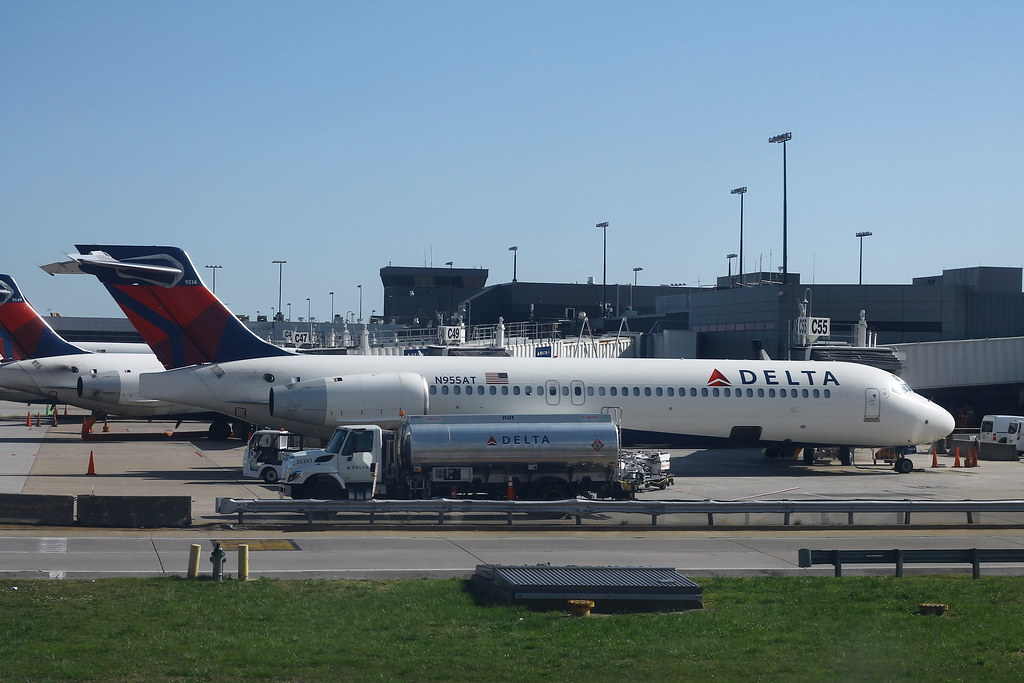
Delta B712 at Charlotte on Jun 28th 2023, landed with nose gear not extended
Last Update: May 23, 2025 / 10:36:43 GMT/Zulu time
Incident Facts
Date of incident
Jun 28, 2023
Classification
Accident
Airline
Delta Airlines
Flight number
DL-1092
Departure
Atlanta, United States
Destination
Charlotte, United States
Aircraft Registration
N955AT
Aircraft Type
Boeing 717-200
ICAO Type Designator
B712
Airport ICAO Code
KCLT
The airline reported the aircraft landed with the nose gear in its up position. The passengers deplaned onto the runway and were bussed to the terminal. There were 96 passengers and 5 crew on board (the crew reported 104 souls on board).
On Jun 28th 2023 18:13Z the NTSB announced they are investigating the occurrence stating: "NTSB investigating the runway landing of a Boeing 712 without the nose gear extended at Charlotte/Douglas International airport in Charlotte, North Carolina."
On Jul 11th 2023 the NTSB released their preliminary report writing:
The flight crew reported that when the airplane was about 2,000 ft above ground level (AGL), the first officer (FO) lowered the landing gear handle and observed the nose wheel unsafe condition light illuminate. The unsafe condition was confirmed in the configuration page of the electronic instrument system (EIS). A go-around was initiated to trouble shoot and complete the applicable checklists. A manual gear extension was attempted without success.
Delta Air Lines’ Atlanta flight control was notified via Aircraft Communication Addressing and Reporting System (ACARS), an emergency was declared with air traffic control (ATC) and the flight proceeded inbound on the ILS 36L approach. As the airplane approached 300 ft AGL, ATC notified the flight crew that the nose wheel was not visible, and a second go-around was initiated. In an effort to lower the nose wheel, multiple normal and manual landing gear extension attempts were made to no avail and the decision was made to proceed with the landing.
The airplane touched down about 1,400 ft from the runway’s threshold and the nose was lowered onto the runway at about 80 knots. The airplane stopped just before taxiway W7 and CLT airport aircraft rescue and fire fighting (ARFF) sprayed the nose wheel area with water.
The flight crew conducted the shutdown and evacuation checklists. After the fire chief verified that the area was safe, an evacuation was performed through the two forward entry doors with the passengers utilizing emergency slides.
A postaccident examination of the nose landing gear system revealed a fractured upper lock link. Due to the fractured upper lock link, the lower lock link was free to swing down to a vertical position and made contact with the nose landing gear assembly and thereby restricted its movement.
On May 23rd 2025 the NTSB released their final report and investigation docket concluding the probable causes of the accident were:
A fatigue fracture of the upper lock link that initiated along scratch features on the lower surface at the parting line of the forged aluminum component. Contributing to the accident was the overhaul facilities noncompliance with Service Bulletin 717-32-002.
The NTSB analysed:
Delta Air Lines flight 1092 was about 2,000 ft above ground level (AGL) when the flight crew lowered the landing gear handle and observed the nose wheel unsafe condition light illuminate. The unsafe condition was confirmed, and a go-around was initiated to troubleshoot and complete the applicable checklists. Multiple normal and manual landing gear extension attempts were made to no avail, and the flight crew conducted an emergency nose gear up landing. After completing the shutdown and evacuation checklists and verifying the area was safe, an evacuation was performed through the forward entry doors utilizing the emergency slides.
A postaccident examination revealed that the nose landing gear upper lock link failed from a fatigue fracture. Fatigue cracks initiated along scratch features which were observed on the lower surface at the parting line of the forged aluminum alloy component. The appearance of the scratch features was consistent with tool marks such as from filing or grinding operations. These scratch features likely acted as stress concentration areas for crack initiation. Once the fatigue cracks had propagated through approximately one-third of the material cross section, the upper lock link fractured in tensile or upward-bending overstress. Visible crack arrest marks indicated the overstress fracture may have occurred over several load cycles.
Boeing/McDonnell Douglas issued Service Bulletin 717-32-0002 on December 4, 2001, based on a reported upper lock link fracture due to tool marks and/or rough surface finish across the parting plane of the forged component. The bulletin provided instructions for eddy current inspection of the nose landing gear upper lock link assembly and modification/reidentification or installation of a new/modified assembly. The upper lock link examined was listed as an affected part in this bulletin and was marked with a “V” following the part dash number, which indicated the Service Bulletin procedures had been performed, which included a task to “verify the surface finish is 125 RMS smooth and free from any transverse manufacturing machining marks and modify as required.” A 125 RMS (root mean square) surface finish refers to a roughness average (Rq) of 125 microinches (µin) or approximately 3.2 micrometers (µm). It means the RMS average height of the discontinuities on a surface that make it 'rough' is 124 µin.
According to maintenance records, the upper lock link was delivered in February 2001 and installed on a Boeing 717 airplane. The link was removed in June/July of 2009 from the original airplane and service bulletin (SB) 717-32-002 was completed by Israel Aerospace Industries (IAI). A “V” was added to the part number per SB instructions to indicate compliance with the SB. The link remained in service for an additional 7,365 flight cycles, when it was removed with the landing gear for landing gear overhaul. After overhaul, the link was installed on N955AT in March 2014 and remained on the airplane until the accident.
A fatigue crack growth analysis was performed by counting major striation features across the fracture surface and estimated 39,059 cycles to failure which agrees well with the maintenance records of 41,257 total flight cycles accumulated on the upper lock link. Boeing indicated that the upper lock link experiences two major loads (extension/retraction) and several minor loads per flight cycle with the extension load being higher due to the gravitational force component. Assuming major fatigue striations correspond to the extension load, fatigue cracking likely initiated early in the part’s lifecycle, and the scratches were present in the as manufactured condition, therefore it is likely that the service bulletin was not adequately complied with by IAI.
Some pitting consistent with environmental attack was observed on the adjacent lower surface near the fracture origin, which may have contributed to the increased stress concentrations caused by the scratches. However, this could also be attributed to environmental/chemical exposure after the accident and/or chemical paint stripping that was performed to analyze the fracture. No other cracks were found on the lower surface parting line by fluorescent penetrant inspection. In addition, no material defects or property deficiencies were observed aside from the scratches along the forging parting line.
Metars:
KCLT 281452Z 00000KT 7SM CLR 28/17 A2998 RMK AO2 SLP157 T02830167 50009=
KCLT 281352Z VRB05KT 7SM CLR 27/17 A2998 RMK AO2 SLP157 T02670172=
KCLT 281252Z 01005KT 7SM CLR 25/17 A2997 RMK AO2 SLP153 T02500172=
KCLT 281152Z 36005KT 7SM CLR 22/17 A2995 RMK AO2 SLP147 T02220167 10222 20189 51018=
KCLT 281052Z 33004KT 7SM CLR 20/16 A2994 RMK AO2 SLP143 T02000161=
KCLT 280952Z 33005KT 7SM CLR 19/16 A2991 RMK AO2 SLP134 T01940161=
KCLT 280852Z 00000KT 8SM CLR 19/16 A2990 RMK AO2 SLP129 T01940156 55003=
Related NOTAM:
!CLT 06/252 CLT RWY 18R/36L CLSD 2306281315-2306291700
Incident Facts
Date of incident
Jun 28, 2023
Classification
Accident
Airline
Delta Airlines
Flight number
DL-1092
Departure
Atlanta, United States
Destination
Charlotte, United States
Aircraft Registration
N955AT
Aircraft Type
Boeing 717-200
ICAO Type Designator
B712
Airport ICAO Code
KCLT
This article is published under license from Avherald.com. © of text by Avherald.com.
Article source
You can read 2 more free articles without a subscription.
Subscribe now and continue reading without any limits!
Read unlimited articles and receive our daily update briefing. Gain better insights into what is happening in commercial aviation safety.
Send tip
Support AeroInside by sending a small tip amount.
Related articles
Delta A339 at Lisbon on Sep 28th 2026, unusual odour on board
A Delta Airlines Airbus A330-900, registration N429DX performing flight DL-273 from Lisbon (Portugal) to New York JFK,NY (USA), was climbing through…
 Fleet type match
Delta A333 over Atlantic on Sep 27th 2026, smoke on board
A Delta Airlines Airbus A330-300, registration N824NW performing flight DL-251 from Barcelona,SP (Spain) to Boston,MA (USA) with 296 people on board,…
 Fleet type match
Delta B763 near New York on Oct 11th 2026, engine problems
A Delta Airlines Boeing 767-300, registration N187DN performing flight DL-232 from New York JFK,NY (USA) to Naples (Italy), was climbing through…
Delta A321 at Atlanta on Oct 9th 2026, engine compressor stall
A Delta Airlines Airbus A321-200, registration N334DN performing flight DL-2050 from Buffalo,NY to Atlanta,GA (USA), was on final approach to…
 Fleet type match
Delta A319 at Minneapolis on Oct 4th 2026, landing gear situation on departure
A Delta Airlines Airbus A319-100, registration N355NB performing flight DL-2692 from Minneapolis,MN to New York JFK,NY (USA) with 120 people on…
Newest articles
 Fleet type match
ANA B738 at Okinawa on Sep 23rd 2026, engine shut down in flight
An ANA All Nippon Airways Boeing 737-800, registration JA86AN performing flight NH-1502 from Okinawa to Saga (Japan) with 158 people on board, was…
 Fleet type match
Condor A320 at Hamburg on Oct 11th 2026, hydraulic failure
A Condor Airbus A320-200, registration D-AICS performing flight DE-4178 from Hamburg to Frankfurt/Main (Germany) with 178 passengers and 6 crew, was…
Subscribe today
Are you researching aviation incidents? Get access to AeroInside Insights, unlimited read access and receive the daily newsletter.
Pick your plan and subscribePartner

ELITE Simulation Solutions is a leading global provider of Flight Simulation Training Devices, IFR training software as well as flight controls and related services. Find out more.
SafetyScan Pro provides streamlined access to thousands of aviation accident reports. Tailored for your safety management efforts. Book your demo today
AeroInside Blog
Popular aircraft
Airbus A320Boeing 737-800
Boeing 737-800 MAX
Popular airlines
American AirlinesUnited
Delta
Air Canada
Lufthansa
British Airways